Oil Sludge Treatment: Thermal Washing Technology for Oil-Contaminated Soil Remediation
Oil Sludge Treatment: Thermal Washing Technology for Oil-Contaminated Soil Remediation
Meta Description: Learn how Desen Environmental's thermal washing technology provide
Oil Sludge Treatment: Thermal Washing Technology for Oil-Contaminated Soil Remediation
Meta Description: Learn how Desen Environmental's thermal washing technology provides effective oil sludge treatment and oil-contaminated soil remediation. Modular systems from 15-100 TPH with proven field results.
Keywords: oil sludge treatment, oil contaminated soil remediation, thermal washing system, oil contaminated soil treatment machine, how to remediate oil contaminated soil, petroleum hydrocarbon remediation
Introduction
Oil sludge and oil-contaminated soil pose significant environmental challenges worldwide. From petroleum exploration and refining operations to accidental spills at industrial sites, hydrocarbon contamination threatens soil quality, groundwater resources, and ecosystem health. Zhengzhou Desen Environmental Technology Co., Ltd. (Desen Environmental) has developed advanced thermal washing technology specifically designed for oil sludge treatment and oil-contaminated soil remediation, offering a proven, cost-effective solution for contaminated site restoration.
With over three decades of equipment manufacturing experience and a dedicated focus on environmental remediation since 2010, Desen Environmental has deployed its modular thermal washing systems across numerous projects, achieving reliable results for clients ranging from oilfield operators to industrial facility owners.
Understanding Oil Sludge and Oil-Contaminated Soil
Oil-contaminated soil typically contains petroleum hydrocarbons (PHCs) including aliphatic and aromatic compounds such as C6-C9, C10-C40 fractions, benzene, ethylbenzene, polycyclic aromatic hydrocarbons (PAHs), and BTEX compounds. These contaminants can originate from:
- Crude oil spills at well sites and pipeline leaks
- Refinery and petrochemical plant operations
- Abandoned storage tank leaks
- Industrial machinery and workshop floor contamination
- Oil field drilling mud and cuttings disposal
The severity of contamination varies widely, with Desen's thermal washing equipment capable of treating soil with total petroleum hydrocarbon (TPH) content up to 50,000 mg/kg, making it suitable for the majority of oil-contaminated sites requiring remediation.
How Thermal Washing Technology Works for Oil Sludge Treatment
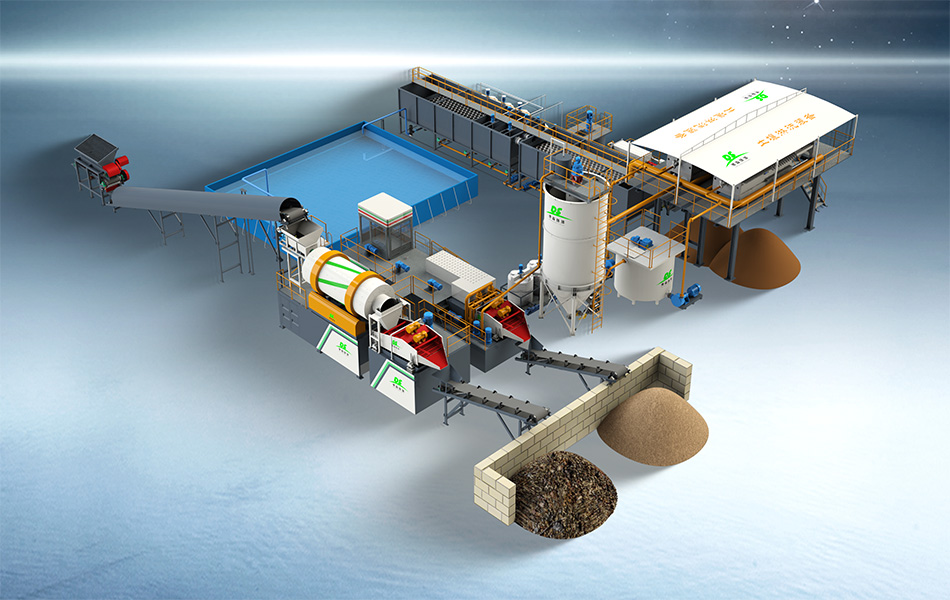
Desen's thermal washing system for oil-contaminated soil remediation follows a multi-stage process that combines physical scrubbing, chemical-enhanced washing, and solid-liquid separation to achieve thorough decontamination:
Stage 1: Feed Preparation and Screening
Excavated contaminated soil is first transported to a pretreatment area where an ALLU bucket screens and crushes oversized materials. The soil is then conveyed to the drum scrubber via a belt feeding system. Water is added at a 2.5:1 water-to-soil ratio, along with specialized washing agents that enhance hydrocarbon detachment.
Stage 2: High-Efficiency Drum Scrubbing
The core of the thermal washing process is the rotary drum scrubber, where contaminated soil undergoes intense mechanical action — lifting, tumbling, and friction — that breaks down oil-soil agglomerates and strips hydrocarbon films from particle surfaces. The scrubbing action, combined with chemical agents, effectively separates oil from solid particles.
Stage 3: Hydraulic Screening and Classification
After scrubbing, the slurry passes through a hydraulic screen where particles larger than 2 mm are separated. These oversized materials are sent for further treatment or biopile disposal. The remaining slurry, containing particles smaller than 2 mm, flows into the soaking module for deeper treatment.
Stage 4: Enhanced Soaking and Fine Classification
In the soaking module, washing agents continue to react with residual hydrocarbons. An integrated oil separation tank captures floating oil and scum, which are collected for proper disposal or recovery. The slurry then enters a secondary classification stage where fine sand (0.15-2 mm) is separated from finer mud (< 0.15 mm) using hydrocyclones and high-frequency vibrating screens.
Stage 5: Sludge Thickening and Filtration
The fine mud is directed to a deep cone thickener where PAM flocculants are added to accelerate sedimentation. The thickened slurry is then fed into a plate-and-frame filter press for dewatering. The resulting filter cake typically has low moisture content, while the filtrate water is collected for treatment and recycling.
Stage 6: Water Treatment and Recycling
All process water — including overflow from the thickener and filtrate from the press — is directed to an integrated wastewater treatment module. Through a series of sedimentation tanks, chemical reaction chambers (with PAC, PAM, and hydrogen peroxide dosing), and secondary settling, the water is treated to meet recycling standards. Over 90% of process water is recycled, significantly reducing freshwater consumption.
Key Advantages of Desen's Thermal Washing System
Modular Design for Flexibility
All components are designed as independent modules that can be quickly assembled and configured according to site requirements. A 30 TPH system occupies approximately 1,200 m2 and can be operational within 15 days of equipment arrival on site, with no concrete foundation required.
Efficient Removal of Oil Contamination
The combination of mechanical scrubbing, chemical-enhanced soaking, and multi-stage classification ensures thorough removal of petroleum hydrocarbons. The system's unique soaking and classification module integrates long-duration temperature-controlled soaking with chemical infiltration for superior decontamination.
Low Operating Cost
With total installed power under 400 kW for a 30 TPH system, actual power consumption of approximately 260 kWh per hour, and a team of only 3-4 operators per shift, the system delivers exceptional cost efficiency. Water recycling exceeding 90% further reduces operational expenses.
Intelligent Control System
The entire process is managed by a DCS (Distributed Control System) providing local one-stop control and remote multi-port real-time monitoring. All operating parameters are displayed instantly, meeting regulatory requirements for continuous data monitoring and reporting.
Proven Field Applications
Desen's thermal washing technology has been deployed in numerous oil-contaminated soil remediation projects, including:
- Ningxia Oil Hydrocarbon Contaminated Soil Remediation Project — 30 TPH capacity, treating approximately 180,000 m3 of sandy soil contaminated with petroleum hydrocarbons (C6-C9, C10-C40), benzene, ethylbenzene, benzo(a)pyrene, and chloroform. Combined soil washing with biopile remediation.
- Middle East Oil-Contaminated Soil Washing Project — 25-30 TPH capacity, treating approximately 300,000 m3 of sandy soil with average 5-8% TPH content. Integrated washing with bioremediation for comprehensive treatment.
- Abu Dhabi Oil-Contaminated Soil Remediation — DS-MSW-100 mobile soil washing system treating approximately 100,000 tons of oil-contaminated soil from oilfield operations, with average oil content of 8%. Successfully reduced TPH to below 2,000 mg/kg, meeting UAE environmental standards.
Conclusion
For organizations facing oil sludge and oil-contaminated soil challenges, Desen Environmental's thermal washing technology offers a reliable, efficient, and cost-effective remediation solution. With modular systems ranging from 15 to 100 TPH, proven field performance across diverse climates and soil types, and a commitment to environmental excellence, Desen is well-positioned to support contaminated site restoration projects worldwide.
Contact Desen Environmental to discuss how their thermal washing technology can address your specific oil sludge treatment requirements.