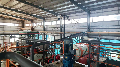
Fixed Soil Washing Plant for Contaminated Site Remediation: A Complete Technical Guide
How the Fixed Washing and Remediation Plant Works
The system follows the standard soil washing process, which is well suited to heavy metals, petroleum hydrocarbons, and complex industrial contamination. Each stage is sized to match the design throughput, usually ranging from 20 t/h to more than 100 t/h depending on project requirements.
Washing and Classification Train
- Feed preparation: contaminated soil is delivered to a hopper and pre-screened to remove oversized debris and cobbles.
- Attrition scrubbing: a rotary scrubber generates intensive particle-to-particle friction that separates contaminant films, clay lumps, and oil coatings from the sand matrix.
- Hydrocyclone classification: the slurry stream is split into coarse and fine fractions; coarse sand is dewatered by spiral classifiers and can be reused as clean fill.
- Fine particle handling: fine solids are thickened in a high-efficiency concentration tank and pressed by a plate-and-frame filter press into low-moisture filter cake for off-site disposal.
Slurry Dewatering and Water Treatment Loop
A closed-loop water system is one of the defining features of a professional fixed plant. Overflow from the deep-cone thickener and filtrate from the filter press are collected, passed through inclined-tube settling, then treated in a four-stage reaction tank equipped with mixing, aeration, and chemical dosing. The treated water returns to the washing circuit, minimizing fresh water consumption and eliminating uncontrolled discharge. Depending on the contaminant, the same circuit can be configured for heavy metal precipitation, pH adjustment, or hydrocarbon separation, giving project teams a single point of control for water quality.
Key Equipment Modules
A fixed washing and remediation plant is assembled from standardized modules that can be configured for different soil types and contaminants:
- Cylindrical attrition scrubber: high-elasticity liners increase scrubbing cycles and achieve complete separation of clay lumps and sand grains.
- High-efficiency soaking and leaching module: chemical or biological reagents promote dissolution and migration of pollutants, covering both organic and heavy metal contamination.
- Washing and beneficiation module: dewatering, medium removal, and desliming of slurry materials, with effective fine sand recovery and sludge volume reduction.
- Slurry filter press system: large processing capacity, low power consumption, 24-hour fully automatic operation, and reusable clear water.
- Water treatment module: inclined-tube sedimentation followed by multi-stage reaction tanks with dosing, mixing, and aeration before discharge or reuse.
Design Considerations for Fixed Installations
Because a fixed plant operates for years rather than weeks, engineering quality directly affects total cost of ownership. The plant should be laid out to minimize material re-handling, with gravity flow used wherever possible between washing, classification, and dewatering stages. Power supply must be sized for peak load, including the filter press and water treatment pumps. Automation is equally important: a PLC-based control system with remote monitoring allows a two-person shift to supervise the whole line, log process data, and respond quickly to feed variability. Finally, the plant should be designed for staged expansion, so additional modules can be added if the remediation scope grows.
Proven Project References
Fixed washing plants from Desen Environmental have been applied across China in demanding, large-scale remediation programs:
- A heavy metal contaminated site in Ningbo with a design capacity above 100 t/h, the first hundred-ton-per-hour contaminated site remediation plant in China.
- A chemical site and heavy metal contaminated soil treatment plant in Shandong, commissioned in 2022 at 30 t/h.
- An arsenic contaminated soil treatment plant in Guangzhou operating at 40 t/h since 2022.
- A former chemical plant site in Shanghai remediated at 90 t/h with a fixed washing and classification system.
- A chromate smelter site in Changsha processed at 90 t/h, demonstrating stable performance on chromium-laden soils.
These projects show that fixed plants are particularly effective when the site is large enough to justify permanent infrastructure and when the remediation schedule requires predictable, around-the-clock output.
Choosing a Fixed Plant vs. Mobile Equipment
The right choice depends on project geometry and duration. Fixed plants suit centralized treatment yards where contaminated soil is transported from multiple excavation zones, or where the client intends to operate a long-term soil treatment facility. Mobile and skid-mounted systems remain the better fit for dispersed sites, short campaigns, or projects requiring rapid mobilization. For many large contracts, a hybrid approach works best: mobile screening units prepare the feed while the fixed washing train handles the main treatment volume.
Conclusion
A fixed soil washing plant provides the throughput, reliability, and water management capability required by modern contaminated site remediation programs. With modular equipment design, closed-loop water treatment, and a track record of projects from 30 t/h to more than 100 t/h, Desen Environmental can deliver fixed washing and remediation systems tailored to site-specific contaminants and targets. Contact the Desen team to discuss plant sizing, process design, and project economics for your next remediation campaign.