Fly Ash Washing Technology: How MSWI Fly Ash Elution Works
Municipal solid waste incineration (MSWI) produces a fine powder residue known as fly ash that is captured from the flue gas treatment system. This material concentrates chlorides, heavy metals and trace organic pollutants, which makes it hazardous and difficult to dispose of or reuse. Fly ash washing, also called fly ash elution or water washing, has become one of the most widely applied pretreatment technologies for reducing the soluble salt and heavy metal load of MSWI fly ash before it is recycled in cement kilns, used as a construction material, or stabilized for landfill. A well-operated fly ash washing plant turns a difficult hazardous waste into a manageable, lower-risk material with a genuine reuse pathway.
Why MSWI Fly Ash Must Be Washed
MSWI fly ash typically contains high concentrations of soluble chlorides, including sodium, potassium and calcium chlorides, together with heavy metals such as lead, zinc, cadmium and chromium. If fly ash is fed directly into a cement kiln or reused in construction, the soluble chlorides can cause serious problems. Chlorides corrode kiln internals, disrupt clinker quality, and can leach back into the environment from finished products. Heavy metals, meanwhile, must be immobilized or removed to satisfy strict regulatory limits for reuse and disposal. Washing attacks both problems at once: water extraction dissolves the soluble salts, while controlled elution conditions encourage heavy metals to transfer from the solid phase into the process water, where they can be precipitated and captured.
The Multi-Stage Fly Ash Washing Process
Industrial fly ash washing is not a single rinse. It is a carefully staged elution process in which the ash is repeatedly mixed with water, scrubbed, separated and rewashed until the desired purity is reached. The number of stages depends on the chloride content of the feed and the target specification of the product.
Slurry Preparation
In the first stage, dry fly ash is dosed into a mixing tank with process water to form a consistent slurry. Precise control of the liquid-to-solid ratio is critical, because it determines the concentration of dissolved salts in each wash cycle and directly affects extraction efficiency.
Attrition Scrubbing and Extraction
The slurry then passes through scrubbing and agitation units. Attrition scrubbing generates strong particle-to-particle friction that breaks up agglomerates and exposes fresh ash surfaces to the wash water, accelerating the dissolution of soluble chlorides and the desorption of surface-bound metals. Multiple extraction stages, each followed by separation, progressively reduce the salt and metal content of the solid fraction.
Solid-Liquid Separation
After each extraction stage, the slurry is dewatered. Hydrocyclones and spiral classifiers split the stream by particle size, while a thickener concentrates the fines and a plate-and-frame filter press produces a low-moisture washed ash cake. The cake is the clean product that moves on to reuse or stabilization, while the liquid phase carries the dissolved contaminants to the water treatment circuit.
Water Treatment and Recycling
Because the process water becomes enriched with chlorides and heavy metals, it must be treated before reuse or discharge. Overflow from the thickener and filtrate from the filter press are collected, passed through inclined-tube settling, and conditioned in a series of reaction tanks where reagents are added with mixing and aeration. Metals are precipitated and removed as sludge, and the treated water is returned to the washing circuit, keeping overall water consumption low.
Key Advantages of Washing-Based Pretreatment
- Substantially reduces soluble chlorides so that washed ash can be fed to cement kilns or used in building materials.
- Shifts heavy metals from the solid ash into a concentrated water stream that can be treated with proven precipitation methods.
- Produces a washed ash cake with predictable, lower-hazard characteristics for downstream stabilization.
- Recirculates process water through an integrated treatment train, minimizing fresh water demand and discharge.
- Can be combined with chelation or solidification steps to meet strict landfill and reuse regulations.
- Uses modular, skid-mounted equipment that can be deployed quickly at existing incineration plants.
Desen's Equipment for Fly Ash Washing
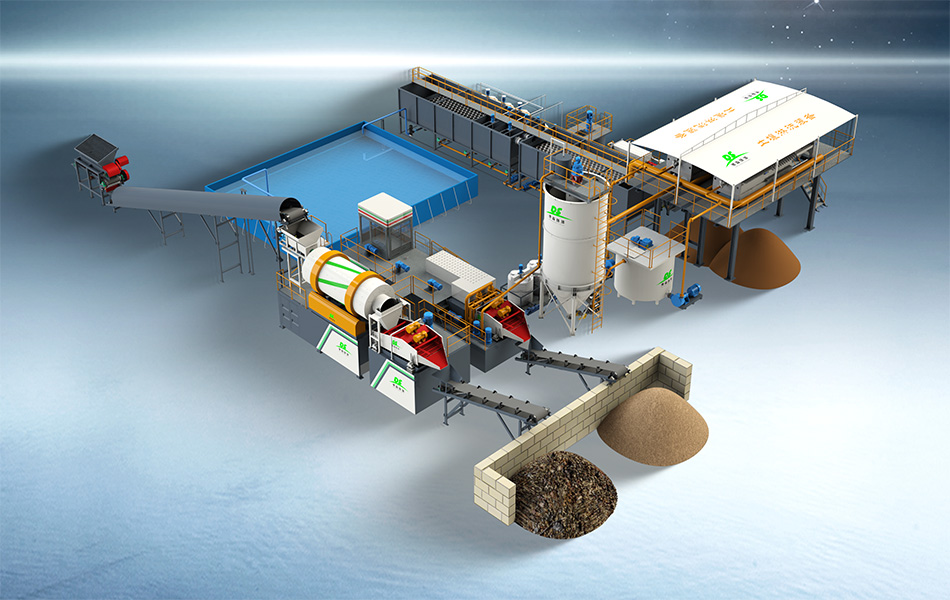
Zhengzhou Desen Environmental Technology Co., Ltd. offers the washing, classification, solid-liquid separation and water treatment modules that form the backbone of a fly ash washing plant. The mobile multistage classifying plant combines a stirring system, washing components, spiral chutes, concentrating screens and slurry pumps, and is engineered for slurry with solid particles up to 2 millimeters. The mobile solid-liquid separation plant and mobile water treatment plant close the loop, producing a dry filter cake and recyclable water on site. All systems run on a distributed control architecture with cloud-based IoT monitoring, allowing plant operators to manage the full elution sequence from a single control room.
Because the equipment is modular and containerized, it can be added to an existing incineration facility without major civil works, and scaled up as waste volumes grow. This makes the technology accessible to municipalities and waste-to-energy operators that need a robust solution without a long construction cycle.
Project Experience
Desen has extensive experience with the resource recovery and stabilization of ash and sludge materials. Reference projects include a municipal sludge and fly ash ceramsite project in Tianjin handling 100,000 cubic meters, and a 30,000 cubic meter per year sludge and fly ash ceramsite line in Huizhou. These projects demonstrate the company's ability to integrate fly ash handling, dewatering and material recycling into complete, production-ready systems that meet the needs of municipal operators and industrial partners.
Conclusion
Fly ash washing is a proven, practical route to making MSWI fly ash safe for reuse and disposal. By combining multi-stage water elution with attrition scrubbing, solid-liquid separation and integrated water treatment, operators can dramatically reduce chlorides and heavy metals, open up reuse pathways, and improve compliance with tightening environmental rules. For municipalities, waste-to-energy plants and environmental contractors evaluating fly ash treatment options, Desen provides modular washing and separation systems backed by real project experience. Contact Desen Environmental Technology at +86-371-61937711 or visit www.materialwashing.com to learn more.