Coal Gangue Washing Plant: Turning Mining Waste into Reusable Aggregate
Coal gangue is one of the largest solid waste streams generated by the coal mining industry. For every tonne of coal extracted, a significant volume of gangue rock is brought to the surface along with the coal seam. Historically, this material was simply dumped in surface stockpiles, occupying valuable land, contaminating surrounding soil and groundwater, and creating a persistent fire and safety hazard. Today, a modern coal gangue washing plant offers mining companies and industrial operators a practical route to turn this liability into a reusable aggregate, while simultaneously solving the waste management and environmental compliance problems associated with unsightly spoil heaps.
What Is Coal Gangue and Why Does It Need Washing?
Coal gangue is a dark, rock-like by-product of coal mining and coal preparation. It contains a mixture of carbon-bearing shale, sandstone, clay and other mineral matter that is rejected during the coal sorting process. While some gangue can be used directly as low-grade fill, most of it carries undesirable components that limit its value. High ash content, residual sulfur compounds, soluble salts and heavy metals mean the material cannot be reused in construction or land restoration without treatment. Washing removes fine clay coatings and contaminants from the surface of the rock particles, upgrades the mineral value, and produces a cleaner product that is far easier to market.
The washing approach is especially important for bulk solids because the contamination is largely surface-bound. Attrition scrubbing generates intense particle-to-particle friction that strips clay films, mud and weakly attached pollutants away from the gangue surface, exposing the clean mineral underneath. Once the fines and contaminants have been released into the water phase, they can be separated, concentrated and disposed of in a controlled manner, while the cleaned coarse fraction becomes a saleable aggregate.
How a Coal Gangue Washing Plant Works
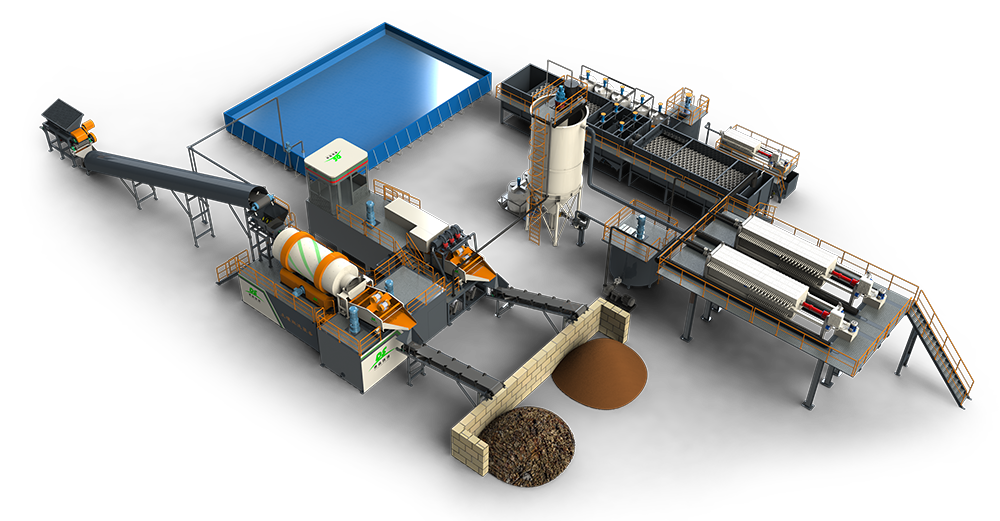
A well-designed coal gangue washing plant is built around a closed water circuit in which every stage is integrated to maximize recovery and minimize waste. Although every site is different, most systems follow the same core process train.
Pre-Screening and Crushing
Raw gangue first passes through a vibrating or drum screen to remove oversized blocks and tramp material. Where necessary, a crusher reduces the feed to a consistent top size so that downstream washing and classification equipment can operate at peak efficiency. This stage protects the scrubbing unit and prevents oversized rocks from damaging pumps and screens.
Attrition Scrubbing
The screened material enters a drum or attrition scrubber, the heart of the plant. Inside the rotating drum, particles rub against each other and against high-elasticity liners, generating the mechanical energy needed to separate mud balls, clay coatings and surface contaminants from the gangue. The result is a clean mineral surface and a slurry of fines that is sent forward for classification.
Classification and Dewatering
The scrubbed slurry is then processed through a classification circuit. Hydrocyclones and spiral classifiers separate the stream into coarse and fine fractions by particle size and density. The coarse sand is dewatered by a spiral dewatering machine or vibrating screen and stockpiled as clean aggregate, while the fine fraction is thickened in a concentration tank and fed to a plate-and-frame filter press. The filter press produces a low-moisture filter cake that can be handled and disposed of easily.
Water Treatment and Recycling
All process water is collected and returned to a treatment circuit. Overflow from the deep-cone thickener and filtrate from the filter press flow into a collection tank, pass through inclined-tube settling, and then move through a series of reaction tanks where reagents, mixing and aeration condition the water. Treated water is returned to the washing circuit, which keeps fresh water consumption low and ensures that discharge complies with local standards.
Key Benefits of a Coal Gangue Washing Plant
- Converts a costly waste stream into reusable sand and aggregate with a clear market value.
- Removes clay, mud, sulfur compounds and heavy metal coatings from the mineral surface.
- Reduces the footprint and fire risk of surface gangue stockpiles.
- Recirculates process water through an integrated treatment circuit, minimizing fresh water use.
- Produces a dry, low-moisture filter cake that simplifies disposal and transport.
- Supports mine closure and land restoration obligations under stricter environmental regulation.
Desen's Coal Gangue Washing Equipment
Zhengzhou Desen Environmental Technology Co., Ltd. designs and builds modular, mobile and fixed washing systems that are well suited to bulk solid processing such as coal gangue, mining tailings and aggregate. The core equipment line includes high-efficiency drum scrubbers, multistage classifying plants, solid-liquid separation plants and mobile water treatment plants. The Mobile Multistage Classifying Plant, for example, handles slurry with a concentrate concentration of up to 30 percent and solid particles up to 2 millimeters, and combines a stirring system, washing components, spiral chutes, concentrating screens and slurry pumps in a single mobile unit. The whole machine is controlled by a distributed control system with cloud-based IoT monitoring, so operators can follow the process from a central control room built on a hydraulic scissor platform.
Because the equipment is modular and skid-mounted, a coal gangue washing plant can be configured to match the capacity and footprint of a specific site, commissioned quickly, and relocated when a project ends. This flexibility is a major advantage for mining operations that handle multiple spoil sites over time.
Project Reference
Desen has applied this washing and classification technology across a wide range of mining and bulk material projects. In one mining tailings washing and classification project in Chengde, a mobile system processes approximately 30 tonnes per hour of mine tailings, recovering valuable mineral fractions while reducing the volume of waste that must be managed. The same scrubbing, classifying and dewatering modules used in that project are directly transferable to coal gangue processing, where the feed material and contamination mechanisms are closely related.
Choosing a Coal Gangue Washing Plant
Selecting the right washing plant depends on the feed characteristics and the target product. Operators should first have their gangue analyzed for ash content, particle size distribution, clay content and the presence of soluble contaminants. This data drives the choice of scrubbing intensity, classification cut points and dewatering capacity. Sites with tight space constraints or short project durations benefit from mobile and skid-mounted systems, while long-life operations may prefer a fixed plant with higher throughput.
Conclusion
Coal gangue is no longer an unavoidable liability for the mining industry. With a properly engineered coal gangue washing plant, the material can be upgraded into reusable aggregate, water can be recycled, and the environmental burden of spoil heaps can be substantially reduced. For mine operators, aggregate producers and environmental contractors evaluating bulk material washing solutions, Desen's modular and mobile systems provide a proven and scalable answer. Contact Desen Environmental Technology at +86-371-61937711 or visit www.materialwashing.com to discuss your coal gangue washing project.