Steel Plant Brownfield Soil Remediation: A Soil Washing Approach for Reuse-Ready Land
Former steel plants and smelting sites are among the most valuable and most challenging brownfield opportunities in industrial cities. Decades of production leave soil contaminated with heavy metals such as lead and arsenic, often alongside other industrial pollutants. Redevelopment of these sites requires remediation that meets strict cleanup criteria, fits within project schedules, and does not send the entire excavated volume to landfill. Soil washing offers a practical route to achieve this: it separates the clean coarse fraction for reuse and concentrates contaminants in a small residual stream that is easier and cheaper to manage.
This article looks at the contamination found at former steel plant sites, why soil washing fits these projects, and the results achieved at real steel and smelter remediation programs.
Contamination Patterns at Former Steel Plant Sites
Steel plants and metal smelters generate characteristic contamination that reflects decades of production and handling:
- Heavy metals, especially lead, arsenic, chromium and nickel, in soils around furnaces, rolling mills and raw material stockpiles.
- Complex multi-metal contamination where several process lines operated on the same site.
- Composite pollution that may also include petroleum hydrocarbons and other industrial chemicals.
- Dense or heterogeneous soils that make sampling and treatment planning more difficult.
Cleanup goals for these brownfields are typically set by the intended end use. Residential and sensitive redevelopment demands stricter residual limits than industrial reuse, and remediation design must be aligned with the target criteria from the start.
Why Soil Washing Fits Steel Brownfield Projects
Soil washing is well suited to former steel plant sites for several reasons:
- It is a physical separation process that does not require high temperatures or long biological treatment periods, so it fits project schedules better than thermal or bioremediation for large volumes.
- It recovers clean sand and gravel fractions that can be reused as backfill, reducing the amount of soil sent off site.
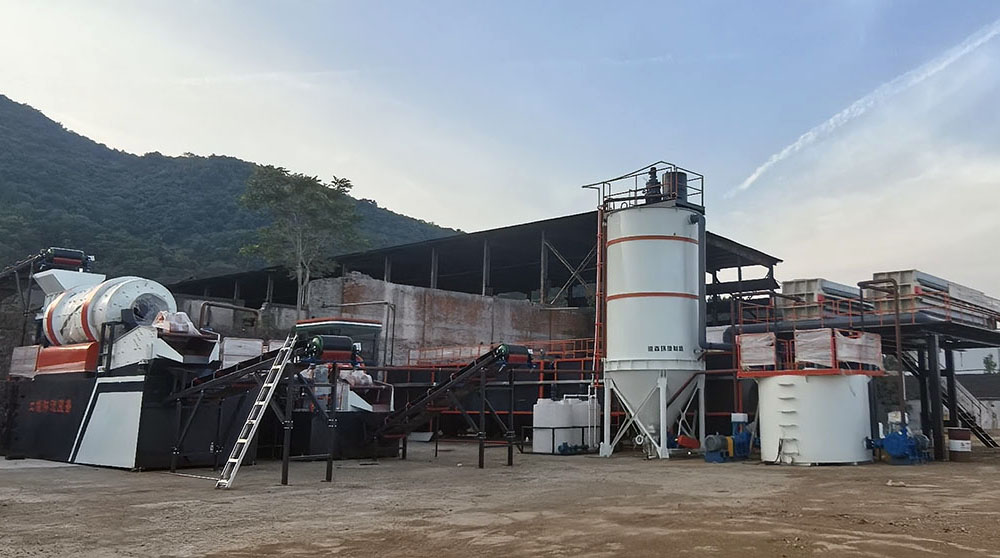
- It can be delivered as a fixed plant for large programs or as mobile and modular equipment for tighter footprints and faster mobilization.
- It integrates water treatment in a closed loop, so process water is recycled and the residual waste is concentrated into a manageable filter cake.
Reference Projects at Steel and Smelting Sites
Desen Environmental Technology has implemented soil washing at multiple steel and smelter projects. Selected references include:
- A 30 t/h soil washing project at a steel plant site in Jinan, treating lead and arsenic contamination from steel production.
- A 30 t/h chemical soil washing project in Hangzhou at the former Hangzhou Steel site (2018).
- A 90 t/h chromium salt smelter site remediation project in Changsha (2018).
- A 90 t/h smelter site remediation project in Hunan (2021).
- A 90 t/h chemical plant site remediation project in Shanghai (2018), demonstrating the approach on large industrial brownfields.
These projects range from 30 to 90 t/h and cover steel, smelter and chemical plant sites. They show that soil washing scales from medium plants to large fixed installations while handling the heavy metal contamination typical of steel brownfields.
Equipment Configurations for Steel Site Remediation
Fixed Washing and Remediation Plant
For large steel brownfields with multi-year programs, a fixed plant delivers the highest throughput and full integration of scrubbing, classification, dewatering and water treatment. Fixed installations support 24-hour automated operation and stable treatment quality over long periods.
Mobile and Modular Systems
When the contaminated area is limited, divided into several parcels, or the schedule is tight, mobile soil washing equipment is an efficient alternative. The mobile washing truck integrates feeding, washing and classification, fine sand screening and dewatering on one skid, with a nominal capacity of 30 t/h, and can move between locations quickly. Modular skid-mounted systems, now in their tenth generation, let a fixed-style process be built up progressively as the project develops.
Managing Process Water and Residual Materials
Steel plant soils often contain a significant fine fraction, so water treatment is a key part of the process. In Desen's system, thickener overflow and filter press water pass through inclined-plate settling and four reaction stages with dosing, mixing and aeration. Treated water is recycled to the washing circuit. The fine fraction is dewatered by filter press into a compact filter cake, which is smaller and cheaper to dispose of than the original contaminated soil volume.
Planning a Steel Brownfield Soil Washing Project
A successful steel brownfield remediation program typically follows these steps:
- Site investigation. Define the contamination types, concentrations and spatial distribution, and confirm the cleanup criteria for the intended land use.
- Feasibility testing. Run lab-scale soil washing tests on representative samples to confirm achievable removal rates.
- Process design. Select throughput, configuration (fixed, mobile or modular) and the water treatment and dewatering circuits.
- Delivery and operation. Mobilize the equipment, install and commission, then operate with regular monitoring of process water and output quality.
- Verification. Confirm that residual concentrations meet the target criteria and document results for the regulator and the site owner.
Conclusion
Steel plant brownfield remediation is demanding, but soil washing provides a scalable, practical solution that recovers clean material for reuse and concentrates contamination in a small waste stream. With reference projects from 30 to 90 t/h at steel, smelter and chemical plant sites, Desen Environmental Technology supports brownfield owners and contractors from feasibility testing through full-scale operation. Contact the Desen team at materialwashing.com to discuss your site.