Arsenic Contaminated Soil Remediation: How Mobile Soil Washing Delivers Reliable Results
Arsenic contaminated soil is one of the most common heavy metal problems found at former smelting plants, pesticide factories, chemical sites and industrial brownfields. Because arsenic binds strongly to fine soil particles and can migrate with dust and groundwater, it demands a treatment method that is both thorough and controllable. Soil washing has become a practical answer. It physically separates the contaminated fine fraction from clean coarse material, concentrates the pollutant into a small waste stream, and allows most of the excavated soil to be reused on site.
This article explains why arsenic contaminated soil remediation is difficult, how a soil washing plant addresses the problem, and what field results look like across projects ranging from 15 to 60 tonnes per hour.
Why Arsenic Contaminated Soil Is Difficult to Remediate
Arsenic behaves differently from many organic contaminants. It is not destroyed by heat or biological activity, and its fate in soil depends heavily on soil texture, mineralogy and redox conditions. Several characteristics make arsenic contaminated soil remediation particularly demanding:
- Arsenic is strongly adsorbed by clay, silt and iron oxide coatings, so it concentrates in the fine fraction rather than in coarse sand and gravel.
- Contamination is often unevenly distributed across the site, which makes reliable sampling and process control essential.
- Arsenic is frequently accompanied by co-contaminants such as lead, mercury, nickel and cadmium at multi-metal sites.
- Regulators typically require residual concentrations to meet strict cleanup criteria before soil can be returned to the site.
These factors rule out a one-size-fits-all approach, but they also explain why a well-designed soil washing circuit, combined with appropriate chemical and physical treatment, can produce sand and gravel fractions that meet reuse standards.
How a Soil Washing Plant Treats Arsenic Contamination
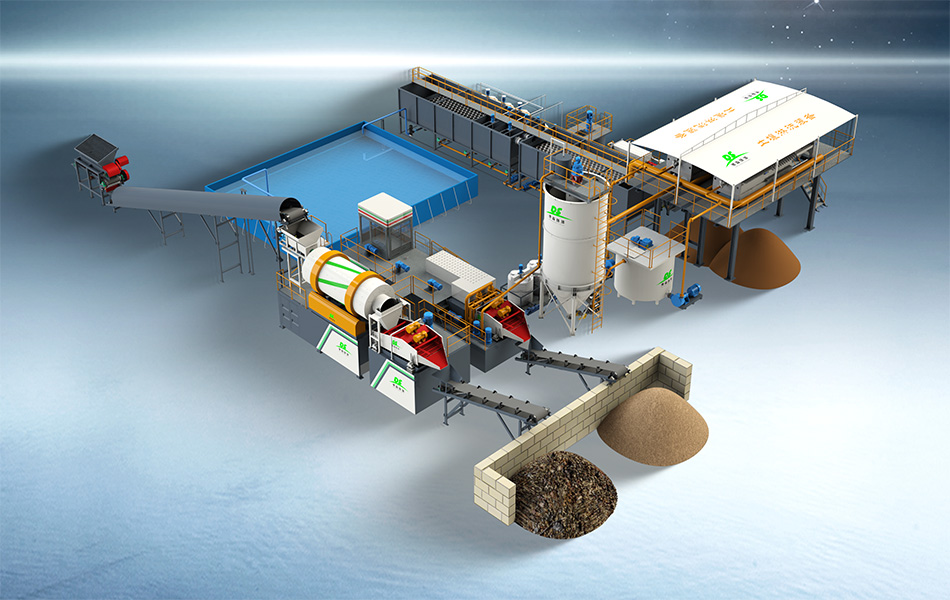
A soil washing plant uses water and mechanical energy to detach contaminants from soil particles, then classifies the material by size. The standard process developed by Desen Environmental Technology follows a consistent route:
- Feed and pre-screening. Oversize material is removed before the main treatment circuit.
- Rotary scrubbing. Contaminated soil is washed in a drum scrubber, where particle-to-particle attrition assisted by high-elasticity liners detaches clay coatings and pollutants from sand grains.
- Classification. A hydrocyclone separates the coarse and fine fractions.
- Coarse fraction recovery. Spiral classifiers dewater the clean sand and gravel, which can be reused on site.
- Fine fraction handling. The clay and silt slurry is thickened and dewatered by a filter press, producing a compact filter cake for controlled disposal.
- Water treatment. Overflow from the thickener and filter press filtrate are treated in inclined-plate settlers and reaction tanks with dosing, mixing and aeration before clean water is recycled to the washing circuit.
Physical-Chemical Enhancement for Stubborn Arsenic
Where arsenic is tightly bound to soil particles, the leaching and soaking module uses chemical or biological reagents to promote dissolution and migration of the contaminant before mechanical scrubbing. This combined physical-chemical approach has proven effective for both organic contaminants and heavy metals, including arsenic, at field scale, and is a key option when simple scrubbing alone does not reach the target concentration.
Proven Field References for Arsenic Contaminated Soil Remediation
Desen Environmental Technology has delivered arsenic remediation plants across China in both fixed and mobile configurations. The following projects illustrate the range of capacities and site conditions handled:
- A 60 t/h arsenic soil washing plant in Guangzhou treating arsenic, mercury, nickel and lead contamination (2021).
- A 40 t/h arsenic treatment plant in Guangzhou serving an arsenic-contaminated site (2022).
- A mobile soil washing truck project in Beijing applying ex-situ chemical washing to arsenic-contaminated soil.
- A 15 t/h mobile washing project in Wenzhou treating lead and arsenic in contaminated soil.
- A 40 t/h plant in North China treating lead and arsenic contamination (2021).
These references span the 15 to 60 t/h range and cover both fixed treatment plants and mobile equipment. The spread is useful because arsenic-contaminated sites are rarely identical: some are single large plots, while others involve multiple separated locations or tight project schedules.
Mobile and Modular Configurations for Arsenic Sites
For arsenic sites with limited space or fast-moving programs, mobile soil washing equipment offers clear advantages. Desen's mobile washing truck integrates material feeding, washing and classification, fine sand screening and dewatering on a single skid, with a nominal capacity of 30 t/h. It occupies a small footprint, is quick to transport between locations, and can be installed with minimal site works. Modular skid-mounted systems, now in their tenth generation of development, allow a fixed-style process to be assembled and expanded step by step as site conditions change.
When to Choose a Fixed Plant
For large, long-duration arsenic remediation programs, a fixed plant is often the right choice. Fixed installations support higher throughput, easier integration of the full water treatment and filter press circuit, and around-the-clock automated operation. Desen has completed a project exceeding 100 t/h for contaminated site remediation, demonstrating that soil washing scales to major programs.
Closed-Loop Water Treatment Reduces Risk
Water management is central to any arsenic soil washing project. The process water used in scrubbing and classification contains fine particles and dissolved constituents, and it must be treated before discharge or reuse. In Desen's system, thickener overflow and filter press water pass through inclined-plate settling followed by four reaction stages with dosing, mixing and aeration. Treated water is recycled back into the washing circuit, which reduces fresh water consumption and keeps the residual waste stream compact and manageable.
How to Select an Arsenic Soil Remediation System
Selecting the right system depends on a few basic questions:
- Contamination profile. Confirm whether arsenic is the only contaminant or is combined with lead, mercury, nickel or organic pollutants.
- Soil characteristics. The share of clay and silt, and the grain size distribution, determine how much material ends up in the fine fraction.
- Throughput and schedule. Required tonnes per hour and project duration guide the choice between mobile, modular and fixed configurations.
- Disposal routes. Local capacity for filter cake disposal and the availability of water treatment affect the overall process design.
Because every arsenic site is different, a lab-based feasibility test on representative soil samples is recommended before equipment selection. This confirms the achievable contaminant removal rate and the correct process configuration.
Conclusion
Arsenic contaminated soil remediation does not require sending an entire site to landfill. Soil washing concentrates the contamination in a small fine fraction, recovers clean sand and gravel for reuse, and treats and recycles its process water. With field references from 15 t/h mobile washing to 60 t/h fixed plants, Desen Environmental Technology offers a practical, scalable path for arsenic-contaminated sites. For site-specific advice, contact the Desen team at materialwashing.com.