Soil Washing Equipment Process Explained
How soil washing equipment works step by step: technical principles, process advantages, volume reduction and practical answers for remediation.
Soil Washing Equipment Process Explained
Most people hear "soil washing" and picture a single machine doing something mysterious with dirt. In reality it is a connected train of unit operations, each with a specific job, and the quality of the final result depends on how well those steps are balanced. Understanding the process matters because it tells you what to expect from the equipment, where the bottlenecks hide, and why two plants with the same name can perform very differently. This article walks through the soil washing equipment process step by step and explains the technical advantages that show up in real projects.
Technical Principle Behind Soil Washing
Soil washing works on a deceptively simple observation: contaminants do not distribute evenly across particle sizes. Heavy metals, petroleum hydrocarbons and many organic pollutants cling to silt and clay because those fine particles have large surface areas and high adsorption capacity. Sand and gravel, by contrast, stay comparatively clean. A soil washing plant exploits that difference by breaking up agglomerates, scrubbing the particle surfaces, and then separating the fractions so the contaminated fines can be concentrated and treated while the clean coarse material returns to useful service.
The Unit Operations in Sequence
Every soil washing equipment process starts with feed preparation. A grizzly or vibrating screen removes oversized rocks and debris, and a log washer or drum scrubber then breaks down clay lumps and releases the bound fines. From there the slurry moves to classification, where hydrocyclones, up-current classifiers or wet screens sort the material by size. The fine underflow is usually thickened and dewatered with a filter press or centrifuge, while process water loops back through a clarification system to be reused.
Technical Advantages of a Well-Designed Process
The benefits of soil washing only appear when the process is designed around the actual soil, not copied from a brochure. Done properly, the technical advantages are measurable.
Volume Reduction That Cuts Disposal Costs
In a typical project, the contaminated fines make up only 20 to 40 percent of the total soil volume. That means up to 60 to 80 percent of the excavated material can be washed, tested and reused on site instead of being trucked to a landfill. When disposal pricing is based on tonnage and hazardous classification, that volume reduction is usually the single largest cost lever in the whole remediation budget.
Closed-Loop Water and Minimal Secondary Waste
A well-configured soil washing plant recirculates process water instead of discharging it. The clarification stage settles suspended solids, and the recycled water keeps the scrubbers and cyclones running at consistent pressure. This cuts fresh water demand dramatically and avoids creating a second liquid waste stream that would need its own treatment permit.
Process Control That Improves End-Product Quality
Modern soil washing equipment gives operators control over residence time, reagent dosing and separation cut points. That control matters because soil is never uniform. When the feed changes from sandy loam to clay-rich material mid-project, the plant should be adjusted rather than left to drift. Good process design builds that flexibility in from the start.
Case Analysis: What Process Design Changed in Practice
Consider a petroleum-contaminated site where an initial equipment quote promised throughput of 40 tonnes per hour but the soil contained heavy clay pockets. The first configuration, which lacked a dedicated drum scrubber, kept clogging the hydrocyclone feed and production crawled below 15 tonnes per hour. After reconfiguring the line to add attrition scrubbing and a larger classifier, the same soil processed at over 30 tonnes per hour, and the coarse fraction met the site's target for reuse as backfill.
The lesson is not that one machine is better than another, but that the process sequence must match the soil. That is the kind of engineering judgement Zhengzhou Desen Environmental Technology Co., Ltd. brings to every project, and the company documents its process layouts and results on materialwashing.com for buyers to compare.
Frequently Asked Questions
What soil types can soil washing equipment handle?
Soil washing is most effective on sandy and silty soils where the coarse fraction is genuinely cleanable. Highly clay-bound contamination is harder and usually needs stronger scrubbing stages, which is why the feed preparation and attrition units matter so much.
Does soil washing remove all types of contaminants?
It is well suited to heavy metals, petroleum hydrocarbons, PAHs and many organic compounds, provided the contamination is attached to particles rather than dissolved or strongly absorbed in a way that resists washing. Bench-scale tests are the reliable way to confirm treatability before committing to a full plant.
How long does it take to set up a washing plant?
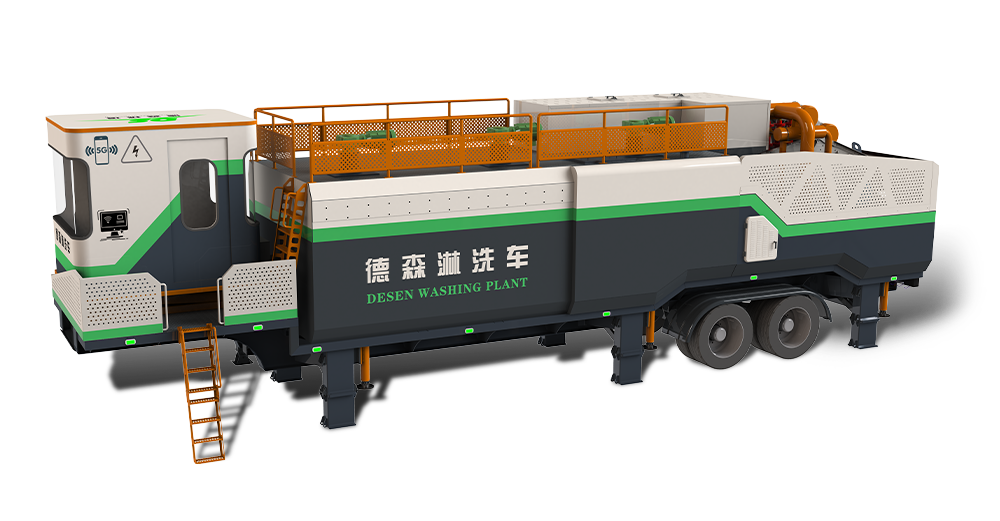
Fixed installations can take months for civil works. Containerised and modular systems from Desen Environment can be operating within weeks of arrival, which is often what makes them practical for remediation contractors working on tight schedules.
What happens to the contaminated fines after washing?
The concentrated fine fraction is usually stabilised, treated thermally, or disposed of at a licensed facility. Because the volume is a fraction of the original soil, the cost and complexity of that final step shrink accordingly.
If you are comparing soil washing equipment for a specific site, the engineering team at Desen Environment can run a treatability test on your soil sample and map the process flow to your contamination profile. Equipment specifications, process diagrams and project references are published at materialwashing.com.
上一篇:Mobile Soil Washing for Heavy Metal Soil
下一篇:没有了!