Mobile Soil Washing for Heavy Metal Soil
How mobile soil washing equipment treats heavy metal contaminated soil on site: process, field results, water use and practical answers.
Mobile Soil Washing for Heavy Metal Soil
Heavy metal contamination rarely announces itself politely. A former plating shop, an old smelter yard or an abandoned industrial lot can sit quietly for years until a developer drills a borehole and finds lead, cadmium or arsenic well above regulatory limits. The standard response used to be excavation and off-site disposal, a slow and costly shuffle of trucks that pushes the problem somewhere else. Mobile soil washing equipment changes that equation by treating contaminated soil where it lies, and in this guide we look at how it works, where it fits, and what field results actually look like.
How Mobile Soil Washing Treats Heavy Metal Soil
The principle behind soil washing is straightforward: heavy metals bind preferentially to fine particles, so the contaminant mass concentrates in the silt and clay fraction while the coarser sand and gravel stay relatively clean. A mobile washing unit exploits this by breaking soil down and separating those fractions hydraulically.
The Core Process Steps
Feed material first passes through a vibrating screen and log washer that knock off adhering fines and disperse clumps. The slurry then moves to a hydrocyclone or up-current classifier where particle size decides the split. The fine fraction, now holding most of the metal content, can be treated further with chemical extraction, while the cleaned coarse fraction is dewatered and tested. Water recirculates through a closed loop, which keeps consumption low and avoids generating a secondary liquid waste stream.
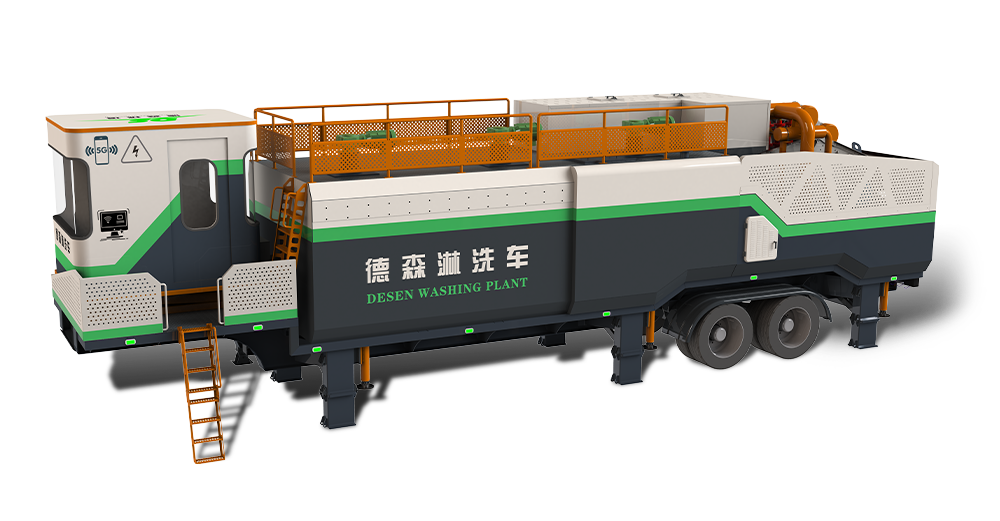
The whole train is engineered onto a trailer or skid frame, and that is what makes mobile soil washing equipment different in the field. Instead of building a permanent plant and waiting for permits, a crew rolls the unit in, connects utilities, and starts processing within days.
Why a Mobile Unit Fits Heavy Metal Sites
Mobile soil washing equipment earns its keep on heavy metal sites for reasons that go beyond convenience.
Faster Remediation Timelines
Most heavy metal cleanups run on a fixed project clock. A mobile soil washing unit removes the civil works and installation lead time that a fixed installation demands, so remediation can start while the site investigation is still wrapping up. For contractors, that compressed schedule translates directly into lower standing costs and earlier certificate of completion.
Lower Logistics Burden
On-site treatment means the soil does not leave the boundary fence. Mobile soil washing equipment eliminates haulage, tipping fees and the paperwork attached to hazardous waste manifests, which in many jurisdictions is the single largest line item in a heavy metal cleanup budget.
Flexible Across Site Sizes
Not every contaminated plot is a thousand-cubic-metre mega-site. Mobile soil washing units scale down to small, awkward parcels where a fixed plant would never pay back, and they can move on to the next location once the job is done. The same machine serves a gas station footprint this month and a former battery factory next quarter.
Case Study: Processing a Former Electroplating Site
A mid-sized electroplating facility in Southeast Asia had left behind roughly 18,000 cubic metres of soil with nickel and chromium concentrations up to four times the local intervention values. The client compared three options: dig and haul, chemical stabilisation, and mobile soil washing. What swung the decision was that the mobile soil washing equipment could be on site and producing clean material inside a month.
Desen Environment deployed a mobile soil washing plant on a 20-day mobilisation schedule. After screening and hydraulic classification, the coarse fraction accounted for nearly 70 percent of the volume and passed leachate testing on the first round. The fine fraction, about 30 percent of the volume, was further treated with a chelating reagent to pull residual nickel from the clay surface. Total treated volume met the required thresholds, and the remediated coarse material was reused on site as backfill, cutting the disposal volume to roughly one third of the original excavation scenario.
Projects like this one are documented in the case library on materialwashing.com, where Zhengzhou Desen Environmental Technology Co., Ltd. publishes treatment data and equipment configurations for public reference.
Frequently Asked Questions
What heavy metals can mobile soil washing remove?
The process is most effective for lead, cadmium, nickel, copper, zinc, chromium and arsenic when they are bound to fine particles. Performance depends on particle size distribution and the chemical form of the metal, which is why a bench-scale test is always recommended before full-scale treatment.
Is the treated soil safe to reuse?
That depends on the target criteria and local regulations. In many projects the cleaned coarse fraction is reused on-site as structural backfill, while the concentrated fines are stabilised or disposed of. Every batch should be verified by an independent laboratory before reuse.
How much water does a mobile unit consume?
Modern systems recirculate process water in a closed loop, so fresh water make-up is typically a small percentage of the throughput, often below five percent. This matters a lot on arid sites where water supply is expensive or restricted.
How fast can a mobile plant be mobilised?
Most Desen mobile soil washing systems are containerised or trailer-mounted and can start production within one to three weeks of arrival, depending on site access and utility connections.
If you are evaluating treatment options for a heavy metal contaminated site, the Desen team at Zhengzhou Desen Environmental Technology Co., Ltd. can run a treatability test on your soil and size a mobile soil washing solution around the data. More details and past project records are available at materialwashing.com.