Petroleum Hydrocarbon Contaminated Soil Remediation: Technical Approaches and Field Practice
Petroleum hydrocarbon contaminated soil remediation: washing, thermal and bioremediation approaches with field practice from Desen Environment.
Petroleum Hydrocarbon Contaminated Soil Remediation: Technical Approaches and Field Practice
Oil finds its way into soil in more ways than most people realise: a leaking tank, an old refinery plot, a pipeline spill, decades of production waste. Once petroleum hydrocarbons are in the ground, they do not simply go away. Petroleum hydrocarbon contaminated soil remediation is rarely a single-step fix, and choosing the wrong approach wastes both time and budget. The good news is that the options are better understood now than they were a decade ago, and field results are easier to compare.
How Petroleum Hydrocarbon Contaminated Soil Is Treated
Every remediation method works on one of two ideas: separate the contaminant from the soil, or break it down into harmless products. Soil washing uses water, mechanical scrubbing and sometimes a mild reagent to strip hydrocarbons off sand and gravel particles, leaving clean aggregate and a concentrated oily slurry that can be treated further. Thermal washing does the same job with heat, loosening heavy oils that water alone cannot shift. Bioremediation, by contrast, lets microbes consume the hydrocarbons over weeks or months, usually as a finishing step after washing has removed the bulk load.
Why the Contaminant Profile Decides the Process
Light fractions such as diesel respond well to washing and aeration. Heavy residues like crude or weathered sludge need heat or a chemical boost. A competent contractor characterises the soil first, maps the hydrocarbon types and concentrations, and then selects the line. Skipping this step is the most common reason projects overspend.
Technical Advantages of an Integrated Remediation Line
A single technology rarely closes a large site. The practical answer is a sequenced line where each stage cuts the problem down to size:
- Higher throughput per day. Washing plants process tens of tonnes per hour, so the schedule is driven by the excavator rather than by slow natural attenuation.
- Recovered soil stays on site. Clean sand and gravel can be reused as backfill, slashing disposal volume and haulage cost.
- Contaminants are concentrated, not diluted. The oily fines stream is small, which makes final treatment or disposal cheaper and more controllable.
- Water is recycled. Modern soil remediation equipment recirculates process water, keeping consumption low even on sites with no fresh supply.
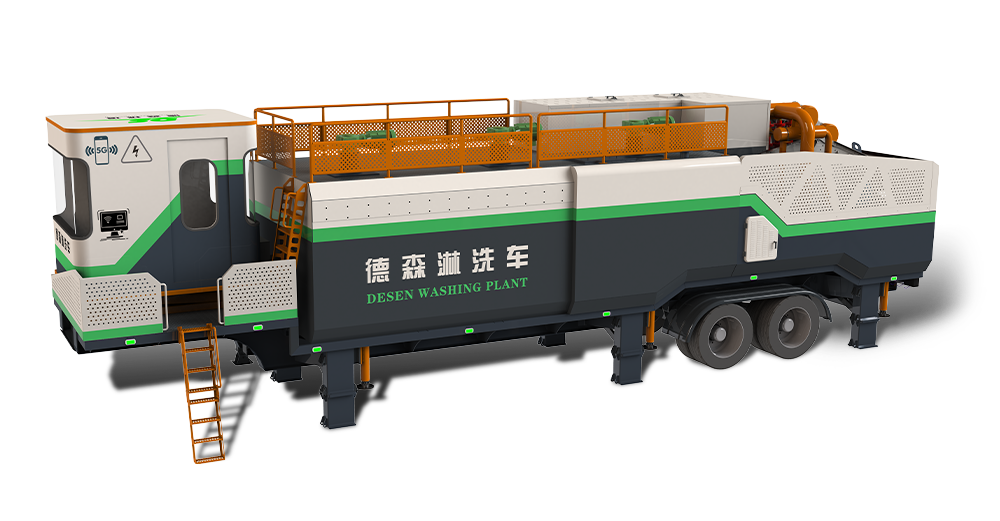
Desen Environment builds this into mobile and modular plants: the DS-MSW for scattered smaller sites, the DSLX modular system for medium to large volumes, and fixed-plus-module configurations when the project runs for years.
Field Practice: A Retired Oilfield Area, 300,000 Cubic Metres of Weathered Soil
One benchmark project in the Middle East shows what the integrated approach looks like at scale. The site was a retired oilfield area with petroleum hydrocarbon contaminated soil averaging 5-8 percent TPH, heavily weathered and bound to fine sand. The line combined mobile soil washing with a bioremediation polishing stage, running at 25-30 tonnes per hour across roughly 300,000 cubic metres of material. Washing removed the free and residual oil, and the bioremediation cells finished the job, bringing residual TPH below 100 mg/kg so the treated soil met the reuse criteria for the site. What made the difference was sequencing: wash first to shrink the workload, then let biology handle the tail. The same logic applies whether the project is a tank farm cleanup or a former refinery footprint.
Frequently Asked Questions
How long does soil remediation take on an oil-contaminated site?
It depends on the volume, the hydrocarbon mix and the target level. Washing-based lines work at tens of tonnes per hour, so bulk removal is quick; biological polishing can take several weeks. Ask the supplier for a treatment schedule based on a representative soil sample rather than a generic estimate.
Can soil washing handle heavy crude or weathered oil?
Weathered oil resists plain water washing because it has bonded to the particles. That is where thermal soil washing comes in, or a combination of washing with chemical enhancement. A lab test on your actual soil is the only reliable way to confirm the process.
Is the treated soil safe to reuse?
Reuse depends on meeting the regulator's target for the site, usually expressed as residual TPH or specific hydrocarbons. After washing and bioremediation, material that meets those limits can be used as backfill or cover. Desen Environment documents the treated fractions on every project so the acceptance criteria are clear.
Partner with Desen Environment
Desen Environment, also known as Zhengzhou Desen Environmental Technology Co., Ltd. in China, supplies soil washing plants, thermal washing systems and modular remediation lines for oil-contaminated sites worldwide. Project engineers at materialwashing.com can help you screen your soil, size the equipment and plan the remediation sequence from the first sample to final reuse.