Mobile Screening Plants for Construction and Demolition Waste: Cutting Haulage Costs on Urban Redevelopment Sites
Mobile screening plants for construction and demolition waste: how on-site size separation cuts truck movements and recycled aggregate costs.
Mobile Screening Plants for Construction and Demolition Waste: Cutting Haulage Costs on Urban Redevelopment Sites
Ask a demolition contractor what makes C&D recycling expensive and the answer is usually tipping fees. The line item that really bites is the truck. On a tight urban site, carting mixed rubble to an off-site facility and bringing clean aggregate back costs more than disposal itself, before counting the hours lost to traffic, weight limits and restricted working windows. A mobile screening plant attacks that arithmetic head-on, because it converts a transport problem into a sorting problem that can be solved inside the site fence.
What a Mobile Screening Plant Actually Does
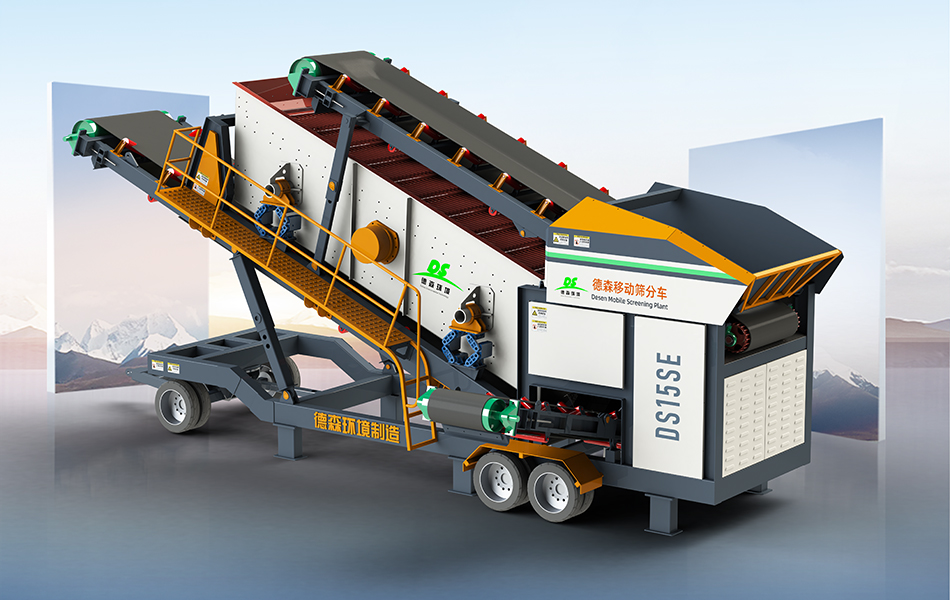
Strip away the marketing and the machine is a size-separation tool on tracks or wheels. Material goes into a hopper, gets scalped to remove oversized lumps, and passes over one or more decks that cut the flow into usable bands. A tracked unit of the size used on urban jobs will process 80 to 150 tonnes per hour, depending on aperture and moisture. Put an overband magnet on the discharge and you recover rebar before anything reaches a crusher.
- Grizzly or vibrating feeder to even out the load and protect the decks
- Two or three decks, typically cutting at 10 mm, 40 mm and 60 to 80 mm
- Overband magnet for ferrous scrap
- Side conveyors that build three or four separate stockpiles without re-handling
- Spray bars and, on dense sites, dust covers or a misting cannon
None of that is exotic. Most of the value of a mobile screening plant comes from where it stands, not from the badge on the deck. and how the products are routed, and that decision belongs to the site plan rather than the equipment catalogue.
Why Haulage, Not Tipping Fees, Decides the Budget
Take one thousand cubic metres of mixed demolition arisings, about 1,600 to 1,800 tonnes. Roughly a third is soil, mortar and fines; the rest is concrete, brick and oversize timber. On a thirty-kilometre round trip with twenty-tonne trucks and six loads a day, you are looking at several weeks of continuous traffic for material that is not, in fact, waste.
Running a mobile screening plant on site changes the flows. It needs no concrete pad and no permanent power connection, which is why it fits a redevelopment programme measured in months rather than years. Fines below 10 mm go to backfill or landscape bunds. The 10 to 40 mm band, if clean enough, replaces imported sub-base. Oversize goes to a jaw crusher and comes back through the same screen. In practice that removes 60 to 70 percent of outbound loads, and every load you do not send out is a truck, a driver and a diesel bill you do not pay. It also means far fewer vehicle movements through residential streets, which is often the difference between a permit you get and a permit you argue about.
A Field Example: Twelve Storeys in a Dense District
One project worth describing involved the demolition of a twelve-storey concrete frame on a plot of roughly forty by sixty metres, with a single access road and working hours capped between seven in the morning and seven in the evening. Total arisings came to about 26,000 tonnes.
A tracked mobile screening plant with a magnet was set up in the only free corner of the site, alongside three stockpile bays created from the first of the spoil. Nothing about the layout was generous; the plant was moved three times as demolition progressed, which is the practical argument for tracks over a static installation.
- Rebar and structural steel recovered as saleable scrap
- 0 to 40 mm recycled material used as piling mat and backfill on the same development
- Oversize recycled through a crusher rather than exported
- Roughly 1,400 fewer outbound truck movements over eleven weeks
- Noise held below the boundary limit with enclosure panels and a working-hour rule
- The mobile screening plant fed by two excavators working opposite shifts
The saving was not only financial. Fewer trucks meant less risk on a street with schools on it, and the recycled aggregate returned to the same plot instead of arriving from a quarry thirty kilometres away.
When Screening Alone Is Not Enough
Mixed arisings sometimes carry more than rubble: clay, salts, gypsum board and contaminated fines that no screen can clean. Where the recycled product has to meet a specification for chloride or sulphate content, screening and washing belong in the same line. That is where a mobile screening plant is paired with a washing module, so the 0 to 40 mm band is rinsed and dewatered before it is stockpiled. In that layout the mobile screening plant sits upstream of the wash box, and the fines it removes go straight to the water circuit. Desen Environment has delivered these combined lines for C&D and soil projects, and the configurations are documented at materialwashing.com by Zhengzhou Desen Environmental Technology Co., Ltd.
Choosing the Right Configuration
Four questions settle most of the selection, and a fifth decides whether a mobile screening plant is the right purchase at all: how many times it will move in the next three years. How much material per hour, and is the bottleneck the screen or the excavator feeding it? What product bands does the receiving specification actually want? How often will the unit move, and does the access road take a tracked machine? And is there grid power on site, because an electric drive cuts running cost on a long campaign but ties the plant to a cable. Answer those honestly and the deck configuration usually picks itself.
FAQ
What throughput does a mobile screening plant need to be worth mobilising?
A mobile screening plant earns its keep through load count rather than raw throughput. Below about 20,000 tonnes of arisings, the savings on haulage get thin unless disposal costs are unusually high. Above that, on-site processing usually pays back the mobilisation within the first few weeks.
Can it work on a tight urban plot?
Yes, with planning. A mobile screening plant on tracks needs roughly twenty by thirty metres for the machine plus stockpile space, and dust suppression is normally a permit condition rather than an option.
Does screened material always meet specification?
Not automatically. A mobile screening plant controls grading easily; cleanliness is harder, because fines and salts cling to the surface of the product. If chloride, sulphate or hydrocarbon limits apply, add a washing stage and test a batch before committing the whole output.
How fast can a mobile screening plant move between sites?
A mobile screening plant on tracks can be loading on a low-loader within a day, and be producing again on the next site within two or three days including set-up and calibration.