Heavy Metal Soil Washing Case Study: Chromium Cleanup at a Former Electroplating Site
Field case study of heavy metal soil washing at a chromium-contaminated plating site: flowsheet, mass balance and reuse of washed sand.
Heavy Metal Soil Washing Case Study: Chromium Cleanup at a Former Electroplating Site
Chromium rarely behaves the way site owners expect. In one oxidation state it locks onto clay and iron oxides and barely moves; in another it turns soluble, travels with groundwater, and refuses to stay where it was placed. That split decides whether heavy metal soil washing can reach a clean-up target at a workable cost, and it shaped nearly every decision on the project described here. The site is a former electroplating works in central China, where roughly four decades of plating baths had driven chromium into the upper two metres of silty clay. What follows is how the soil washing plant was configured, what the post-treatment numbers looked like, and which parts other heavy metal sites can borrow.
Why Chromium Contaminated Soil Is Never a Single Problem
Bench screening before mobilisation showed two very different kinds of chromium on site. Trivalent chromium, Cr(III), sat in the fine fraction, held tightly by iron and manganese oxides and by clay minerals. Hexavalent chromium, Cr(VI), showed up mainly as chromate in pore water, covered a wider footprint, and reached into the sandier layers as well. Treating the two as one contaminant would have produced an oversized plant and an oversized budget.
Particle size distribution gave the opening. Close to 70 percent of the total chromium mass sat in the fraction below 0.063 mm, even though that fraction made up only about a quarter of the soil volume. This is the classic precondition for soil washing: contamination follows the fines, while the coarse fraction stays clean enough to be separated, verified, and put back to work. Without that split, a soil washing flowsheet has nothing to exploit.
How the Washing Circuit Was Put Together
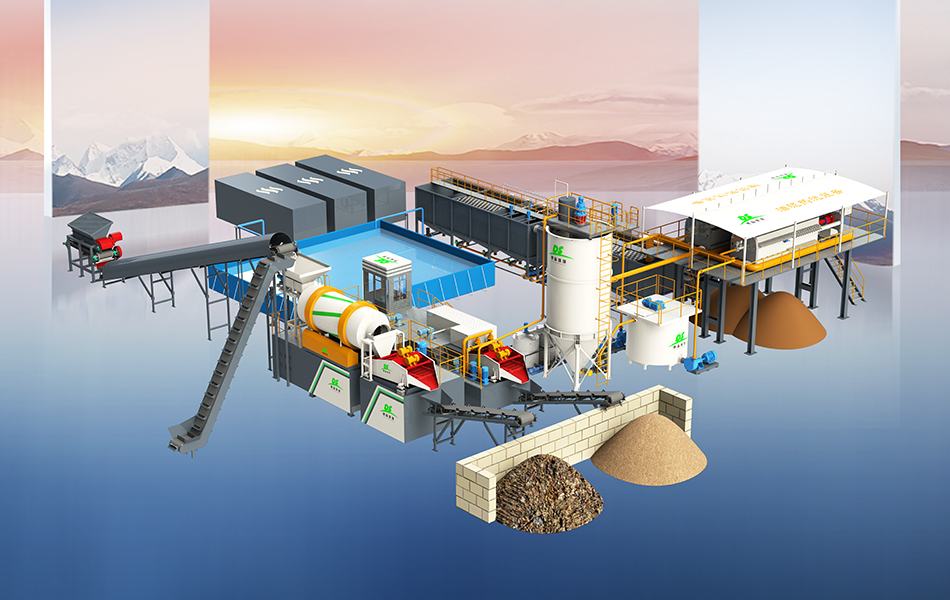
The plant was a mobile soil washing unit rated at 60 tonnes per hour, built on two trailer-mounted frames so it could be repositioned as excavation advanced across the site.
- Feed hopper with grizzly, discharging through a belt scale for a continuous mass balance
- Rotary trommel with high-pressure spray bars to break down agglomerated clay
- Attrition scrubber, where the shear does the real work of stripping coatings off grain surfaces
- Two-deck vibrating screens at 2 mm and 0.2 mm, cutting the flow into three streams
- Hydrocyclone and spiral classifier to recover the fine sand
- Thickener and filter press for the fines, with process water returned to the head of the plant
Chromate in the fine slurry was reduced with sodium metabisulfite ahead of dewatering, so the filter cake leaving the soil washing plant carried the far less mobile Cr(III) form rather than the anionic one.
What the Numbers Showed
The campaign moved roughly 3,800 cubic metres of soil over six weeks of single-shift operation. Average inlet total chromium came in at 910 mg/kg against a remediation target of 250 mg/kg.
- Sand fraction above 0.2 mm: 78 mg/kg, cleared for reuse as backfill
- Fine fraction below 0.063 mm: 2,400 mg/kg, about 18 percent of feed mass, sent for controlled disposal
- Process water recycling rate: 87 percent across the campaign
- Landfill volume against a dig-and-dump option: roughly one fifth
Hauling the same 3,800 cubic metres off site would have meant well over 5,000 tonnes of truck movements out of a plot bordered by housing on two sides, in a district with restricted working hours. Soil washing cut that traffic hard and yielded a usable aggregate stream as a by-product.
Advantages That Held Up in the Field
Volume reduction is the headline, but it is rarely the whole story. On this project the economics worked because four things landed at once: disposal tonnage fell to about a fifth, clean sand replaced imported backfill, the water circuit recycled most of what it used, and the plant could be dismantled and moved to the next parcel without a construction programme. Desen Environment supplied the soil washing line and the water treatment package, with the flowsheet tuned after the bench tests rather than fixed in advance, a detail that mattered because the fines content shifted once excavation reached the southern corner of the site.
Lessons for Other Heavy Metal Sites
Three habits are worth copying. Start with a proper particle size and speciation study; without it, nobody can say whether soil washing is the right tool or an expensive detour. Run a pilot batch of several tonnes, not a jar test, because clay dispersion and screen blinding only appear at scale. Soil washing is a physical separation process first and a chemical polishing step second, and the flowsheet should read that way. Finally, plan the fines route before mobilisation, since the fine fraction is where the contamination ends up and where permits, transport and disposal capacity decide the schedule. Detailed equipment specifications and reference projects are published at materialwashing.com by Zhengzhou Desen Environmental Technology.
FAQ
Is soil washing suitable for every heavy metal?
No. It performs best when the metal concentrates in the fine fraction, as with chromium, lead, copper, zinc, nickel and arsenic in many industrial soils. Metals that spread evenly across all particle sizes, or sit mostly in a dissolved plume, usually need a different approach or a combined treatment train.
How much volume can soil washing actually remove?
On heavy metal sites, soil washing delivers 60 to 85 percent mass reduction when the fines carry the load. Sites with a high clay content sit at the lower end; sandy, granular soils with a small fine fraction can go higher.
Can the washed sand be reused?
Yes, provided it clears the agreed threshold and the local rules for reuse. On this project the sand above 0.2 mm was used as backfill on the same plot, which also removed the need to import aggregate.
How long does mobilisation take?
A trailer-mounted soil washing plant of this size typically takes two to three weeks from arrival to steady production, including assembly, commissioning and operator training.