Skid-Mounted vs Fixed Soil Washing Equipment: Selection Guide for Contaminated Site Remediation
Comprehensive guide comparing skid-mounted vs fixed soil washing equipment for contaminated site remediation. Covers selection criteria, cost analysis, case studies and engineering decision framework from Desen Environment at materialwashing.com.
Choosing between skid-mounted soil washing equipment and fixed soil washing equipment is one of the most consequential decisions in contaminated site remediation project planning. Each configuration offers distinct advantages in deployment speed, capital efficiency, operational flexibility and long-term treatment cost. The optimal choice depends on project-specific factors including site scale, treatment volume, schedule constraints, contamination profile and site ownership timeline. This article provides a systematic comparison of skid-mounted and fixed soil washing systems, outlines a practical selection framework with real-world decision criteria, and presents engineering case studies illustrating each approach. Desen Environment (郑州德森环境科技有限公司, operating globally as Desen Environment and online at materialwashing.com) manufactures both skid-mounted and fixed soil washing systems, enabling unbiased technical recommendations tailored to each project's specific requirements.
What Is Skid-Mounted Soil Washing Equipment?
Definition and Design Principles
Skid-mounted soil washing equipment refers to a pre-fabricated, modular treatment system in which all process components — feed preparation, scrubbing, classification, dewatering and water treatment — are mounted on structural steel skid frames engineered for lifting, transport and rapid site connection. The key distinguishing features of skid-mounted systems are:
- Modular skid design: each functional module is a self-contained unit mounted on a fabricated steel base frame with integral lifting eyes and fork pockets for handling.
- Integrated process train: within each skid module, all internal process piping, slurry hoses, instrumentation and electrical wiring are completed at the factory, reducing on-site installation work to external utility connections.
- Fast-track commissioning: because process piping and electrical systems are pre-tested at the factory, on-site commissioning focuses on utility hookup, process water filling and performance calibration — typically completing in 7–14 days.
- Transport-ready configuration: skid dimensions conform to standard road transport limits (typically 2.5–3.0 m wide, 6–12 m long, 2.5–4.0 m tall per module), enabling legal transport on public roads without special permits in most jurisdictions.
Typical Skid-Mounted Configuration
A standard skid-mounted soil washing train comprises five to seven process modules, each delivering a discrete function:
- Feed module: vibrating grizzly or apron feeder for controlled feed introduction and coarse oversize removal.
- Screening module: trommel screen (typically 3–10 mm aperture) for debris removal and particle size pre-classification.
- Scrubbing module: attrition scrubber (single-cell or twin-cell configuration) providing intensive particle-on-particle abrasion to disaggregate soil and remove surface-contaminant coatings.
- Classification module: hydrocyclone cluster for hydraulic size separation of fine (contaminated) and coarse (clean) fractions.
- Dewatering module: high-frequency vibrating screen with polyurethane panels for coarse fraction dewatering to 15–25 % moisture.
- Water treatment module: flocculation, settling and clarification system for process water recycling.
- Chemical dosing module (optional): acid leaching, chelant or surfactant dosing skid for chemically enhanced removal of specific contaminants.
What Is Fixed Soil Washing Equipment?
Definition and Design Principles
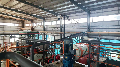
Fixed soil washing equipment refers to process systems installed permanently within dedicated civil structures — typically enclosed buildings or purpose-built facilities — with foundations, structural supports, permanent piping, fixed electrical infrastructure and integrated environmental control systems. Fixed installations are designed for long-term continuous operation at a single location.
- Permanent civil construction: concrete foundations, structural steel frames, enclosed building with roof and walls, climate control and industrial ventilation systems.
- Permanent utility connections: fixed piping networks for process water, compressed air and effluent discharge; dedicated electrical switchgear and motor control centers.
- Integrated environmental systems: baghouse dust collectors, mist eliminators, odor control systems and full containment of process areas.
- Custom engineered configuration: fixed installations can accommodate non-standard equipment dimensions, complex multi-stage process flows and oversized components that exceed transport limitations.
Skid-Mounted vs Fixed: Five Core Advantages of Skid Systems
1. Rapid Deployment
The most decisive advantage of skid-mounted systems is deployment speed. Skid-mounted soil washing equipment typically achieves first-production within 7–14 days of on-site arrival. Fixed plant construction — including geotechnical investigation, foundation engineering, structural fabrication, equipment installation, piping and electrical work, and commissioning — requires 3–6 months before treatment begins. In the Chinese remediation market, where remediation contracts often charge daily rates for site supervision and engineering, and where redevelopment pressure creates hard completion deadlines, the 3–5 month schedule advantage of skid systems translates directly into cost savings that frequently exceed the capital cost difference between the two approaches.
2. Mobility and Re-Deployment Flexibility
Once a remediation project is complete, skid-mounted equipment can be relocated to the next site with minimal cost and delay. The entire train — or individual modules — is disconnected, loaded onto trucks and redeployed at a new location. Re-deployment time is typically 7–14 days. This flexibility is particularly valuable for remediation contractors managing multiple sites, environmental service companies offering mobile treatment as a contracted service, and sites requiring sequential remediation phases. Fixed equipment, by contrast, is a sunk cost at its original location. Relocation of fixed equipment requires demolition, equipment removal, transport of individual components, new foundation construction and re-installation — a process costing 20–40 % of new equipment investment and requiring 1–3 months of schedule.
3. Scalability
Skid-mounted systems offer modular scalability: processing capacity can be increased by adding parallel modules to the treatment train, or by deploying additional complete trains at the same site. For projects where treatment volume is uncertain or may change mid-project — a common scenario in environmental remediation where contamination extents are discovered progressively during excavation — skid-mounted modularity enables capacity adjustment without capital-intensive facility expansion. Fixed installations, by contrast, require civil construction modifications to expand capacity — new building sections, additional foundations and expanded utility infrastructure — a capital-intensive and time-consuming process.
4. Lower Capital Investment
Skid-mounted soil washing systems eliminate the need for concrete foundations, structural buildings, extensive on-site piping and complex electrical installations. Capital costs are typically 30–50 % lower than equivalent-capacity fixed installations. This capital efficiency is particularly valuable for:
- Projects with constrained capital budgets or financing limitations
- Projects where treatment volume or project duration is uncertain
- Emergency remediation projects requiring rapid equipment mobilization
- Small to medium remediation projects where fixed-plant economics do not justify civil construction investment
5. Reduced Site Disruption
Skid-mounted equipment operates from the ground surface on prepared aggregate pads, requiring minimal site preparation and generating no permanent civil works. Upon project completion, the site is returned to its pre-installation condition with no residual infrastructure. This is especially advantageous for urban remediation sites, where space is constrained and neighbors are sensitive to construction disruption, and for time-limited land leases, where the remediation company must restore the site at lease-end.
When Fixed Soil Washing Equipment Is the Better Choice
Long-Term High-Volume Remediation Projects
For very large remediation projects — handling volumes above 500,000 tonnes with a treatment period exceeding 24 months at a single location — fixed installations can offer lower total cost of ownership. The avoided costs of repeated skid mobilization across multiple years, combined with the ability to optimize fixed equipment for maximum throughput, can produce a compelling economic case for permanent installation. Fixed facilities also accommodate larger and more specialized equipment that may exceed transport dimensions, enabling treatment of coarse oversize materials and mixed debris streams that would require pre-processing at a skid-equipped site.
Complex Multi-Stage Treatment Requirements
Some remediation projects require complex multi-stage treatment trains that exceed the practical limits of modular skid design. Projects involving sequential physical washing, chemical leaching, advanced oxidation, thermal treatment and stabilization/solidification — all integrated into a single process train — may be more practically housed in a purpose-built facility. Fixed installations also accommodate large storage silos, extended reaction vessels and multi-effect evaporation systems that cannot be skid-mounted.
Stringent Environmental Compliance Requirements
Fixed installations offer superior capability for meeting the most stringent environmental emission standards in urban or residential settings. The enclosed building environment enables comprehensive dust control, odor management and acoustic containment — achieving air emission limits and noise thresholds that may be challenging for open-site skid operations. For sites with zero-discharge requirements, fixed installations can integrate complete wastewater recycling and evaporator systems within the facility footprint.
Selection Framework: Key Decision Criteria
Project Duration and Site Ownership Timeline
Duration is the most fundamental selection criterion. For projects shorter than 12 months at a single site, skid-mounted equipment is almost always the superior choice: the entire project may be completed within the mobilization and commissioning period of fixed equipment. For projects with 12–24 month treatment periods, both options merit evaluation; skid systems offer schedule advantage, while fixed systems may offer lower per-tonne operating cost. For projects exceeding 24 months at a single location, fixed installations begin to show economic advantage on total cost of ownership.
Treatment Volume and Throughput Requirements
Daily throughput requirements directly influence equipment selection. Skid-mounted systems in standard configuration process 20–80 tonnes per hour per train. For projects requiring 30–300 t/h throughput, multiple skid trains can be deployed in parallel. Fixed installations are designed for continuous operation at 100–500+ t/h, with the economics of scale favoring fixed equipment for projects demanding sustained throughput above 300 t/h on a single treatment line.
Contamination Profile and Treatment Complexity
Simple single-contaminant remediation — for example, lead contamination at an industrial site — is well-suited to skid-mounted washing with chemical enhancement. Complex multi-contaminant remediation — for example, mixed heavy metal and petroleum hydrocarbon contamination at a former refinery — may require sequential treatment stages that are more practically integrated in a fixed facility. Desen Environment conducts contaminant characterization and washability testing during site investigation to determine the optimal treatment approach and equipment configuration for each contamination profile.
Site Conditions and Logistics
Site access and logistics influence both the feasibility and the cost of each option. Skid-mounted equipment requires road access for truck delivery (standard-width, low-height loads) and sufficient laydown space for module offloading and positioning. Sites with restricted access — narrow urban streets, underground structures, confined industrial facilities — may require smaller skid modules or fixed installation. Fixed installations require space for civil construction equipment and materials, which may be more challenging in space-constrained urban environments.
Site Ownership and Future Use
If the remediation company or developer retains site ownership and plans long-term industrial use, a fixed installation may serve as permanent site infrastructure. If the site is being remediated for sale or redevelopment, the remediation company may prefer to avoid leaving permanent infrastructure and instead use skid-mounted equipment that is fully removed at project completion. This consideration is particularly relevant in China's industrial land transfer market, where buyers expect remediation companies to leave sites clean and free of residual infrastructure.
Engineering Case Studies
Case Study 1: Skid-Mounted System for Multi-Site Remediation Contract (Eastern China)
Project context: A national environmental remediation contractor won a framework agreement to remediate three contaminated sites in Jiangsu Province over an 18-month period: Site A (former electroplating facility, 30,000 tonnes, cadmium and chromium), Site B (abandoned chemical warehouse, 18,000 tonnes, petroleum hydrocarbons) and Site C (former metal finishing plant, 25,000 tonnes, lead and zinc). Total treatment volume: 73,000 tonnes across three sites with an 18-month program window.
Equipment selection rationale: The contractor selected a single Desen Environment skid-mounted soil washing train (capacity 40 t/h), deployed sequentially to each site. The rapid redeployment capability (8 days per relocation) enabled treatment of all three sites within the program window — something that fixed equipment could not achieve given the 3–6 month installation period per site. Total mobilization cost across three sites was CNY 1.2 million, compared with an estimated CNY 8.4 million for three separate fixed installations.
Performance results: Over 14 months of combined operation ( Sites A and B), the skid system achieved 91 % cadmium removal, 87 % chromium removal and 94 % TPH reduction, meeting GB 36600-2018 Class A standards at all three sites. Clean coarse fraction recovery averaged 68 % of excavated material, producing 49,600 tonnes of reusable backfill material and eliminating the need for clean fill import.
Case Study 2: Fixed Installation for Large-Scale Mining Remediation (Northern China)
Project context: A 65-hectare former mining and metallurgy complex in Hebei Province required remediation of 680,000 tonnes of soil contaminated with arsenic, antimony and mercury from historical ore processing operations. Project duration: 36 months. Daily throughput target: 600 t/h. Regulatory deadline: 42 months to project completion.
Equipment selection rationale: Given the 36-month treatment period, 680,000-tonne total volume and 600 t/h throughput target, the project developer commissioned a purpose-built fixed soil washing facility with three parallel 200 t/h treatment trains housed in a 3,200 m² enclosed structure. While the capital cost (approximately CNY 85 million, including civil works) was significantly higher than equivalent skid capacity, the 36-month project duration and very high throughput requirements justified the fixed installation on total cost of ownership analysis.
Performance results: The fixed facility achieved average removal rates of 94 % for arsenic, 91 % for antimony and 88 % for mercury across 30 months of continuous operation. Mean throughput was 585 t/h — 97.5 % of design capacity — reflecting the operational reliability advantages of fixed equipment. Total treatment cost per tonne was CNY 128, compared with an estimated CNY 165/tonne for skid-equivalent capacity over the same period.
Frequently Asked Questions
What is the cost difference between skid-mounted and fixed soil washing equipment?
Skid-mounted soil washing equipment typically costs 30–50 % less in capital terms than equivalent fixed installation, primarily because fixed systems require concrete foundations, structural buildings, permanent utility infrastructure and integrated environmental control systems. For a 50 t/h treatment system, skid-mounted capital cost typically ranges from CNY 8–15 million, while a fixed installation of equivalent capacity costs CNY 18–35 million including civil works. However, for long-duration projects exceeding 24 months, the per-tonne operating cost advantage of fixed equipment can partially offset this capital difference over time.
How quickly can skid-mounted soil washing equipment be deployed to a new site?
Skid-mounted deployment from Desen Environment's equipment yard to a domestic Chinese site typically requires 5–10 days for logistics and offloading. Site preparation (ground works, utility connections) and commissioning together require 7–14 days, yielding a total mobilization period of 12–24 days from equipment departure to first production run. Fixed plant construction requires 3–6 months before treatment begins.
What is the typical processing capacity of a single skid-mounted soil washing train?
A standard single-train skid-mounted soil washing system from Desen Environment processes 20–80 tonnes per hour, depending on soil type, moisture content and process configuration. Over a 10-hour operating shift, this yields 200–800 tonnes per day. Multiple parallel trains can be deployed to achieve higher throughputs — up to 200+ t/h with three parallel trains. Fixed installations are designed for continuous operation at 100–500+ t/h per train.
Can skid-mounted equipment handle mixed heavy metal and organic contamination?
Yes. Desen Environment configures skid-mounted systems for mixed contamination by adding chemical dosing modules — acid leaching for metals and surfactant/solvent washing for organic contaminants. For sites with severe organic contamination, a skid-mounted thermal desorption unit can be integrated downstream of the washing train. The modular architecture of skid-mounted systems makes process customization straightforward without civil construction modifications.
Which equipment type is better for short-term emergency remediation projects?
Skid-mounted equipment is definitively the superior choice for emergency remediation. With deployment capability of 12–24 days from order to first production, skid-mounted systems can respond to environmental emergency events — chemical spills, illegal dumping discoveries, sudden regulatory enforcement actions — within timescales that fixed installations cannot match. Desen Environment maintains a fleet of rental-ready skid-mounted soil washing modules for emergency deployment, with typical lead times of 3–7 days from order confirmation to site arrival.
Conclusion
The choice between skid-mounted and fixed soil washing equipment is fundamentally a question of project-specific economics, timeline and operational requirements rather than inherent technical superiority. Skid-mounted soil washing equipment excels in projects demanding rapid deployment, multi-site flexibility, lower capital investment and adaptability to uncertain treatment volumes. Fixed soil washing equipment delivers superior economics for large-scale, long-duration, high-throughput projects where the capital premium is justified by operational efficiency and where permanent infrastructure is aligned with site ownership strategy.
The most reliable selection methodology is a structured evaluation framework covering project duration, treatment volume, throughput requirements, contamination profile complexity, site conditions and site ownership timeline. Desen Environment's technical team provides this evaluation as a standard component of project scoping — free of charge and without obligation, drawing on operational data from over 200 soil washing projects across China and international markets. Whether your project calls for a single skid-mounted treatment train or a purpose-built fixed facility, Desen Environment (郑州德森环境科技有限公司, available at materialwashing.com) has the equipment, engineering expertise and project delivery capability to deliver optimal remediation outcomes.