Soil Pre-Screening for Remediation: Why Screening Comes First in Soil Washing
Mobile Screening Plant in Practice
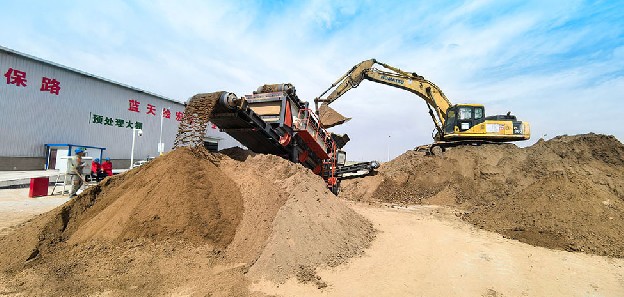
For remediation projects, mobility is often as important as capacity. Sites change, excavation faces move and temporary permits limit the footprint available for equipment. A mobile screening plant such as Desen's DS15SE addresses these constraints directly.
The DS15SE is a two-deck heavy screen mounted on a three-axle chassis that is towed by a conventional truck. Key specifications include:
- Processing capacity: 60 to 200 tonnes per hour;
- Screen decks: two layers with custom apertures from 2 cm to 6 cm;
- Maximum feed particle size: 150 mm;
- Total installed power: 28.5 kW;
- Total weight: 13,500 kg;
- Screen inclination: 14 to 20 degrees, adjustable to suit the material;
- Screening efficiency: 90% or higher.
Because the plant is fully integrated, it can be deployed on site in a short time without permanent civil works, and repositioned as the remediation area advances. Its modular, integrated structure also keeps the site footprint small, which matters on constrained urban sites.
References from the Field
Desen mobile screening plants have been applied in multiple soil remediation projects across China as the front-end pre-treatment unit of remediation lines.
Contaminated Soil Pre-Screening in Chongqing and Nanjing
In Chongqing and Nanjing, mobile screening plants were used as the pre-screening core of soil remediation production lines. The equipment performed pre-screening, impurity removal and classification of contaminated soil, preventing oversized material from blocking downstream washing machinery and stabilizing the operation of the whole line. The pre-treated feed made the subsequent remediation process continuous and efficient.
Homogenization for Bioremediation in Ningxia
In a bioremediation project in Ningxia, the requirement for feed particle size and uniformity was extremely strict. The mobile screening plant handled the entire pre-treatment task for the contaminated soil, removing oversize debris and homogenizing the soil material. By solving the problems of uneven feed and unstable remediation performance, the screening stage unlocked the efficiency of the downstream biological treatment train.
Selecting the Right Pre-Screening Equipment
When choosing a screening unit for a soil washing project, consider both the material and the project rhythm:
- Particle size range of the excavated soil and the required cut points;
- Share of oversize and abrasive material, which drives screen deck and liner selection;
- Throughput needed to match the washing plant's capacity;
- How often the machine must move between excavation areas;
- Power consumption and maintenance requirements over a long campaign.
The DS15SE can be configured with different deck apertures, making it suitable for soil remediation, mineral separation, coal processing, chemical material handling, construction aggregate screening, solid waste classification and landfill resource recovery.
Conclusion
Soil pre-screening is not an optional extra in a remediation project; it is the foundation on which the entire soil washing line depends. By removing oversize material, homogenizing the feed and separating the fine fractions, a well-specified screening stage protects downstream equipment, stabilizes throughput, reduces operating cost and improves the quality of both the treated soil and the recovered water and aggregate. For project owners and remediation contractors, investing in a capable mobile screening plant at the front of the line is one of the most reliable ways to keep a contaminated soil project on schedule and on budget.