Petrochemical Site Soil Remediation: How Soil Washing Equipment Handles Complex Contamination
Petrochemical facilities — refineries, chemical plants, tank farms and former production sites — leave behind some of the most difficult soil contamination that environmental teams face. Decades of spills, leaks, storage handling and process emissions can saturate the ground with petroleum hydrocarbons, aromatic compounds, chlorinated solvents and heavy metals. For owners, developers and regulators the question is no longer whether or not the soil must be cleaned, but how to do it safely, cost-effectively and within a realistic schedule. Soil washing equipment has become one of the most dependable answers, and Desen Environmental Technology has applied it across dozens of industrial sites in China and overseas.
Why Petrochemical Site Soil Is So Hard to Clean
Soil on petrochemical land is rarely contaminated by a single pollutant. A typical brownfield combines several challenges at once, which is why many remediation contractors regard this segment as one of the most demanding:
- Mixed organic fractions such as petroleum hydrocarbons in the C6-C9 and C10-C40 ranges, the BTEX group (benzene, toluene, ethylbenzene and xylene), polycyclic aromatic hydrocarbons including benzo(a)pyrene, and chlorinated compounds such as chloroform.
- Co-contamination with heavy metals such as lead, arsenic and chromium, each of which needs different chemical treatment and different disposal routes.
- Highly variable soil, alternating between sandy fill, clay lenses, silty layers and demolition rubble, so a single fixed process cannot treat the whole site uniformly.
- Contaminants trapped inside soil aggregates or bound to fine silt and clay particles, where simple rinsing cannot release them.
Because of this complexity, gathering soil from different excavation zones and treating it as one batch is usually a recipe for missed targets. A well-designed soil washing plant handles the variability by separating the material into fractions and treating each one according to its contamination and grain size.
How Soil Washing Equipment Works on Petrochemical Sites
Pre-screening and scrubbing
Excavated soil is first delivered through a hopper feeder, where oversized material is removed and sticky clay is broken up. The prepared soil then enters a rotary drum scrubber. Inside the drum, soil particles collide, rub and abrade one another, fracturing the clay-soil aggregates and releasing the oil films and chemical coatings that surround each grain. For soils that are heavy in clay or silt, a surfactant or washing agent can be added at this stage to improve detachment of hydrocarbons from mineral surfaces.
Classification and separation
After scrubbing, the slurry moves through hydrocyclones and dewatering screens. Coarse sand and gravel are devatered, tested and either reused on site or sent for further treatment. Fine sand between 0.15 mm and 2 mm can be separated for bio-stacking, while the finest silt and clay fraction is captured as a concentrated slurry and pumped into a thickening unit. This staged separation is exactly what makes soil washing suitable for petrochemical sites: clean material is recovered as a resource, heavily contaminated fine material is concentrated into a much smaller volume for final disposal.
Water treatment and recycling
The water used for scrubbing is not discharged after one pass. Overflow from the thickener and filtrate from the filter press flow into a water treatment module with lamella settling and staged reaction tanks, where PAC, PAM and oxidising agents remove suspended solids and organics. Treated water returns to the washing loop, which is why modern soil washing plants can recycle more than 90 percent of their process water.
Field-Proven Results in Petrochemical Environments
Desen has delivered modular, mobile and fixed soil washing plants for a wide range of petrochemical brownfields. Selected references show what the equipment can achieve under real project constraints:
- Ningxia, China: approximately 180,000 cubic metres of sandy soil contaminated with petroleum hydrocarbons, benzene, ethylbenzene, benzo(a)pyrene and chloroform, treated with a 30 t/h washing line combined with bio-piling.
- Shanghai: a former chemical plant remediated with a 90 t/h washing line processing heavily contaminated industrial fill.
- Guangdong province: chemical and heavy metal sites in Dongguan and Guangzhou cleaned with 20 to 30 t/h modular washing plants.
- Hunan province: a chemical production brownfield treated at up to 30 t/h with automated, round-the-clock operation.
Across these projects the pattern is consistent: soil washing reduces the volume of material that must be disposed of as hazardous waste, recovers clean sand and gravel, and keeps total remediation cost per tonne under control.
Choosing the Right Soil Washing Plant
Petrochemical projects vary widely in volume, contamination and schedule, so the plant configuration should follow the site. Consider the following when selecting equipment:
- Throughput: production lines can be configured from 15 to 100 t/h, with the 20 to 40 t/h range covering most medium and large brownfield projects.
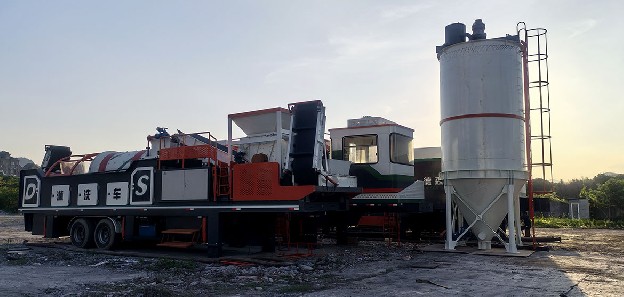
- Configuration: fixed plants suit long-term treatment centres, skid-mounted and mobile plants suit multiple excavation zones or drilling pads, and modular designs allow the line to be expanded as the project grows.
- Automation: a DCS control system with local and remote monitoring gives regulators real-time data and reduces the operating crew to just three or four people per shift.
- Water management: verify that the system includes recycling so that fresh water demand and wastewater discharge stay low.
- Footprint and energy: modular units save civil works and can be commissioned within about two weeks of arriving on site.
Conclusion
Petrochemical site soil remediation does not forgive guesswork. The contamination is complex, the volume is large and the regulatory pressure is high. Soil washing equipment addresses these demands by separating the problem into manageable fractions, concentrating the contamination, recycling process water and turning recovered sand into a usable resource. With more than a thousand references worldwide, Desen offers the engineering experience and the full range of mobile and modular systems needed to bring even the most complicated petrochemical brownfield back into service.