Modular Soil Washing for Remediation: How Compact Plants Cut Site Cleanup Timelines
Learn how modular soil washing for remediation cuts cleanup timelines, with technical principles, advantages, and real site cases from Desen Environment.
Modular Soil Washing for Remediation: How Compact Plants Cut Site Cleanup Timelines
When a contaminated site sits idle, every extra month of cleanup costs money, delays redevelopment, and keeps the risk alive. That is why project owners and environmental contractors keep asking the same question: how do you shrink the schedule without cutting corners? For many sites, the answer is a modular soil washing plant that arrives quickly, hooks up fast, and starts producing clean aggregate almost immediately. Desen Environment, based in Zhengzhou, has built its reputation on exactly this kind of practical, deployable remediation equipment, and this article walks through how modular soil washing for remediation actually shortens project timelines on real sites.
Technical Principles: How Modular Soil Washing Works
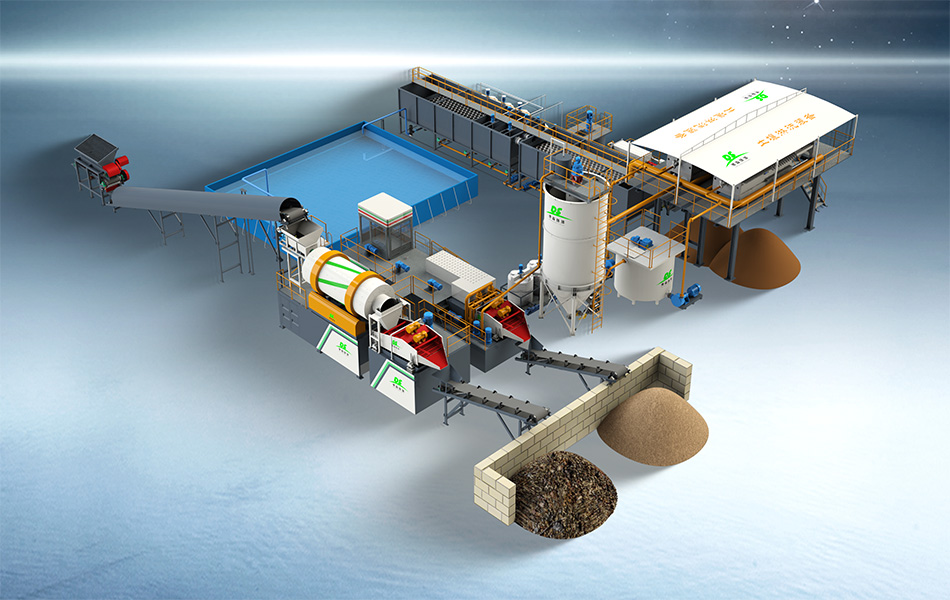
Soil washing is a physical-chemical process that separates contaminated fines from cleaner coarse fractions, then concentrates the pollution into a small volume for further treatment or disposal. A typical modular soil washing plant combines feeding, scrubbing, screening, hydrocyclone classification, and water treatment into compact units that bolt together on a prepared pad. Because each module is pre-assembled and factory-tested, the usual on-site construction work collapses into simple lifting, aligning, and connecting.
In practice, the process starts with an excavator feeding the contaminated soil into a hopper and log washer, where clay-bound contaminants are broken apart. A trommel or vibrating screen splits the material by size, and hydrocyclones recover fine sand while the sludge stream moves to a filter press. The result is a clean sand fraction that can often be returned to the excavation, and a much smaller contaminated concentrate. This principle does not change with scale; what changes is how quickly the system can be stood up, which is where modular design earns its keep.
Key Advantages of Modular Equipment on Contaminated Sites
Why does modular soil washing beat a permanently built plant for most remediation jobs? The advantages are practical rather than theoretical:
- Rapid mobilization. Modules ship on standard trailers, so a plant that treats dozens of tons per hour can be on site and commissioning within days rather than months.
- No heavy civil works. A horizontal hardened surface is enough. There is no need for deep foundations, permanent buildings, or lengthy utility runs, which removes a major source of schedule delay.
- Flexible capacity. Contractors can start with a single line and add modules as the job grows, matching throughput to the excavation rate instead of over-building.
- Fast relocation. When the site is closed out, the same modules pack up and move to the next project, spreading the capital cost across multiple campaigns.
- Simplified permitting. Because the plant is temporary and contained, many jurisdictions treat it as equipment rather than a fixed installation, shortening the approval path.
These factors combine to compress the critical path of a remediation project. Instead of waiting six months for a facility, the team starts treating soil in weeks, and that time saving is often the difference between a viable redevelopment plan and a stalled one.
Case Analysis: Modular Soil Washing in Practice
Consider a former chemical plant site in a fast-growing city where brownfield redevelopment was tied to a strict handover date. The owner evaluated fixed installations and walked away because of the lead time. Desen Environment supplied a modular soil washing and remediation plant that treated heavy-metal contaminated soil in place, with the clean sand reused as backfill on the same plot. The project kept its deadline, and the client avoided both disposal fees and the cost of importing fill material.
In another example, an oilfield remediation contractor used modular equipment across three different well sites in a single season. Between campaigns, the modules were relocated, re-tested, and recommissioned in under two weeks each time. Site managers reported that the predictable mobilization schedule let them lock in subcontractor windows without buffer days, which is a quiet but significant saving on any project budget.
These are not exceptional outcomes. They reflect a simple logic: when the equipment is the bottleneck, shrinking the equipment timeline shrinks the whole project. You can review more project details and equipment configurations at materialwashing.com, where Zhengzhou Desen Environmental Technology publishes case records and technical documents for every application line.
Frequently Asked Questions
How long does it take to install a modular soil washing plant?
For a standard system on a prepared pad, installation and commissioning typically take one to three weeks, depending on the number of modules and local logistics. Desen Environment normally provides on-site supervision and training during this phase.
Can modular soil washing handle all contaminant types?
It is most effective for heavy metals, petroleum hydrocarbons, PCBs, and other contaminants that bind to fines or can be mobilized by washing. Highly soluble or volatile compounds may need additional steps, and a treatability test is always recommended before sizing the plant.
What happens to the contaminated fines after washing?
The concentrate stream, usually a small percentage of the original volume, is dewatered with a filter press and sent for proper treatment or disposal. The clean fraction can often be reused on site, which is a major cost and sustainability win.
Is modular soil washing cheaper than building a fixed plant?
For a single campaign, almost always yes, because you avoid permanent construction and can resell or redeploy the equipment. For very long, high-tonnage operations, a fixed installation may amortize better; the right answer depends on project duration and volume.
Does Desen Environment provide pilot testing before full-scale deployment?
Yes. Zhengzhou Desen Environmental Technology runs treatability studies and offers rental or pilot systems so clients can verify performance on their own soil before committing to a full-scale modular soil washing project. It is a low-risk way to de-risk a large investment.