Petroleum Hydrocarbon Soil Washing Remediation: Recovering Oil-Contaminated Land in the Middle East
Petroleum hydrocarbon soil washing remediation separates oil from sandy soil so most of the volume can be reused on site. See the hot washing process and results from UAE and Ningxia projects.
Petroleum Hydrocarbon Soil Washing Remediation: Recovering Oil-Contaminated Land in the Middle East
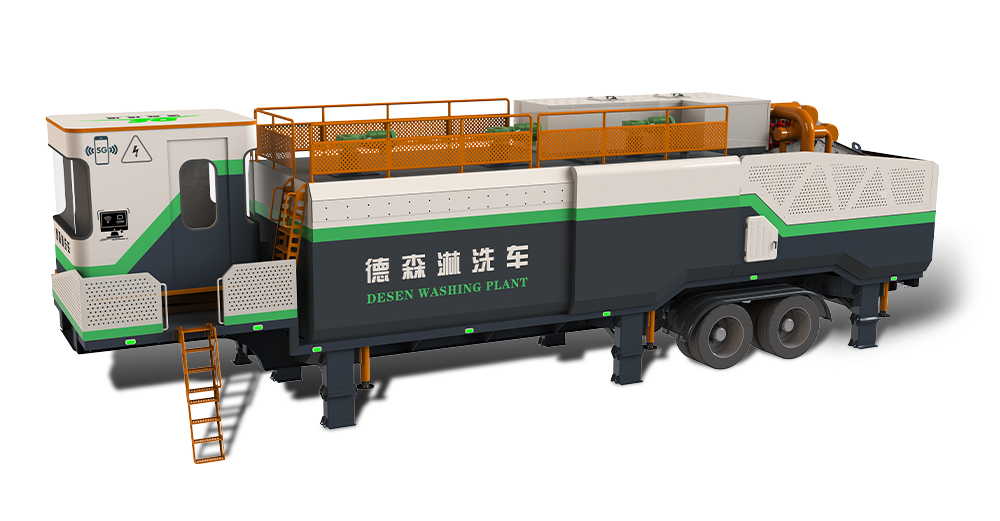
Petroleum hydrocarbon contamination is one of the most common legacy problems across the oil-producing regions of the Middle East and southern Africa. Leaked crude, drilling residues, tank bottom sludge and refinery waste leave soil that fails every reuse test, and hauling it to landfill is neither economical nor, in most jurisdictions, acceptable any more. Petroleum hydrocarbon soil washing remediation offers a different route: the contaminated soil is washed on site, the oil is concentrated into a small fraction for further treatment, and the cleaned sand and aggregate stay on the project. Desen Environmental builds both modular and mobile washing plants for exactly this application.

Why Washing Works for Petroleum Hydrocarbon Soil
Soil washing removes hydrocarbons by physical separation rather than by dilution. Oil binds strongly to fine particles such as clay and silt, while the coarse sand and gravel fraction is comparatively easy to clean. A washing plant exploits that difference: intensive scrubbing detaches oil-coated fines from the sand grains, classification separates the two streams, and the fines carry the contaminant load into a dewatering stage. On the sandy soils typical of the Gulf region, where the coarse fraction dominates, the share of soil requiring further treatment after washing is correspondingly small.
The role of hot washing
For aged or heavily emulsified sludge, Desen applies a hot washing process. Heating the wash water and dosing suitable agents destroys the emulsified structure of the oil and lowers the interfacial tension between oil and water, so the hydrocarbon disperses, demulsifies and separates from the solid surface. The recovered oil phase can be collected, and the washed solids proceed to classification. This principle has been applied in ground oil sludge, oil tank bottom sludge and aged oil sludge disposal projects in major oil fields.
Washing combined with biological polishing
Washing is rarely the whole answer on a hydrocarbon site. The usual configuration pairs the washing plant with a biopile: washing strips the bulk of the contamination from the coarse and medium fractions, while the remaining fine, oil-rich fraction goes to biological treatment, where microbes degrade the residual hydrocarbons. Both Desen reference projects described below use this combination.
The Process Flow, Stage by Stage
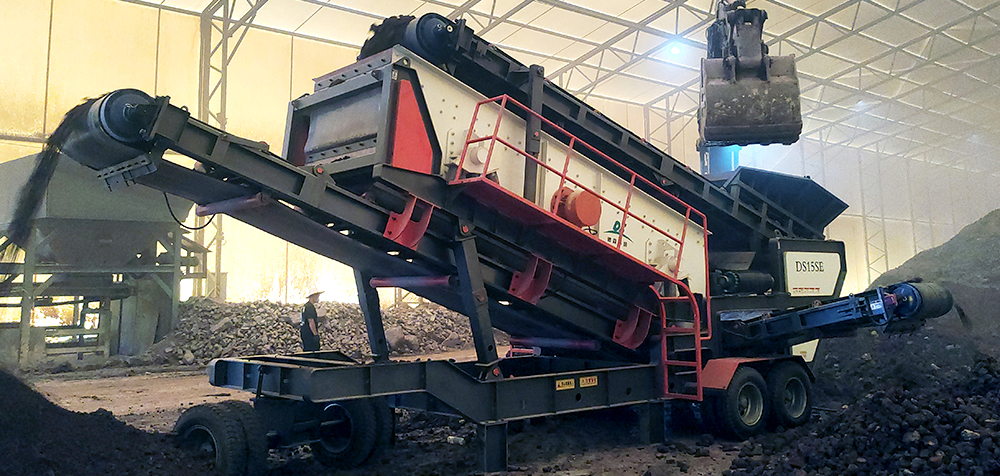
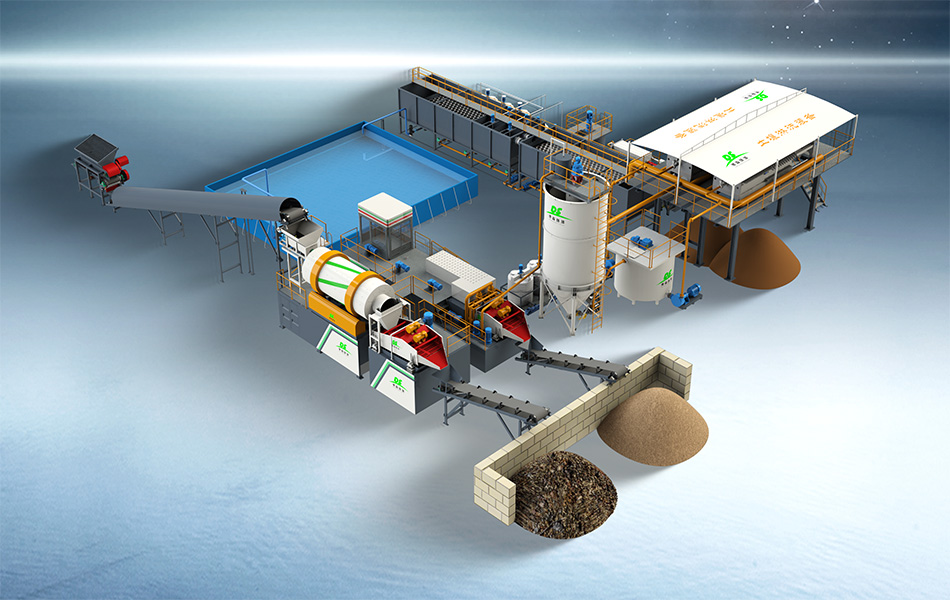
On site, the sequence starts at the excavation face. Soil is loaded into the feed hopper, prescreened to remove oversize material, and mixed with water, together with treatment agents where the contamination requires them, before it enters the scrubbing circuit.
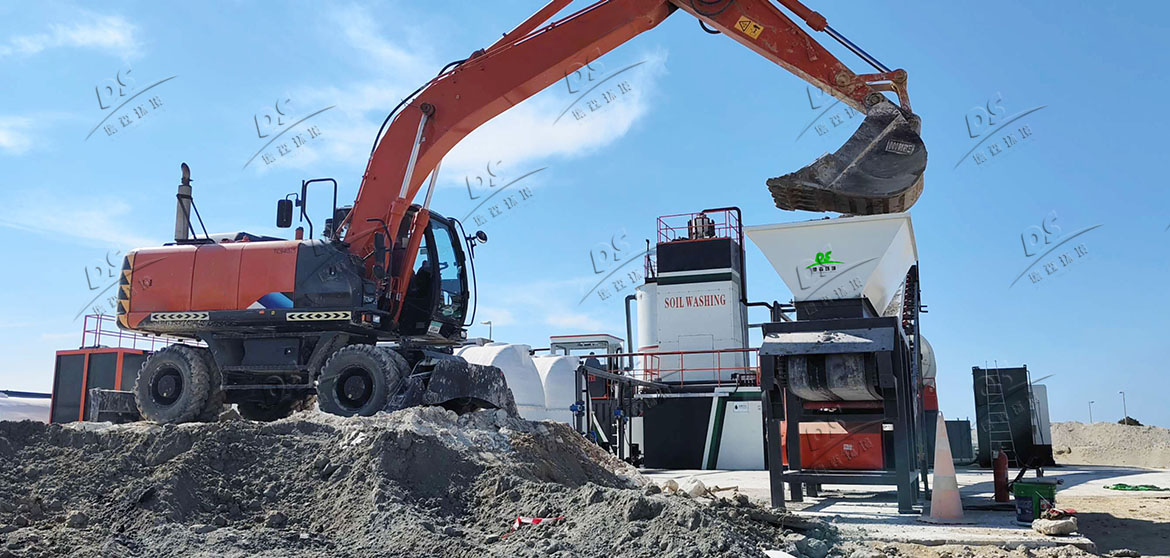
Prescreening and feeding — a bar screen removes coarse debris before the soil is metered into the washing line.
Cylinder scrubbing — the soil slurry passes through a rotating scrubber, where self-grinding and repeated abrasion detach oil-coated fines from the sand grains.
Multistage classification — particles larger than 2 mm are separated out, and a second stage grades the 0.15 to 2 mm fine sand, minimising the solid content carried in the slurry.
Flocculation and filter pressing — the fine slurry is flocculated and settled in the sedimentation tank, and the dewatered cake carries the concentrated contaminant load.
Water recycling — clarified water overflows back into the circuit, which matters in regions where fresh water is costly to produce.
Across a correctly configured line, the reduction rate of contaminated soil exceeds 80 percent: of every tonne excavated, only around 200 kilograms leaves the site as dewatered cake, while washed aggregate and sand are returned for reuse once laboratory tests confirm compliance with the project criteria.
Field Results from Two Reference Projects
Desen supplied the washing stage of a petroleum hydrocarbon soil washing project at a former refinery site in Ningxia, China. The soil carried hydrocarbons in the C6 to C40 range together with benzene and other aromatic compounds. The Desen line, rated at 30 tonnes per hour, has worked alongside a biopile on a remediation area of roughly 180,000 square metres since September 2024.
Further west, a project in the UAE treated sandy soil contaminated by landing oil, with average petroleum hydrocarbon concentrations of 5 to 8 percent. The plant ran at 25 to 30 tonnes per hour against a treatment volume of about 300,000 cubic metres, combining washing remediation with bio-remediation. Sandy soils of this kind are the standard case across the Gulf, and the same plant concept transfers directly to projects in Saudi Arabia, Kuwait and South Africa.
Before committing to any supplier, project owners should ask for a small set of verifiable items:
A feed characterisation report with particle size distribution and hydrocarbon concentration by fraction, because these two numbers determine the split between washable soil and residual cake.
A bench or pilot test on soil from the actual site, not on reference samples from elsewhere.
The water balance of the plant, including the closed loop and the expected make-up water demand per tonne.
The disposal route and volume for the dewatered cake, and whether the washed aggregate meets the reuse limits that apply at the site.
Desen Environmental, Zhengzhou Desen Environmental Technology Co., Ltd., supplies modular and mobile soil washing plants rated from 15 to 30 tonnes per hour for petroleum hydrocarbon, heavy metal and combined contamination. Project references, process descriptions and contact details are available at materialwashing.com.