Trailer Mounted Soil Washing Plant for Hire: Flexible Contaminated Soil Remediation Across Europe
Hire a trailer mounted soil washing plant for short-term contaminated soil projects in Europe. Fast mobilisation, operator support and a clear hire-to-own path from Desen.
Across Europe, many contaminated soil projects sit in an awkward middle ground: too large for simple dig-and-dump disposal, yet too short or too uncertain to justify purchasing a full washing line. A six-month remediation contract, a pilot phase ahead of a framework tender, or a seasonal workload can all leave a contractor with expensive equipment sitting idle between jobs. This is precisely where a trailer mounted soil washing plant for hire changes the economics. Renting a road-towable washing plant lets contractors process soil on site, cut disposal volumes, and keep capital free — without committing to ownership.
Why European Contractors Choose to Hire Instead of Buy
Soil washing has moved from a niche technique to a mainstream remediation method in Germany, the Netherlands, Belgium, the Nordics and the UK. But the project landscape is uneven: a single contractor may win one brownfield contract in spring, then face no comparable job for a year. Hiring responds to that uncertainty directly.
- Short-duration projects — contracts of a few months rarely repay the capital cost of a purchased plant.
- Pilot trials before framework agreements — a hired unit proves washability and volume reduction on the actual soil before a long-term investment is approved.
- Multi-site contractors — a towable plant moves between dispersed urban plots without disassembly.
- Cash-flow control at tender stage — hire converts a large capital outlay into an operating cost that scales with the awarded workload.
- Limited in-house maintenance capacity — hire agreements shift servicing and spare parts responsibility to the supplier.
For remediation consultancies bidding on public-sector tenders, another advantage matters: a hire option allows a realistic equipment line item in the bid, instead of a speculative purchase that may never be recovered.
What a Desen Trailer Mounted Washing Plant Delivers on Site
Desen Environmental's trailer mounted washing plant is built around a dual-axle chassis with hydraulic support legs, an integrated operator cabin and a compact process train: feed hopper, attrition scrubbing, screen classification and cyclone separation arranged along the trailer deck. The unit arrives road-towable behind a standard tractor unit and needs only grid power or a generator, plus a water connection, to start production.
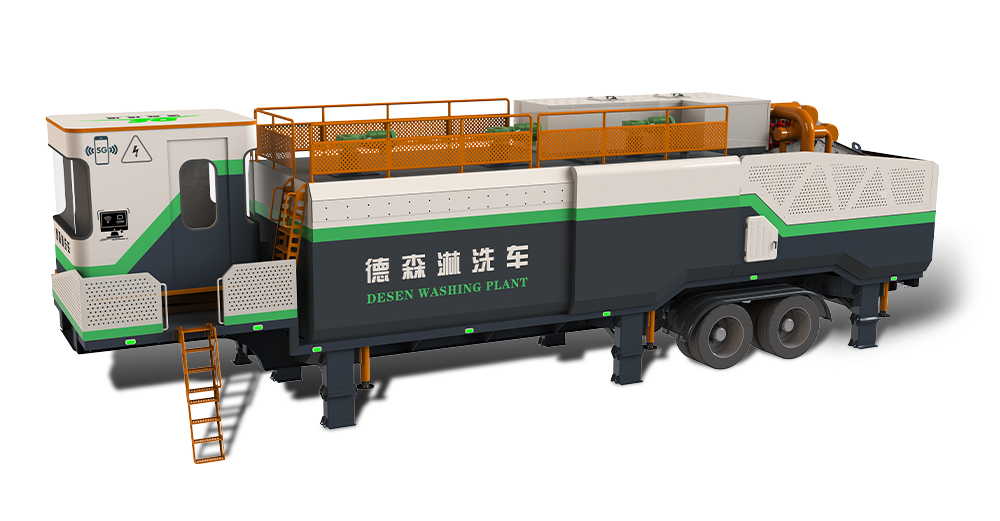
Because the process modules are pre-assembled at the factory, commissioning does not involve cranes, foundations or weeks of pipework. The plant is levelled on its hydraulic legs, connected to power and water, and can begin washing within days of arrival.
Mobilisation in Days, Not Months
On a typical hire deployment, the sequence is straightforward: the plant is towed to site, positioned on compacted ground, levelled, and linked to the water treatment loop. Desen engineers supervise the first start-up and train the contractor's operators as part of the hire package. When the project ends, the same compactness works in reverse — the unit is cleaned, hitched up and moved to the next contract, leaving the site free of permanent installations.
Washing Performance on Heavy Metal and Organic Contamination
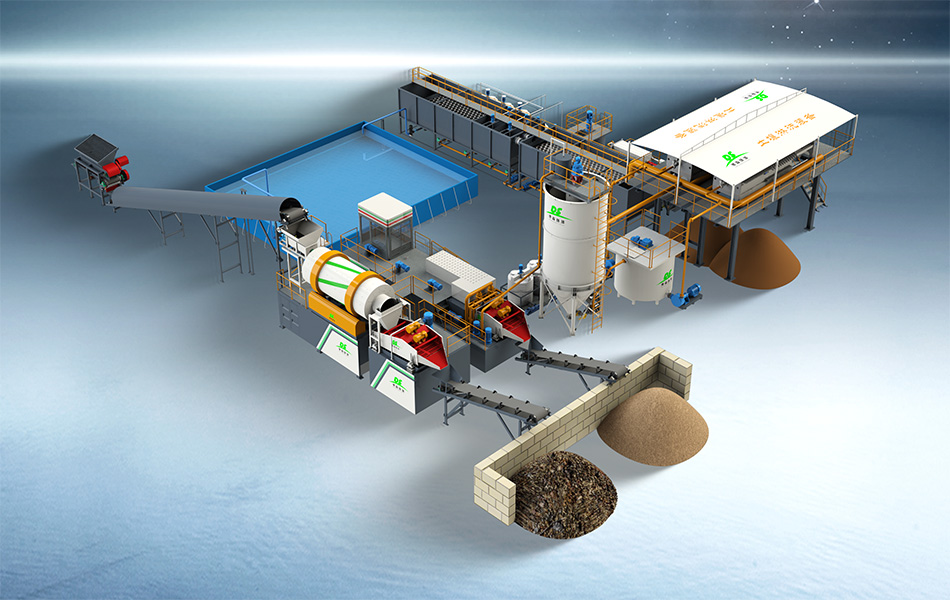
Once running, the plant applies the same process logic as a fixed installation: contaminants bound to fine fractions are liberated through attrition scrubbing, screens and hydrocyclones separate clean coarse sand and gravel from polluted fines, and the fines are dewatered for controlled disposal or further treatment. On heavy metal contaminated soils — lead, cadmium, arsenic, chromium — this classification step routinely converts a large share of the excavated volume into reusable aggregate, directly reducing landfill gate fees.
From Hire to Ownership: A Decision Path, Not a Dead End
Hiring does not close the door on ownership; in practice it is the most reliable way to size a purchase correctly. Desen structures hire agreements so that a defined portion of the rental cost can be credited against a subsequent purchase, and the operating data collected during the hire period — throughput, water consumption, volume reduction achieved on the client's actual soil — becomes the technical basis for that investment decision.
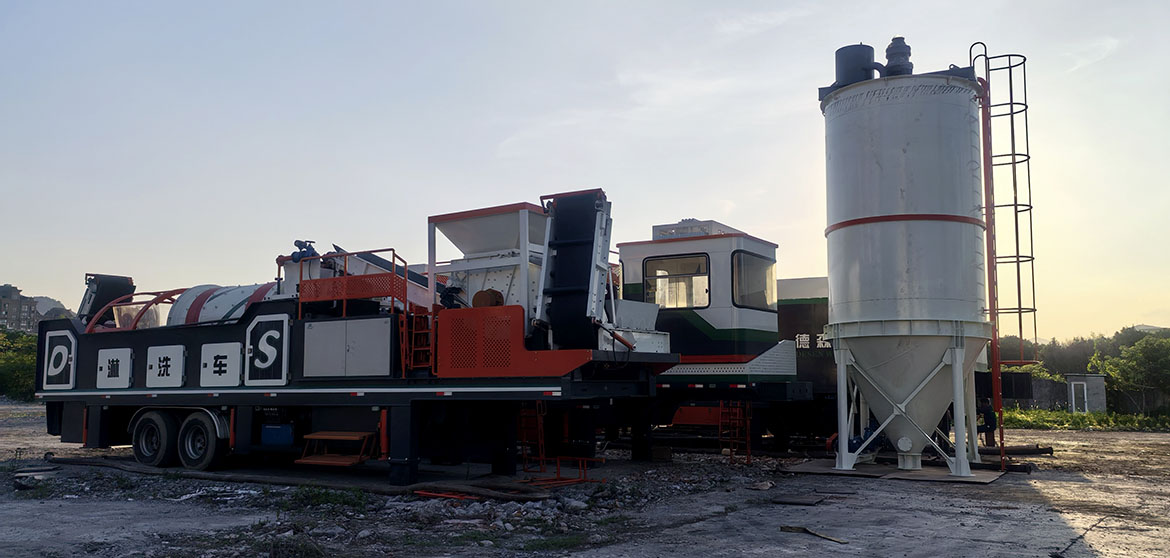
The photograph above shows Desen washing equipment deployed on a live remediation site: excavator feeding, continuous washing and dewatering running side by side. This is the same operational picture a hire customer should expect on day one.
What to Confirm Before Signing a Hire Agreement
- Soil type and throughput match — clay content, particle size distribution and target tonnage determine the correct plant configuration.
- Water management — confirm whether a closed-loop water recycling option is included, essential on urban sites with limited discharge consent.
- Operator training and supervision — clarify how many start-up days and training hours the hire covers.
- Spare parts and response time — agree in advance which consumables are stocked on site and how quickly technical support can attend.
- Transport compliance — for movement within the EU, confirm that the trailer's dimensions, axle loading and braking system meet road regulations on the planned route.
For European contractors weighing these points, Desen Environmental supplies trailer mounted soil washing plants for both hire and purchase, with commissioning support, operator training and spare parts supply from its factory in Zhengzhou, China. Sharing your soil analysis and project timeline with the engineering team is the fastest way to receive a configured proposal and a hire quotation.