Soil Washing Water Treatment: Recycling Process Water in Remediation Plants
Soil washing is an effective technology for remediating contaminated soil, but a washing plant also produces large volumes of process water that must be treated before it can be reused or discharge
Soil washing is an effective technology for remediating contaminated soil, but a washing plant also produces large volumes of process water that must be treated before it can be reused or discharged. Proper soil washing water treatment keeps the remediation line running efficiently, cuts fresh water consumption and helps projects meet environmental compliance requirements. This article explains the water treatment process used in modern soil washing plants, the recycling rates that can be achieved, and how modular water treatment equipment fits into fixed, modular and mobile remediation systems.
Why Water Treatment Matters in Soil Washing
A 30 t/h soil washing line typically uses 60 to 100 cubic metres of water per hour. Without treatment, this water would carry suspended solids, heavy metals and organic pollutants such as petroleum hydrocarbons. If the water is simply discharged, the project faces high fresh water costs and strict discharge limits. Treating and recycling the water brings clear advantages:
- Water consumption is reduced because most of the process water is recycled.
- Operating cost falls, since fresh water supply and wastewater discharge are both minimized.
- Regulatory monitoring is easier when the treatment system is automated and transparent.
- Continuous operation is possible even in arid regions where fresh water is scarce.
How the Water Treatment Process Works
In a Desen soil washing plant, the overflow from the deep cone thickener and the filtrate from the plate and frame filter press are collected in a sump. The water then flows through a multi-stage treatment train:
- Primary inclined-tube sedimentation to remove the largest suspended particles.
- Four reaction tanks with mixing and aeration, where PAC and PAM flocculants settle suspended solids and hydrogen peroxide oxidizes organic contaminants.
- Secondary inclined-tube sedimentation to polish the water.
- A clean water tank that supplies the washing circuit for reuse.
Sludge from the sedimentation tanks is pumped to a small filter press, and the filtrate is returned to the treatment system. Site wash-down water is also collected and routed to the primary settling stage, so no contaminated water leaves the remediation area.
Role of the Reagents
Three reagents play the main roles in the reaction tanks. PAC and PAM work as flocculants: they make fine suspended particles clump together so they settle faster and can be removed as sludge. Hydrogen peroxide acts as an oxidant, breaking down organic contaminants in the water. Each reaction tank is equipped with a stirring system and an aeration system to ensure the chemicals are mixed and reacted thoroughly before the water moves to the next stage.
Closed-Loop Water Circuit
The treated water is stored in a clean water tank and pumped back into the washing circuit for reuse. In this way, the whole remediation plant operates as a closed loop. The only water that leaves the system is the moisture contained in the filter cake and any final discharge after polishing, which keeps the environmental footprint of the project small.
Recycling Rate and System Design
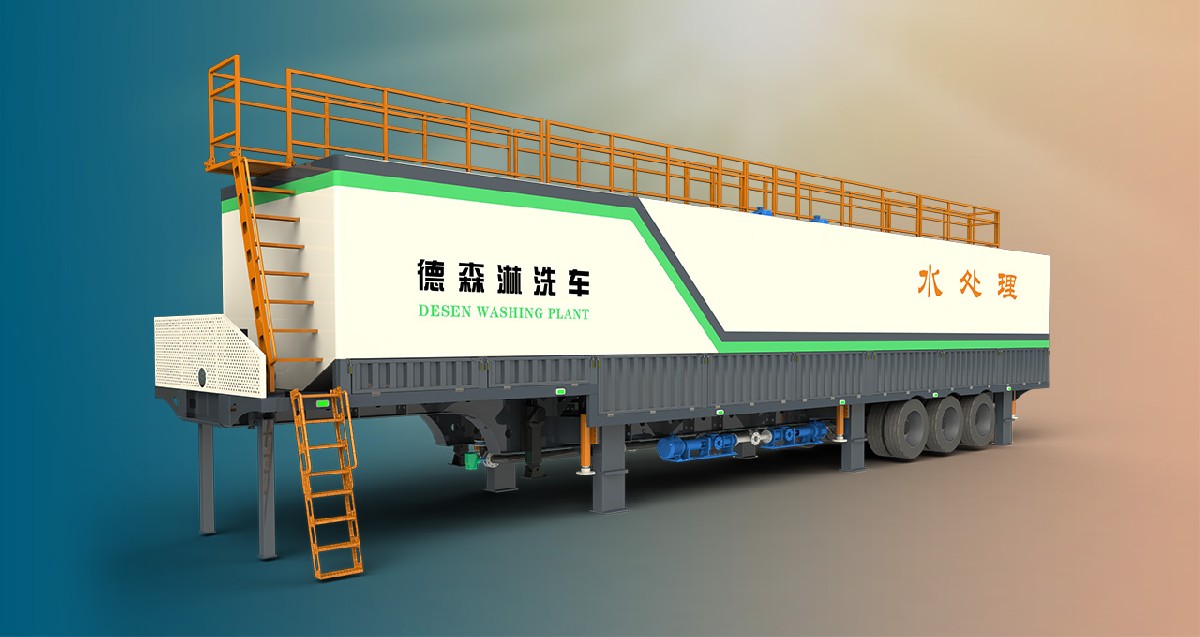
Desen's washing water treatment modules achieve a recycling rate of at least 90 percent for the whole remediation plant. The modules are compact and can be integrated with fixed, modular or mobile washing plants. For projects that need flexibility, the Mobile Water Treatment Plant combines the same treatment train in a transportable configuration, so the system can be moved between sites and commissioned quickly.
- Mobile water treatment capacity: 90 cubic metres per hour.
- Installed power: 134 kW on a three-axle trailer.
- Dimensions: 17.8 m x 3.0 m x 4.4 m, total weight about 37 tonnes.
- Standard trailer towing, with hydraulic support for quick set-up.
Integration with Fixed, Modular and Mobile Plants
The water treatment module is designed to work with every configuration of Desen washing equipment. In a fixed washing and remediation plant, the treatment train is sized to match the throughput of the line and installed beside the main process units. In a modular skid-mounted system, the water treatment units are delivered as standard modules and connected on site within the same commissioning schedule. For emergency response or multiple dispersed sites, the mobile water treatment plant provides the same capability on a trailer, so projects in different locations can share one unit and avoid duplicate investment.
Field Experience
Water recycling has been a key part of large remediation projects delivered by Desen. In the Middle East, a soil washing project treating about 300,000 cubic metres of oil-contaminated sandy soil relies on a closed-loop water circuit to operate in an arid environment. In Ningxia, China, a petroleum hydrocarbon remediation project with roughly 180,000 cubic metres of contaminated soil combines soil washing with biological treatment, with the water treatment module supporting continuous operation.
Compliance and Monitoring
Modern water treatment modules are controlled by a DCS system with local one-stop control and remote multi-port monitoring. Operating parameters are displayed in real time, which makes it straightforward to provide the monitoring data required by regulators and third-party supervisors during the remediation process. Automated dosing also reduces manual work and improves the consistency of the treatment result.
Conclusion
Soil washing water treatment is not a side process; it is essential to the economics and compliance of a remediation plant. With recycling rates above 90 percent, automated dosing and a compact modular design, Desen's water treatment systems help soil washing plants operate continuously, consume less water and meet the monitoring requirements of regulators. Contact the Desen team for a water treatment solution tailored to your remediation project.