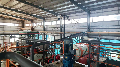
Slurry Treatment System: Modular Dewatering for Dredged and Tunnel Sludge
Municipal pipe dredging, river dredging and underground construction generate large volumes of slurry that is difficult to transport and expensive to dispose of. A modular slurry treatment system s
Municipal pipe dredging, river dredging and underground construction generate large volumes of slurry that is difficult to transport and expensive to dispose of. A modular slurry treatment system solves this problem by washing, classifying and dewatering the sludge on site, recovering clean aggregates and recycling process water. This article explains how a slurry treatment system works, which modules it contains, and how it reduces the cost of sludge disposal for municipal, construction and dredging projects.
Why Slurry Needs On-Site Treatment
Untreated slurry typically contains more than 80 percent water, which makes haulage costly and increases the burden on landfill or treatment facilities. For municipal utilities and construction contractors, transporting wet sludge is often one of the largest cost items in a dredging, sewer cleaning or tunnelling project. On-site treatment brings three immediate benefits:
- Volume reduction: solid content is separated and dewatered, so the amount of material leaving the site drops sharply.
- Resource recovery: sand and coarse aggregates are washed, classified and reused as construction materials.
- Water recycling: treated water is returned to the process, reducing fresh water consumption.
On-site treatment also shortens the disposal cycle. Instead of waiting for trucks to haul wet slurry to a landfill or treatment centre, operators can process the material continuously and send only dewatered filter cake off site. This matters in congested urban areas where truck access is limited and disposal windows are short.
Core Modules of a Slurry Treatment System
The DS-STS series slurry treatment system from Desen Environmental is built from independent modules that can be arranged according to the site conditions. A typical configuration includes the following units:
- Scrubbing module with a drum scrubber that separates clay lumps from sand and stone.
- Primary screening module for removing oversized particles.
- Soaking and classifying module where chemicals react with the slurry and fine sand is recovered.
- Deep cone thickening module for slurry concentration.
- Solid-liquid separation module with a plate and frame filter press.
- Water treatment module that cleans the filtrate for reuse.
- Electrical control module with DCS and 5G cloud monitoring.
Scrubbing and Pre-treatment
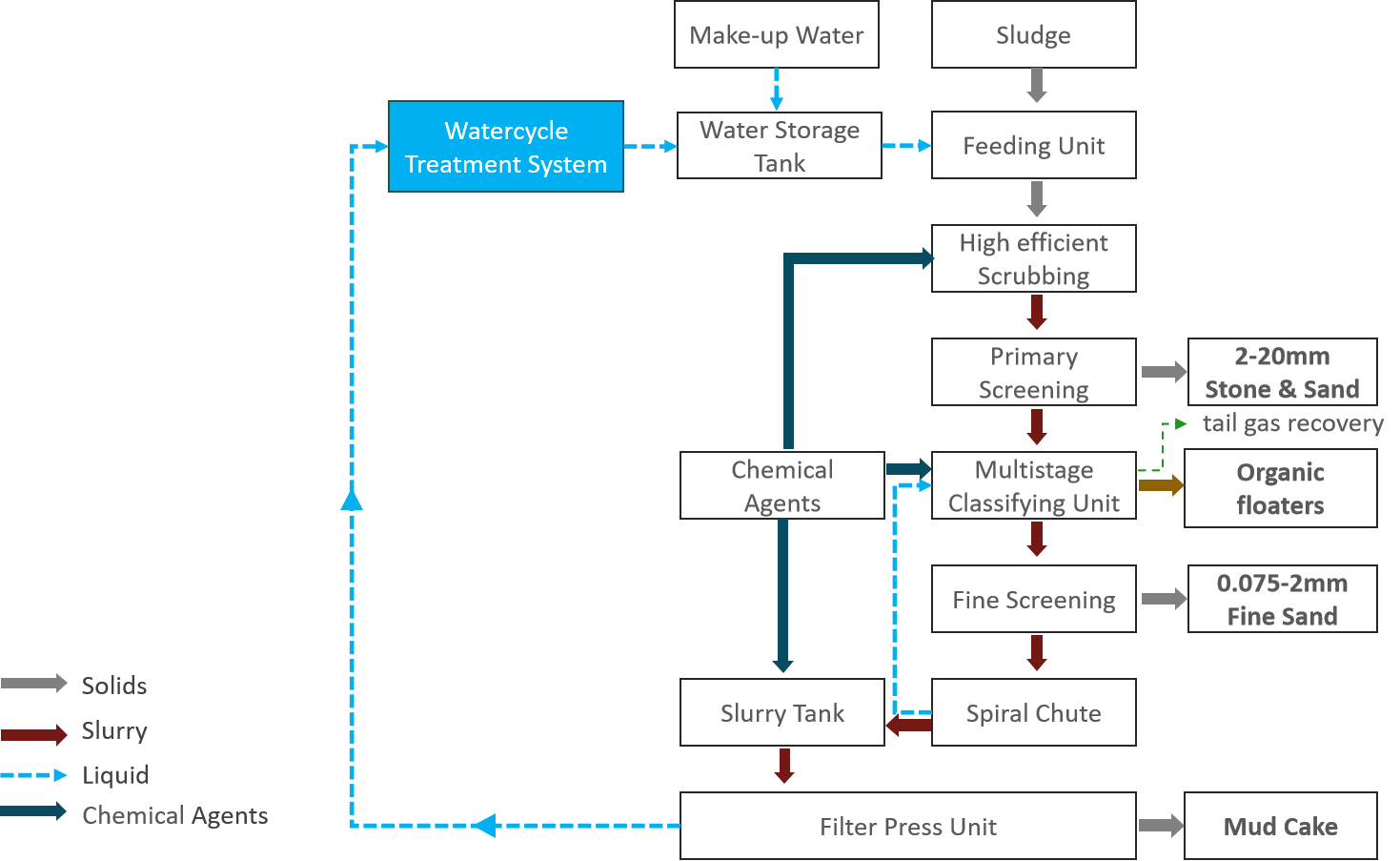
Slurry with a maximum particle size of 150 mm is fed into the drum scrubber together with water at a ratio of about five to one. The water addition rate can be adjusted according to the actual conditions of each project. Washing chemicals may also be added at this stage to extend the reaction time of the reagent. Inside the scrubber, the material is lifted, rubbed and dropped repeatedly by internal friction bars. The friction between particles creates a self-grinding effect, while high-elasticity wear-resistant liners increase the number of scrubbing contacts, so clay lumps and stones are separated thoroughly and the sand is washed clean.
At the discharge end of the scrubber, a concentric head screen removes material larger than 20 mm. This coarse fraction is conveyed to a stockpile. The remaining slurry-water mixture, containing fine sand and particles smaller than 20 mm, moves to the next classifying stage.
Classifying, Soaking and Concentration
The mixed slurry first passes through a primary hydraulic screen, where solid particles larger than 2 mm are separated. The underflow enters the soaking and classifying module, where reagents are added and mixed thoroughly with the slurry. A scraper system removes light floating debris such as leaves, plastics and films, and an odour exhaust line collects gases for separate treatment. A multi-stage screw classifier recovers sand in the 0.075 to 2 mm range with high efficiency.
The remaining slurry is pumped into a deep cone thickener, where flocculant is added to accelerate settling and concentration. The underflow is stored in a buffer tank and then fed to a plate and frame filter press for solid-liquid separation. The separated water is sent to the water treatment module and recycled into the process.
Key Performance Indicators
- Processing capacity: 5 to 100 tonnes per hour for modular systems, up to 15 tonnes per hour for truck-mounted units.
- Aggregate recovery rate: over 95 percent.
- Filter cake moisture content: no more than 40 percent.
- Installation period: roughly 10 days on site, with no concrete foundation required.
- Footprint: about 600 square metres for a 15 t/h line (40 m x 15 m x 9.5 m).
- Operating crew: two to three people per shift for a line producing around 120 cubic metres per 8-hour shift.
Key Advantages of the Modular Design
- Compact process chain: each module has a clear function and the units are connected in a simple, efficient sequence.
- Low site preparation cost: modular equipment requires no concrete foundation, which greatly reduces civil works.
- Fast commissioning: modules are connected quickly and a system can be installed and commissioned in about 10 days.
- Wide application range: the system handles ditch residue, river sludge, piling slurry, tunnel slurry and soil washing feed.
- Low operating cost: water consumption is low and the control system is highly automated, keeping the crew small.
- Intelligent control: DCS distributed control with 5G cloud IoT enables remote real-time monitoring of the whole line.
Suitable Materials
- Municipal sewer and pipeline residue
- River and channel sludge
- Tunnel and shield slurry
- Dredged sediment
Project Experience
Desen has delivered slurry treatment systems for municipal and construction applications in China. In Jiangxi province, a modular system processes ditch and dredged sludge at 15 tonnes per hour with a total installed power of 224.85 kW and a crew of two per shift. In Nansha, Guangzhou, an 8 t/h system handles urban pipeline sludge with a feed, scrubbing and classifying configuration controlled by a PLC system.
Conclusion
A modular slurry treatment system turns difficult sludge into reusable sand, dewatered cake and clean water. For projects dealing with dredged sludge, tunnel slurry or pipeline sediment, on-site treatment reduces transport cost, shortens the disposal cycle and improves the overall economics of the worksite. Contact Desen Environmental to discuss a system sized for your project.