Sludge and Fly Ash to Ceramsite: Lightweight Aggregate Production for Solid Waste Resource Recovery
Municipal sludge and fly ash are two of the most challenging solid waste streams for cities and industrial facilities. Both are produced in large volumes, contain heavy metals and organic residues, and are difficult to dispose of safely. At the same time, the construction industry needs sustainable sources of lightweight aggregate for concrete, insulation and drainage applications.
Municipal sludge and fly ash are two of the most challenging solid waste streams for cities and industrial facilities. Both are produced in large volumes, contain heavy metals and organic residues, and are difficult to dispose of safely. At the same time, the construction industry needs sustainable sources of lightweight aggregate for concrete, insulation and drainage applications. Ceramsite production offers a proven way to convert sludge and fly ash into high-quality lightweight aggregate while achieving genuine resource recovery. This article examines how Desen Environmental Technology designs sludge fly ash ceramsite production lines and the international projects that demonstrate the technology in practice.
Why Convert Sludge and Fly Ash into Ceramsite
Traditional options for sludge and fly ash include landfill and cement kiln co-processing, but both have limitations. Landfill consumes scarce capacity and risks secondary pollution from leachate and dust, while cement kiln routes depend on the availability of nearby cement plants and may not be economical for every location. Ceramsite production provides a dedicated, self-contained route: the waste is mixed with additives, pelletized and sintered at high temperature in a rotary or vertical gradient sintering kiln. The result is a strong, lightweight, porous aggregate that meets construction material standards.
Ceramsite is a marketable product with steady demand in lightweight concrete, insulation board and water treatment filtration.
Sintering at high temperature destroys organic contaminants and stabilizes heavy metals within the ceramic matrix.
Resource recovery turns a disposal cost into a revenue stream for the operator.
The technology is proven at industrial scale, from small plants to multi-unit production lines.
How the Ceramsite Production Process Works
Feed Preparation and Pelletizing
The production line begins with dewatering and conditioning of the sludge, which is mixed with fly ash and selected additives to achieve a consistent moisture content and plasticity. The blended material is then pelletized into uniform green balls. Careful control of the raw mix ratio is essential for producing ceramsite with consistent density, strength and pore structure.
High-Temperature Sintering
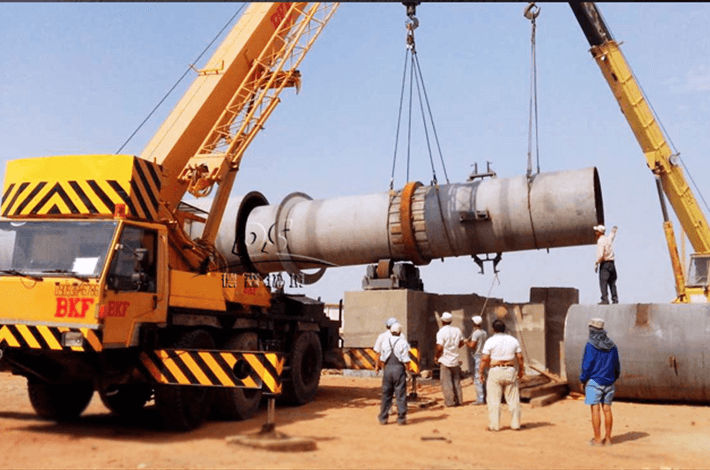
The green pellets are fed into a sintering kiln, where they are heated through a carefully managed temperature profile. As the pellets pass through the kiln, organic matter is burned off, the ceramic material expands and the surface vitrifies, producing a hard shell with a porous core. Desen provides vertical gradient sintering kiln technology that delivers even temperature distribution and high energy efficiency, as well as conventional rotary kiln configurations depending on project scale and raw material characteristics.
International Project Experience
Kazakhstan: 100,000 m³ per Year Solid Waste Ceramsite Project
One of Desen's flagship overseas projects is a solid waste ceramsite production facility in Kazakhstan with an annual output of 100,000 cubic meters. The project demonstrates the full treatment chain, from waste receiving and conditioning to pelletizing, sintering and product handling, in a single integrated plant. It is a reference for operators in Central Asia and other regions looking to monetize solid waste while meeting environmental requirements.
Tianjin: 100,000 m³ Sludge Fly Ash Ceramsite Project
In Tianjin, Desen has supported a sludge fly ash ceramsite project with an annual capacity of 100,000 cubic meters. The facility processes municipal sludge together with fly ash, converting two problematic waste streams into lightweight aggregate for regional construction markets. The project highlights how industrial-scale resource recovery can be implemented within a large Chinese municipality.
Huizhou, Fujian and Taiwan Projects
Desen's experience also includes a 30,000 cubic meter per year sludge fly ash ceramsite plant in Huizhou, installation of vertical gradient sintering kilns at a solid waste resource recovery site in Fujian, and a municipal sludge resource reuse project in Taiwan. Together, these projects span different regulatory environments, raw material characteristics and market conditions, giving Desen the capability to adapt its technology to local requirements.
Technical and Operational Considerations
Raw material variability: sludge composition changes with season and upstream treatment, so the dosing system must respond quickly.
Energy efficiency: the sintering kiln is the main energy consumer, and careful heat recovery design reduces operating cost.
Emission control: exhaust gas from the kiln must be treated to meet local air quality standards.
Product quality: ceramsite must consistently meet grading, density and strength requirements for the target application.
Site integration: material handling, storage and utility connections should be planned to keep the whole plant running reliably.
Why Choose Desen for Solid Waste Resource Recovery
Desen Environmental Technology is a national high-tech enterprise based in Zhengzhou, China, with more than 30 years of experience in heavy equipment manufacturing and a decade of focused development in environmental equipment. The company has delivered more than 1,000 projects and supports customers in more than 100 countries and regions. Its business areas cover contaminated soil washing, oil-contaminated soil treatment, dredged sludge disposal, material washing and classification, solid waste reuse systems and organic kitchen waste treatment. This broad base of engineering experience supports reliable design and commissioning of ceramsite production lines around the world.
Conclusion
Sludge and fly ash ceramsite production offers a practical and profitable path for solid waste resource recovery. With proven technology, international reference projects and full engineering support, Desen Environmental Technology helps operators turn municipal and industrial waste into lightweight aggregate for the construction industry. To discuss raw material analysis, capacity planning and plant design, contact the Desen Environmental Technology team through the official website.