Smelting Site Soil Remediation: Heavy Metal Contaminated Soil Washing Solutions
Why Smelting Sites Leave Behind Heavy Metal Contaminated Soil, Decades of metallurgical production at smelting plants often leave behind large volumes of heavy metal contaminated soil.
Why Smelting Sites Leave Behind Heavy Metal Contaminated Soil
Decades of metallurgical production at smelting plants often leave behind large volumes of heavy metal contaminated soil. Lead, arsenic, chromium, nickel and mercury accumulate in surface and subsurface layers through atmospheric deposition, dust fall, and the uncontrolled discharge of process water. When an old smelter or chromium salt plant is decommissioned and the land is redeveloped, site owners must treat this contaminated soil before the plot can be reused for housing, commercial districts, or industrial parks. Soil washing has become one of the most practical and cost-effective technologies for this task.
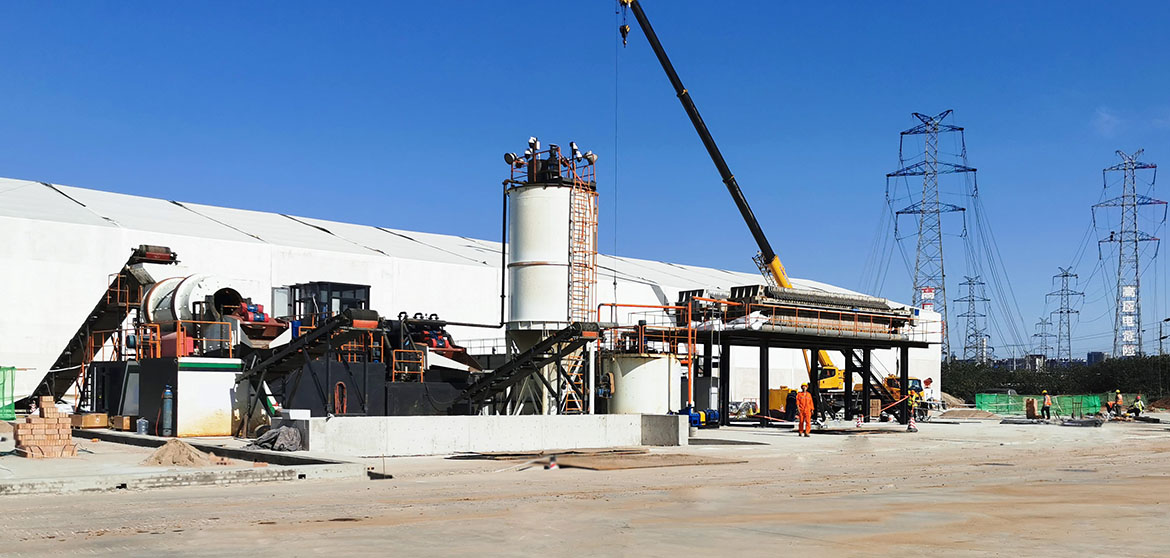
Zhengzhou Desen Environmental Technology Co., Ltd. has delivered dozens of smelting site remediation projects across China, including one of the country's largest single contaminated site remediation programs. The company's fixed and modular soil washing plants handle capacities from 15 to 100 tons per hour, which makes them well suited to the large contaminated volumes that old metallurgical plants typically generate.
Why Soil Washing Suits Heavy Metal Contaminated Soil
Soil washing is an ex-situ remediation technique that separates contaminated fines from clean granular fractions using water, mechanical scrubbing, and controlled chemical reactions. For heavy metal contamination, the process works through several mechanisms that complement each other:
Mechanical scrubbing breaks down soil agglomerates so that metal-bearing clay and silt particles are released from the surface of clean sand and gravel.
Particle size classification separates the metal-rich fine fraction from the coarser, cleaner fraction, dramatically reducing the volume of soil that needs further treatment or disposal.
Chemical leaching uses carefully dosed washing agents to dissolve and mobilize heavy metals bound to soil particles, targeting contaminants that cannot be removed by physical means alone.
Reducing Waste Volumes Is the Key Economic Driver
In many smelting site projects, only a small percentage of the total soil mass is heavily contaminated. When a soil washing plant can recover clean sand for backfilling and concentrate the contaminants into a much smaller fraction, the client avoids the high cost of excavating, transporting and treating the entire volume as hazardous waste. This volume reduction is why soil washing consistently delivers better economics than landfilling every ton of excavated soil.
How a Heavy Metal Soil Washing Plant Works
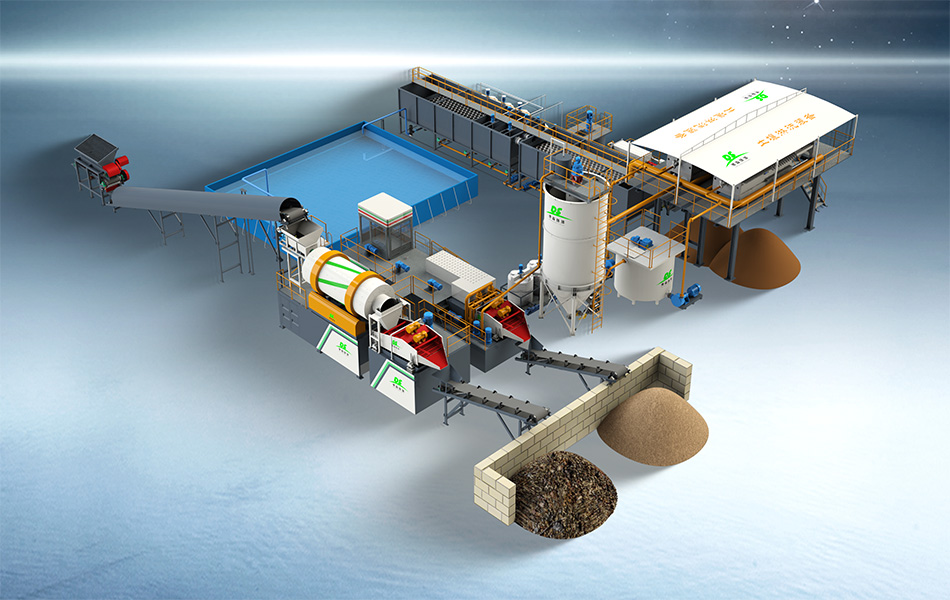
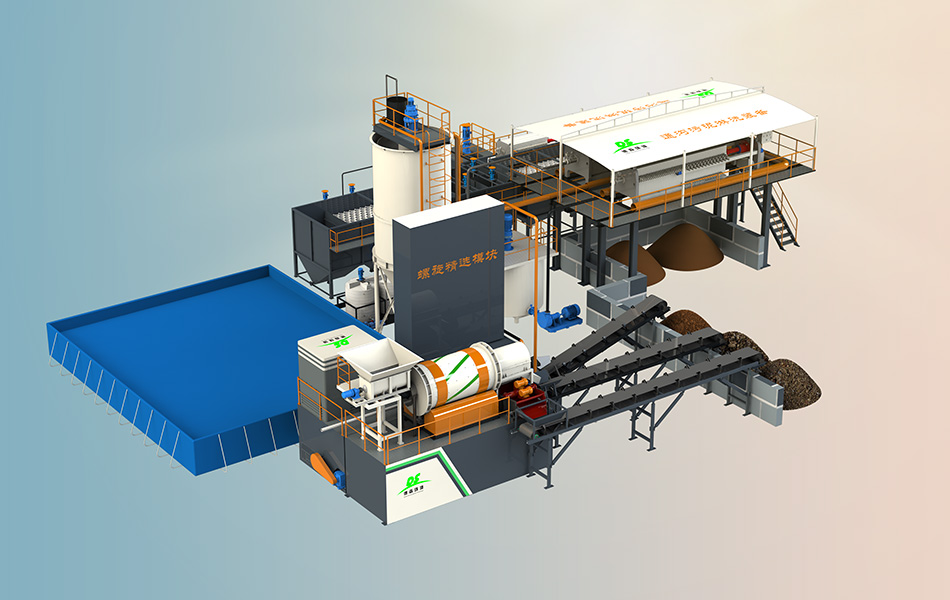
A complete soil washing and remediation system integrates a series of modular process stages. The same basic flow is used whether the plant is a fixed installation or a mobile skid-mounted unit.
Feed and Pre-treatment
Excavated soil is screened and fed into a bunker feeder with variable frequency speed control. Oversized materials are removed at the grate, while sticky or cloddy soil is broken up by the breaker teeth on the feed shaft. Water is added at the feeding stage according to a pre-set water-to-soil ratio, which can be adjusted between 1:1 and 5:1 depending on site conditions.
Cylinder Scrubbing
The slurry enters a rotary cylinder scrubber where soil particles are lifted, rubbed and dropped against each other by internal friction bars. This self-grinding action, combined with high-elasticity wear-resistant liners, separates clay from sand very thoroughly. The scrubbed material passes over a primary hydraulic screen that removes particles larger than 2 mm, while the finer slurry moves on to the next stage.
Immersion, Classification and Fine Separation
Slurry under 2 mm is pumped into an efficient immersion and classification module. Washing agents are mixed with the slurry during a controlled soaking period, allowing chemical reactions to mobilize heavy metals. A spiral classifier then separates the 0.15 to 2 mm fine sand fraction and dewaters it on a secondary fine selection screen, so that the amount of solids entering the filter press is minimized.
Thickening and Filtration
The remaining fine slurry is flocculated with PAM and thickened in a deep cone thickener. The underflow is fed to a plate and frame filter press, which produces a low-moisture filter cake and clean filtrate. The cake can be analyzed and routed to further treatment if required, while the filtrate returns to the water treatment circuit.
Closed-Loop Water Treatment
Overflow from the thickener and filtrate from the filter press are collected and treated in an integrated water treatment module. After primary inclined-plate settling, the water passes through reaction tanks where PAC, PAM and hydrogen peroxide are dosed under agitation and aeration. After secondary settling, the clarified water returns to the clean water tank for reuse in the washing circuit, achieving a water recycling rate of at least 90 percent.
DCS and 5G Cloud Control for Transparent Operations
Modern Desen soil washing plants are controlled by a DCS distributed control system with 5G cloud connectivity. Operators can monitor the entire process from a single control center, view real-time operating parameters, and share process data with regulators. For smelting site projects, where third-party supervision of treatment data is often mandatory, this transparency is a decisive advantage.
Field-Proven Smelting Site Remediation Cases
Desen Environmental has applied this technology across multiple metallurgical and smelting site projects in China:
Changsha chromium salt plant: one of the country's largest single-site contaminated soil remediation programs, treated at 90 tons per hour.
Hunan smelting site: a 90 tons per hour soil washing remediation project delivered on a former smelter site.
Changsha smelter project: another 90 tons per hour remediation case addressing heavy metal contaminated soil.
Guangzhou arsenic contaminated soil: a 60 tons per hour washing project handling arsenic, mercury, nickel and lead contamination.
Northern China lead and arsenic site: a 40 tons per hour remediation project on a metallurgical site.
Choosing the Right Plant for a Smelting Site Project
Every smelter leaves a different contamination profile, so the treatment plan must be tailored to the actual soil conditions. Desen recommends a site investigation and treatability study before selecting equipment. Key factors include soil type, contaminant concentration, target remediation levels, project schedule and available footprint.
For large centralized treatment, a fixed soil washing plant offers the highest capacity and best process control.
For dispersed plots or phased remediation, modular or mobile washing units can be relocated quickly between working areas.
For contaminated soil with a high clay content, a plant with strong cylinder scrubbing and immersion capability delivers better metal release.
Summary
Smelting site soil remediation no longer has to mean excavating everything and sending it to landfill. With a well-designed heavy metal contaminated soil washing plant, site owners can recover clean granular material, concentrate the contamination into a small fraction, recycle process water, and move the land toward safe reuse. With more than 1,000 completed projects and equipment exported to over 100 countries, Desen Environmental provides the engineering experience and proven technology to de-risk even the most challenging metallurgical brownfield sites.