Filter Press Dewatering for Soil Washing Sludge: Closing the Water Loop in the Gulf
Filter press dewatering for soil washing sludge turns metal-loaded fines into a stackable cake and returns clean water to the circuit. See how Desen sizes presses for Middle East projects.
Filter Press Dewatering for Soil Washing Sludge: Closing the Water Loop in the Gulf
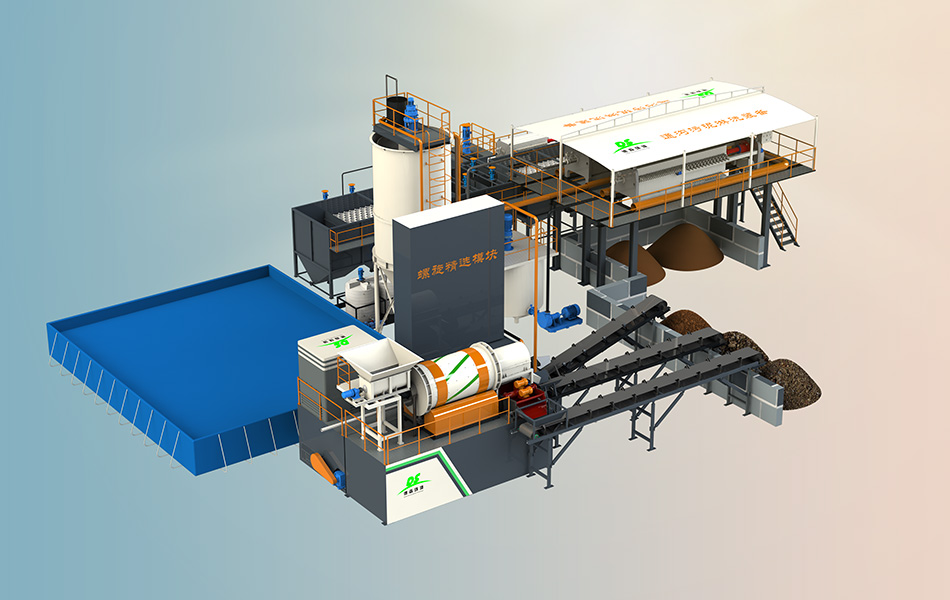
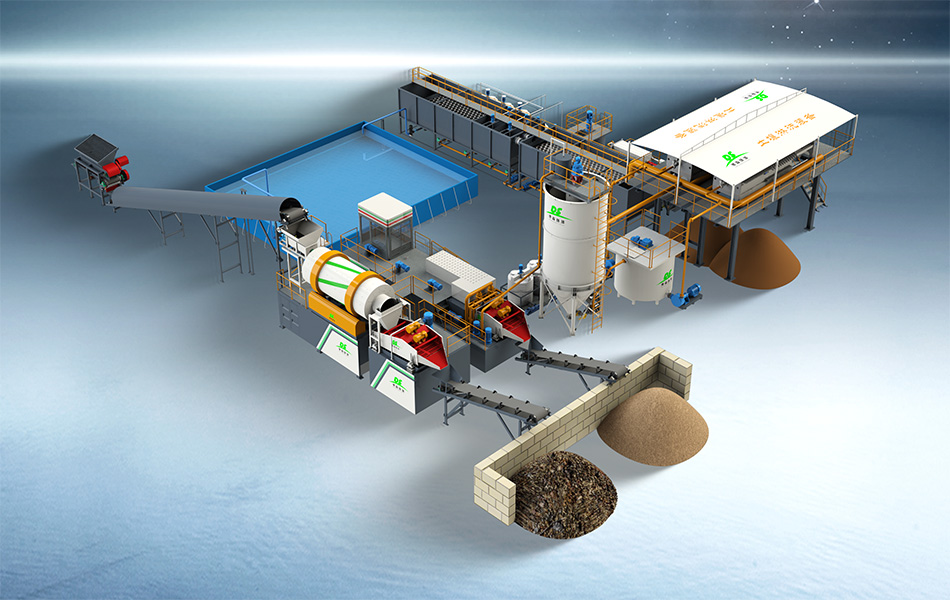
A soil washing plant produces clean sand and gravel on one side and a metal-loaded slurry on the other. In the Gulf region that slurry line often decides whether the project makes economic sense: water is the scarce resource in Saudi Arabia, the UAE and across the Middle East, and the fines that carry the contamination are mixed into every cubic metre of it. Filter press dewatering for soil washing sludge is the step that separates the two, converting dilute contaminated fines into a stackable solid cake and handing most of the water back to the process.
Why the Fines Fraction Decides Your Water Budget
Soil washing works by detaching contaminants from particle surfaces and then classifying the material by size. Scrubbing and attrition strip metals and hydrocarbons off sand and gravel, and classification sends the cleaned coarse grains to stockpile. The problem accumulates at the bottom of the size range: silt and clay particles have enormous surface area, hold the largest share of the contamination, and will not settle quickly on their own.
The first stage of handling is thickening. A thickener dosed with polymer collects the fine solids into an underflow that typically carries a quarter to a third of the feed as solids, while the clarified overflow is pumped straight back to the washing circuit. That recovery alone cuts fresh water demand sharply, but the underflow is still a pumpable sludge, not a material a site can handle. This is where the filter press takes over.
From Thickener Underflow to Stackable Filter Cake
A chamber filter press is a simple machine in principle: a stack of recessed plates clad in filter cloth, squeezed together hydraulically, with sludge fed into the chambers by a feed pump. Liquid passes through the cloth and leaves as clear filtrate; solids build up inside the chambers until they fill the space. When the plates open, the cake drops out as a solid slab that can be stacked with a loader. On a well-run washing line the cake leaves the press at roughly sixty to seventy percent solids, so it can be transported, stockpiled or sent for stabilization without free water dripping off the trucks.
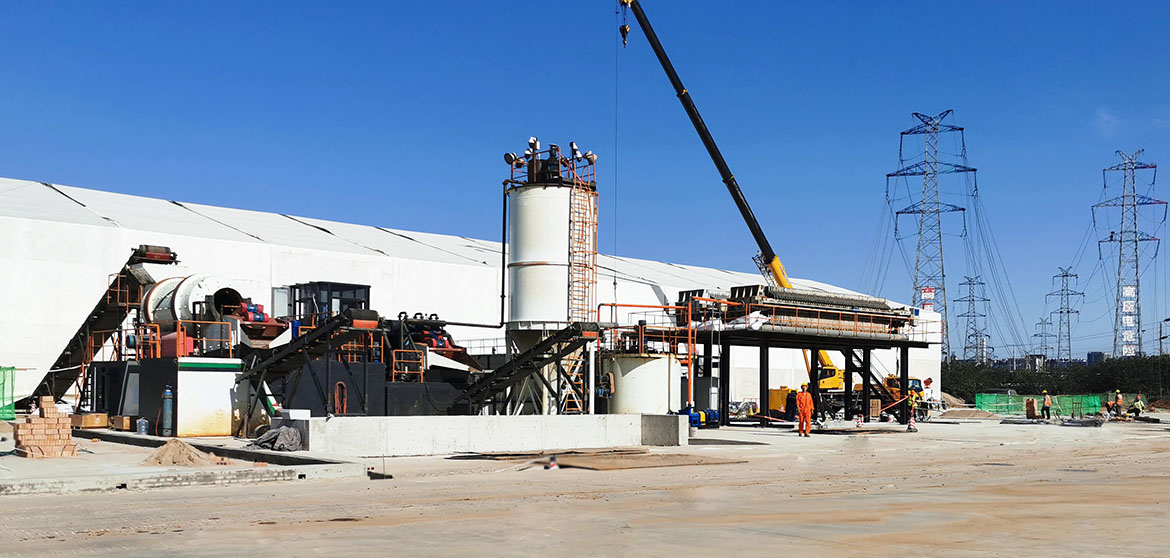
The filtrate deserves as much attention as the cake. Having passed through the thickener and the press cloth, it returns to the process tanks with most suspended solids removed, so the water treatment stage only has to handle dissolved contaminants. In a closed-loop design this water supplies the scrubbing and attrition stages again, and the plant draws fresh water mainly to replace what leaves with the cake and what evaporates.
Sizing a Filter Press for a Soil Washing Line
A press that is too small backs up the whole circuit; one that is oversized wastes capital and floor space. Sizing starts with the mass balance, not with a catalogue. The key inputs are:
- Dry solids per hour entering the fines circuit, calculated from the feed tonnage and the fines content of the soil.
- Feed solids concentration from the thickener underflow, which sets how much slurry volume the pump must deliver per cycle.
- Cycle time — fill, press, and discharge — which determines how many cycles the press must run each shift.
- Cake thickness and chamber depth, balancing dry capacity per cycle against discharge handling.
- Target cake moisture, agreed with the disposal or reuse plan before the press is ordered.
Operation brings its own habits. Fine silts and residual reagents can blind the filter cloth, so cloths need periodic washing and spare sets belong on site. Cake release improves when the chambers fill completely, so operators watch the feed pressure curve rather than the clock. And because the cake concentrates the contamination, its handling — a lined stockpile area, covered transport and clear routing to disposal or stabilization — belongs in the site plan from the first drawing.

What the Closed Loop Means for Gulf Projects
In the Gulf, the arithmetic of water is unforgiving. Evaporation rates are among the highest in the world, sites are often far from a municipal supply, and permits increasingly treat discharge water as a liability. A washing line without effective dewatering needs a continuous supply of fresh water and a pond large enough to hold its fines; a line with thickening and press dewatering needs neither.
Operating Points That Matter Most in Hot Climates
High temperatures and remote locations add practical detail to the design. Polymer preparation behaves differently in warm water, so dosing should be confirmed with jar tests on site rather than copied from a temperate project. Dust control consumes water too, and that demand should sit inside the same mass balance as the washing circuit. And because dewatering equipment runs continuously, spare parts for the feed pump and the hydraulic closing system belong in the commissioning package that ships with the plant.
Handled this way, the filter press becomes the component that makes a Middle East soil washing project feasible: clean coarse products one way, a dry and predictable cake the other, and the water cycling between them instead of leaving the site. Desen Environmental builds modular and mobile soil washing equipment with integrated thickening and filter press dewatering, configured for the water realities of projects across the Gulf, Europe, Southeast Asia, North America and South Africa.