Environmental Permit for On Site Soil Washing Operations: What Regulators Ask Before Approval
On site soil washing requires an environmental permit in most jurisdictions. See what regulators ask for: containment, water discharge conditions and residue routes.
Environmental Permit for On Site Soil Washing Operations: What Regulators Ask Before Approval
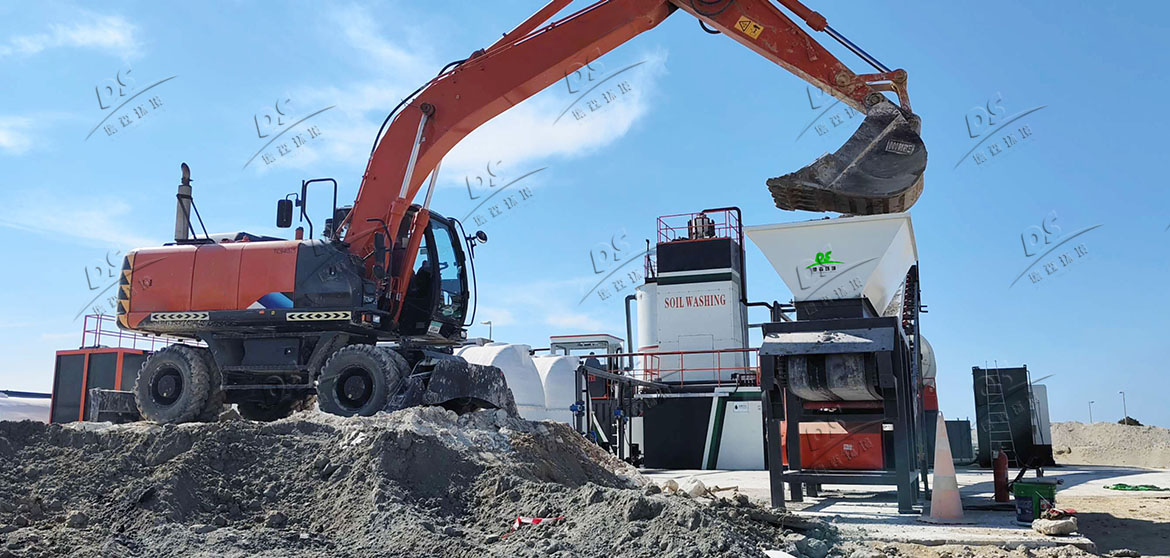
Treating contaminated soil directly on the project site is the fastest way to cut haulage volumes and disposal bills. It is also a regulated activity: once excavated soil is washed, screened or dewatered on site, the operation usually qualifies as waste treatment, and most jurisdictions require an environmental permit — or a registered exemption — before the first loader bucket moves. Understanding what the regulator will ask for turns the permitting step from a delay into a predictable line item in the project schedule.
Why On Site Soil Washing Falls Under Permitting Rules
Soil washing is an ex-situ treatment process, but "ex-situ" refers to the soil being excavated — not to the legal status of the operation. Under the European Waste Framework Directive, treating waste at a temporary installation on the site where it was excavated is still a waste operation, and national rules set out when a full permit applies and when a lighter registration is enough. In the Gulf region, federal and emirate-level environment authorities follow a similar logic: processing contaminated material outside a licensed facility requires approval, with conditions attached.
Three factors usually decide which route applies: the volume of soil to be treated, the treatment duration, and whether the soil was excavated on the same site. A campaign lasting a few months on the source site often qualifies for a simplified notification; a stockpile brought in from elsewhere, or a plant that stays for years, moves the project into the full permit regime.
What Regulators Typically Ask For
Permit applications differ by country, but the technical core is remarkably consistent. Authorities want to see that the operation is contained, that emissions to water and air are controlled, and that residues have a defined destination.
Site Layout, Containment and Drainage
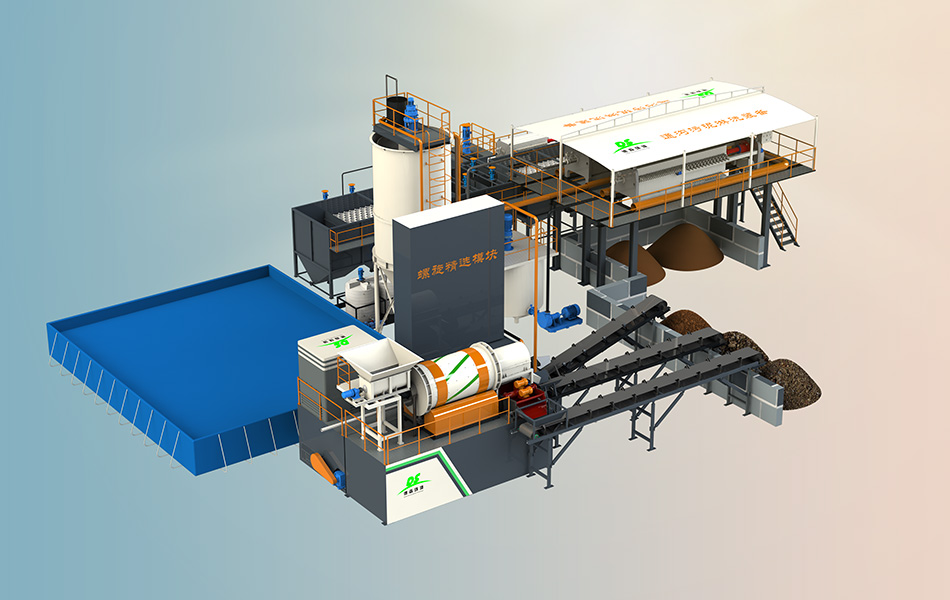
The application normally includes a site plan showing where each plant module stands, how runoff is collected, and where contaminated water could escape. Regulators look for impermeable surfaces or bunding around the washing and dewatering areas, silt traps ahead of any drainage outlet, and a clear segregation between clean and dirty zones across the site.
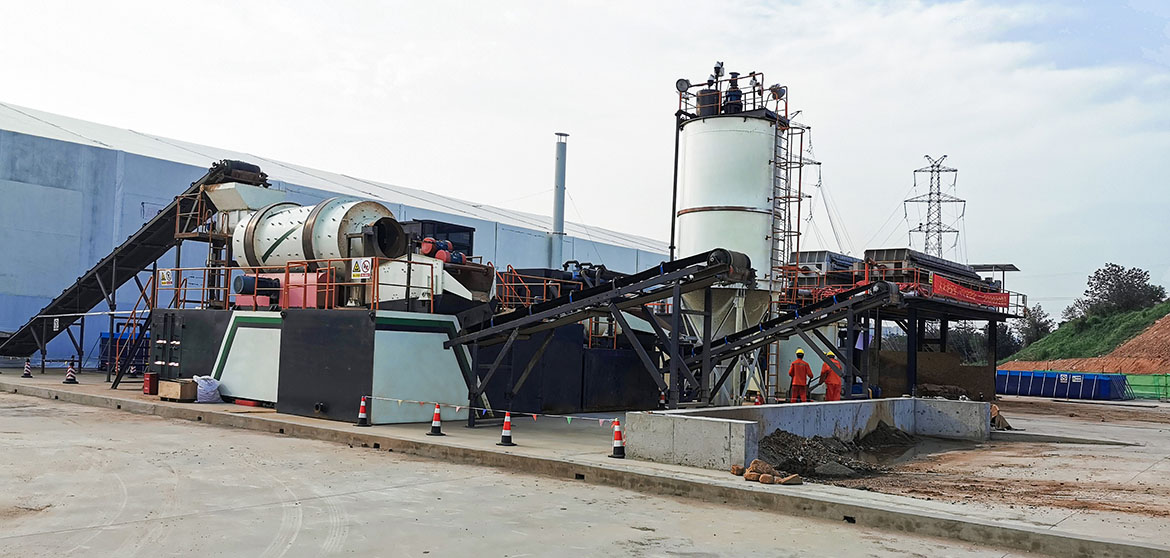
A modular washing plant set on a concrete foundation with perimeter containment gives the reviewer exactly what they want to see: defined footprints for each module, controlled drainage and a settlement pit that keeps process water inside the system.
Water Management and Discharge Conditions
Process water is the most scrutinised stream on any washing site. Closed-loop systems that recycle wash water through settlement and clarification simplify the permit conversation, because there is little or no discharge to approve. Where treated water will be released — to a sewer, a watercourse or for dust suppression — the application must state the discharge point, the parameters to be monitored, typically pH, suspended solids and hydrocarbons or heavy metals, and the sampling frequency.
Residue Storage and Disposal Routes
Washing concentrates contamination into fines and filter cake, so the permit must also cover how those residues are stored and where they go. Authorities expect covered or contained storage, clearly labelled bays, and a named disposal route leading to a licensed receiving facility.

- Site plan with plant layout, containment and drainage design
- Process flow diagram and water balance for the washing circuit
- Emission points, monitoring parameters and sampling schedule
- Residue management plan: storage, transport and receiving facility
- Emergency and spill response procedures
- Site restoration plan after the treatment campaign ends
Practical Steps to Keep the Approval Moving
Permitting timelines range from a few weeks for a notification to several months for a full permit, so the application should start during procurement, not after the plant has shipped. Early consultation with the regulator is the single most effective step: a short pre-application meeting reveals which documents matter locally and which standard templates can be reused.
- Engage the regulator as soon as soil data confirms that treatment is needed, and request the applicable checklist
- Use supplier documentation — process flow diagrams, water balance sheets and equipment specifications — as the technical annex
- Agree the monitoring plan in writing: who samples, which parameters, and how results are reported
- Secure the residue disposal agreement early, because the receiving facility acceptance criteria feed directly back into plant settings
With the dossier built around these points, approval becomes a scheduling question rather than a project risk. Desen Environmental supplies the technical documentation package for its modular and mobile soil washing plants — process descriptions, water balances and layout drawings — so project developers can assemble permit applications faster. Contact our team to receive the documentation set for your next remediation project.