
Soil to Solution Ratio in Soil Washing: Setting the L/S Ratio for Removal, Reagents and Slurry Handling
How the soil to solution ratio in soil washing affects metal removal, reagent use and slurry pumping, and how pilot tests fix the right L/S value.
Soil to Solution Ratio in Soil Washing: Setting the L/S Ratio for Removal, Reagents and Slurry Handling
The soil to solution ratio in soil washing, usually written as the L/S ratio, is the amount of process water a plant uses per tonne of contaminated soil. It looks like a simple number, yet it quietly governs three expensive things at once: how much metal actually detaches from the grains, how much reagent the line consumes, and whether the resulting slurry can be pumped, cycloned and dewatered without choking. This guide explains what the ratio controls, how feed composition moves the starting point, and how to fix the value with pilot data before any tank or pump is ordered.

On a modular washing line like the one above, water circulates through the reservoir, scrubbing units and mixing tanks in a closed loop. The L/S ratio therefore sets more than chemistry: it defines tank volume, pump duty and the fresh water top-up the site needs every day.
What the Soil to Solution Ratio Controls
Engineers express the ratio as tonnes of dry soil per cubic metre of wash liquor, for example 1:3 means one tonne of solids moving through three cubic metres of water and reagent solution. Every downstream decision in the plant inherits this number.
Contact, Detachment and Removal Efficiency
Heavy metals in contaminated soil sit on particle surfaces and inside clay coatings. For the washing process to release them, every grain needs enough liquor around it to disperse the slurry and carry the attrition action to the surface. When the ratio is too low, the slurry turns thick, grains crowd each other, and scrubbing energy is wasted on internal friction instead of cleaning. When the ratio is pushed far above what the feed needs, removal does not improve in proportion; the extra water simply dilutes the liquor and enlarges every tank, pump and thickener behind the washer.
Reagent Demand and Water Chemistry
Chelating agents, pH adjustment chemicals and flocculants all dose against liquor volume. A higher L/S ratio means more solution per tonne, so reagent consumption per tonne of soil rises even when concentration in the liquor stays constant. Dissolved metal loading in the recycle stream also spreads across a larger water volume, which changes how fast salts accumulate in a closed loop and how often a portion of the liquor must be bled off to the precipitation stage. Plants that run a lean ratio with adequate contact typically spend less on chemistry and discharge less bleed water.
Setting the Ratio for Your Material
Feed Composition Sets the Starting Point
Sand and gravel dominated feeds wash at lean ratios, often in the range of 1:2 to 1:3, because metal concentrates on coarse grain surfaces that release quickly. Clay rich or silt bound feeds need a wetter regime, commonly 1:4 to 1:5, so the fines can disperse and the attrition cells can work. Organic rich sludges sit at the wet end of that range as well. The correct starting point therefore comes from the size distribution and clay content of the site soil, not from a generic handbook value.
Test the Ratio Before You Fix It
A short bench or pilot programme resolves the question cheaply. Compare candidates on the same feed sample and judge them on the full chain, not on removal alone.
- Run two or three L/S ratios on split samples and compare metal removal per size fraction after washing.
- Record reagent dose and residual dissolved metal in the liquor at each ratio.
- Measure slurry density at the pump suction and at cyclone feed for each candidate.
- Check dewatering performance at the wettest ratio, since screen and filter press sizing follow the worst case.
- Select the leanest ratio that still meets the cleanup target with acceptable contact and pumping behaviour.
Slurry Density, Pumping and the Downstream Split
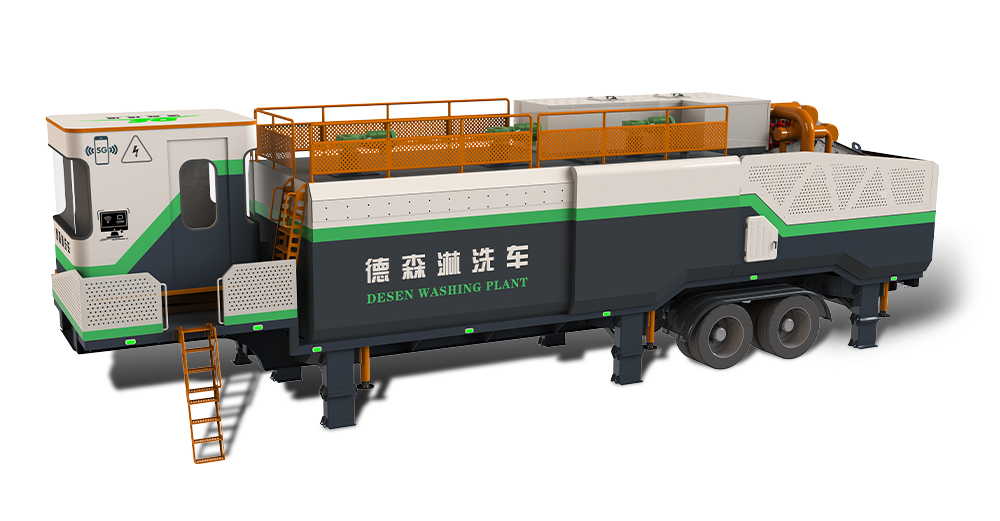
The L/S ratio decides how dense the slurry is, and density decides how everything moves. A dense slurry demands more pump power, wears pipework faster and loads cyclones closer to their operating limit; a thin slurry pumps easily but triples the volume the dewatering stage must handle. On mobile washing equipment, where pumps and piping are integrated into a compact frame, keeping the ratio near the design point matters even more because there is less spare hydraulic capacity to absorb a deviation. Hydrocyclones then split the washed slurry at a controlled density: sand and coarse fractions report to dewatering screens, while the fines stream carries attached and dissolved metals to thickening and filtration.
Desen Environmental designs modular and mobile soil washing plants around the L/S value measured in pilot tests rather than around assumptions. Sharing your soil analysis and target cleanup levels with our engineers lets us size the tanks, pumps and dewatering stage to the ratio your material actually needs. You can review reference projects at materialwashing.com or contact the team for a process proposal.