Washing Plant Slurry Density Control: Keeping Cyclones, Pumps and Dewatering in Range
How to measure and hold slurry density in a soil washing plant: cyclone feed set points, pump limits, dilution control and the sampling routine that keeps dewatering stable.
Washing Plant Slurry Density Control: Keeping Cyclones, Pumps and Dewatering in Range
Slurry density is the one process variable an operator can move within a shift, and it reaches almost everything downstream: the cut a hydrocyclone makes, the power a pump draws, the volume a thickener must settle, and the moisture left in the filter cake. Design work fixes a target ratio between soil and water, but that ratio is only a promise. Density control is how the promise is kept hour by hour, on feed that arrives wetter, drier or finer than the sample the plant was sized on.

The line above shows where density is set and corrected: a cone-bottom process tank, transfer pumps and the manifold feeding the dewatering stage. Each item behaves differently at a light pulp than at a heavy one, so the reading needs a defined set point rather than a feel for the mixture.
Why Slurry Density Decides How the Line Behaves
An operating number, not a design number
The soil to solution ratio is calculated once from pilot work and written into the specification. Slurry density is read every few hours and drifts in between. Feed moisture alone moves it: soil at 12 percent moisture and soil at 25 percent give very different pulp densities at the same water rate. Clay content, stockpile age and rainfall push the same way, and in monsoon markets the swing can happen inside one shift. A plant held at its design density removes metals as tested; the same plant running thin wastes water and reagent, while running heavy leaves coarse particles only partly contacted.
What density does to cyclones, pumps and dewatering
Hydrocyclones are the most density-sensitive item on the line. As feed density rises the cut size coarsens and the underflow thickens; pushed further, the discharge stops spraying and starts roping, and a rope carries coarse material into the fines stream, undoing the separation the plant was bought for. Centrifugal slurry pumps lose head as density climbs, so a duty point chosen on water no longer delivers the flow the cyclone needs, and wear scales with the solids concentration passing the pump. On the dewatering side, thin slurry floods a screen or a filter press and never builds a cake, while heavy slurry blinds the medium.
Measuring Slurry Density on Site
Instruments that survive a washing plant
Three routes are common. A nuclear density gauge on a vertical section of the cyclone feed line gives a continuous signal and is the reference instrument in many fixed plants, though it needs source registration and a competent person to look after it. A mass flow meter measures density and flow together, at a cost and with its own wear parts. The third infers density from a magnetic flow meter plus the level in a tank of known volume: cheap, and adequate for trend control. None replaces a weighed sample, a one-litre cup on a scale or a Marcy scale, which proves the instrument is still telling the truth.
Sampling points and a calibration routine
The sample point has to be representative: a vertical run in turbulent flow, downstream of the dilution connection and upstream of the cyclone manifold, never the bottom of a tank where sand settles and never a horizontal run where coarse particles slide along the invert. Compare gauge against cup weekly at the same operating condition and log both. A slow divergence is the earliest warning that a gauge needs cleaning, and cheaper to find in the log than in a blocked cyclone.
Holding the Set Point Through a Shift
Dilution control and buffer volume
Density is corrected with water, added at the scrubber and at the cyclone feed. Correcting at the cyclone is faster and protects the separation, but it adds volume that the thickener and filter press must handle, so the correction belongs as far upstream as mixing allows. A buffer tank holding twenty to thirty minutes of residence lets the loop respond without starving the pump, and on Gulf sites with saline make-up water the viscosity shift is worth checking at commissioning.
Responding to feed changes without chasing the gauge
When the excavator opens a wet pocket the signal moves within minutes, and an operator who reacts to every flicker spends the shift opening valves. Change one thing at a time, let the tank turn over, then judge. Four habits cover most of it:
- Correct with water first and only then adjust throughput, so the pump and cyclone keep a stable duty point.
- Read the cyclone underflow shape as often as the gauge: a spraying cone is healthy, a rope is a density problem arriving.
- Record density against the stockpile reference, not the clock, so a wet pile is identified and blended before it reaches the hopper.
- Check thickener settling and cake moisture at the same interval, since both are the downstream verdict on the density the line actually ran.
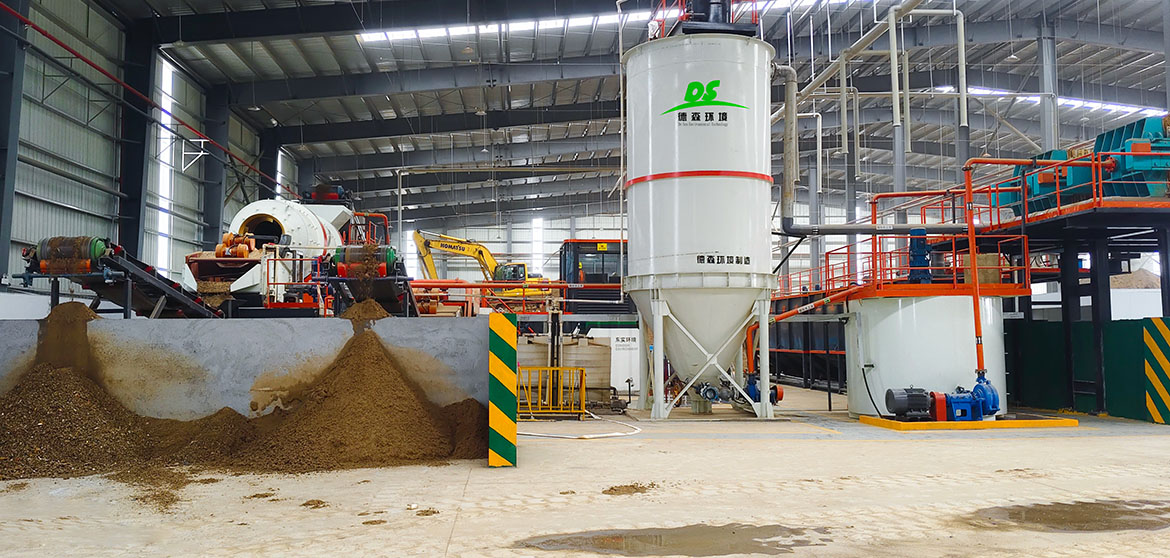
In the plant above, the pump skid and cone-bottom tank sit close to the washing drum, shortening the response between a density change and the correction. Compact layout helps, but the set point still has to be written down and handed over between shifts. Desen Environmental builds modular and mobile washing lines with the density loop, dilution points and sampling connections laid out for the operator, and reviews proposals against a project's soil data. Reference installations are listed at materialwashing.com.