Pesticide Contaminated Soil Washing Remediation: Recovering Land at Former Agrochemical Sites
Former pesticide plants and orchards leave DDT, lindane and arsenic locked in fine soil. See how surfactant-enhanced soil washing cuts disposal volumes on site.
Pesticide Contaminated Soil Washing Remediation: Recovering Land at Former Agrochemical Sites
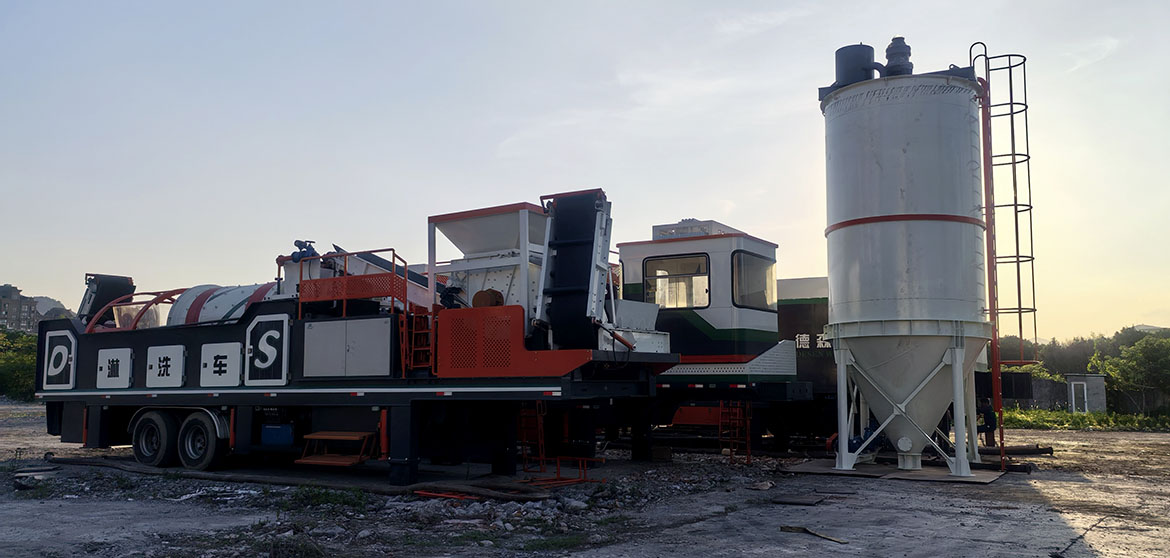
Land that once hosted pesticide production plants, formulation and packaging facilities, or orchards treated for decades with persistent chemicals carries some of the longest-lived organic contamination in the remediation sector. Compounds such as DDT, hexachlorocyclohexane and arsenical pesticides were designed to resist breakdown, so they remain detectable decades after the last application. Excavating and landfilling all of that soil is costly, and in many North American and European projects most of the mass is only lightly affected. Soil washing remediation concentrates the pesticide residue into a small fraction so that the majority of the soil can remain on site or return to beneficial use. Desen Environmental builds modular and mobile soil washing plants for projects of this kind, and the sections below outline how the process is arranged for pesticide-affected land.
Where Pesticide Residues Sit in the Soil Profile
The first design decision is understanding how the residues are distributed, because pesticide contamination behaves differently from heavy metal contamination in one important respect: these compounds are organic, hydrophobic and preferentially attach to fine, organic-rich particles rather than spreading evenly through the excavated mass.
Size fraction concentration
Screening and classification trials on former agrochemical sites typically show a consistent pattern. Sand and gravel fractions release their contamination readily once surface films are washed off, while silt and clay hold most of the chemical load because of their organic content and large surface area. A washing line therefore concentrates its chemistry on the fine fraction, and the coarse fraction, often the majority of the excavated tonnage, can be validated for reuse after relatively gentle washing. This fractionation is what turns an unaffordable dig-and-haul program into a manageable on-site project.
Typical contaminants at former agrochemical sites
- Organochlorine insecticides such as DDT, dieldrin and the hexachlorocyclohexane isomers, which persist for decades and bind strongly to soil organic matter.
- Arsenical and lead-based pesticides from older orchard and crop-dusting operations, which behave like metal contamination and respond to washing combined with chemical extraction.
- Herbicide residues from formulation plants, usually concentrated around former mixing pads, storage areas and drainage routes rather than spread across the whole site.
- Solvent and carrier residues near former production buildings, which can mobilize other compounds into the fines and complicate water treatment.
How the Washing Process Is Adapted for Pesticide Soils
Surfactant-enhanced washing
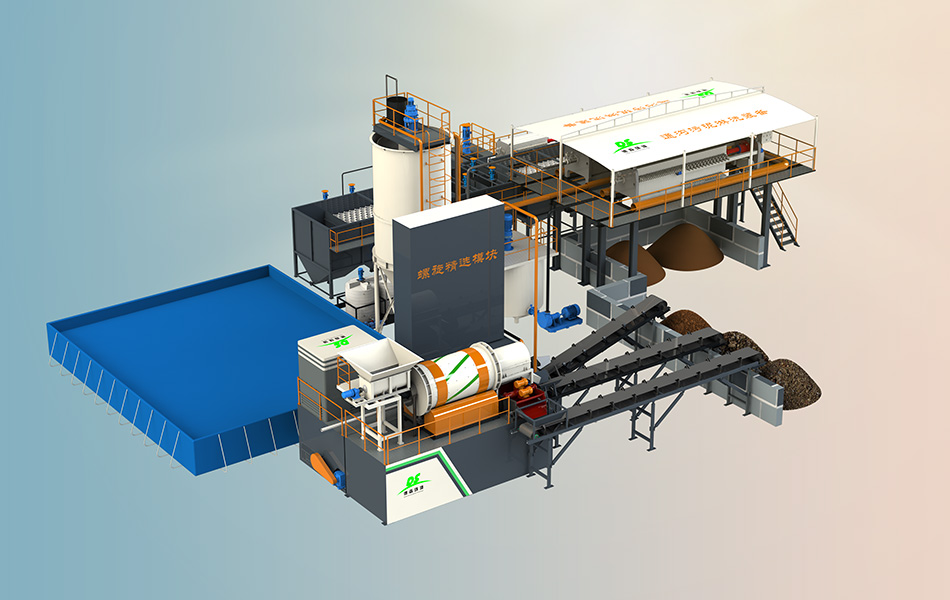
Hydrophobic pesticides do not release from soil particles with water alone, so the wash stage is where a pesticide project differs most from a straightforward heavy metal job. Raising the wash water temperature and dosing a biodegradable surfactant lowers the interfacial tension between the chemical film and the particle surface, transferring the residue into the liquid phase where it can be captured. Drum washing units with controlled retention time give the surfactant sufficient contact with the soil, and Desen's hot washing configuration is arranged so reagent dosing, drum retention and water temperature are set against bench-scale results rather than fixed assumptions.
Attrition scrubbing for clay-bound residues
Where residues have aged into clay aggregates, simple rinsing leaves the fines contaminated. High-intensity attrition scrubbing breaks these aggregates apart and strips organic coatings from particle surfaces, releasing bound pesticide into the wash water so that subsequent classification and flotation or separation steps can remove it. Tuning scrubbing intensity matters: the goal is to clean the particles, not to generate excessive new fines that overload the dewatering stage.
Closed-loop water and fines treatment
Wash water leaving the line carries dissolved and emulsified pesticide, so it is treated through sedimentation, sand filtration and polishing with activated carbon or an oxidant before returning to the wash circuit. Closed-loop recirculation keeps fresh water demand low and prevents contaminated water from leaving the site. The concentrated fine fraction is dewatered, commonly with a filter press, into a compact cake that is small enough to transport to a licensed disposal facility at a fraction of the original soil volume.
What to Confirm Before Committing to a Pesticide Washing Project
Pilot testing against cleanup targets
North American and European regulators approve remediation against compound-specific, risk-based targets, not against a generic cleanliness grade. Bench and pilot trials should measure removal of each named compound, DDT isomers, arsenic, herbicide residues, on the actual site soil, and demonstrate that the coarse fraction meets the reuse criteria in the project's approved work plan. A pilot run also fixes the surfactant dose, wash temperature and scrubbing energy that the full-scale plant must deliver, which makes equipment selection and cost estimation far more reliable.
Planning for the residual fines
Although washing reduces the disposal volume dramatically, the dewatered fines still require a compliant outlet. In Europe this means testing the cake against the waste acceptance criteria of the intended landfill and preparing the supporting dossier; in North America the requirements depend on the compound class and the receiving facility. Building the fines disposal route into the project schedule early avoids the situation where a washing plant produces clean soil faster than the residue stream can be handled. With the process verified, the fractionation logic of soil washing gives pesticide-affected sites a practical route from long-stalled liability back to usable land.