Mobile Soil Washing Equipment: Fast On-Site Remediation for Contaminated Sites
What Is Inside a Mobile Soil Washing System?
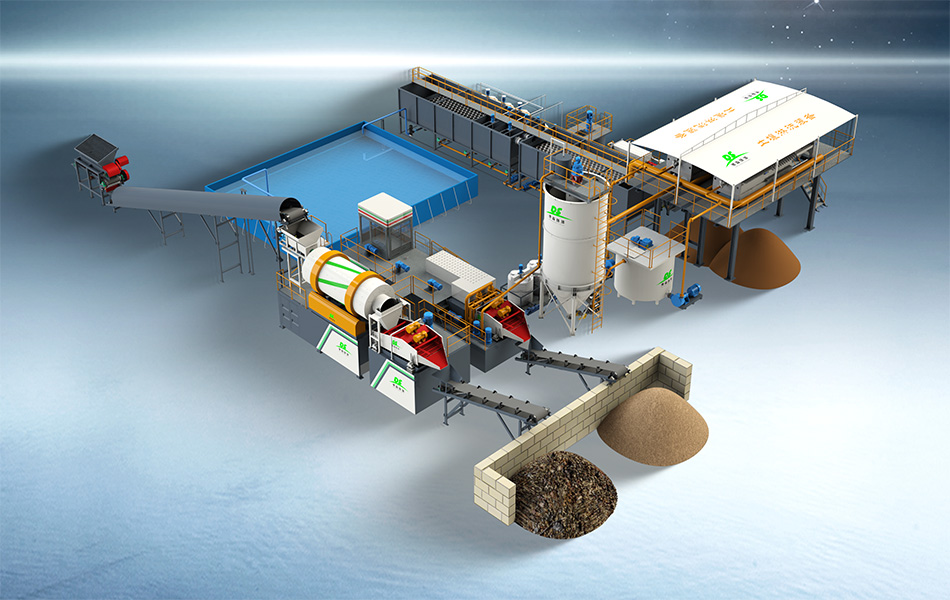
A complete mobile washing train is made of standardized, trailer-mounted modules that work together as a full remediation plant:
- Mobile scrubbing unit (15-20 t/h): bar grizzly screening, high-efficiency drum scrubbing, clean aggregate classification and integrated hydraulic station with water tank.
- Mobile classifying and concentrating unit (30 t/h): soaking, spiral classification, hydrocyclone fine-sand recovery and chemical reaction enhancement, all supervised by a DCS distributed control system.
- Mobile filter press unit (15 t/h): rapid solid-liquid separation of thickened slurry with filter cakes discharged by belt conveyor.
- Mobile water treatment unit (90 m3/h): treatment and recycling of wash water for closed-loop operation.
All units are designed for conventional trailer towing, with hydraulic leveling systems and independent electrical control. The modular concept means plants can be sized from a single scrubbing unit to a complete multi-module line, and expanded later by adding modules as project volumes grow.
Key Advantages of Mobile Soil Remediation Equipment
Fast Deployment, Ready in Days
Because the system is fully integrated on trailers, no concrete foundations or complex site installation are required. On arrival, the equipment can typically be commissioned within 1-3 days, and some configurations can start operation within 24 hours. Project startup time can be shortened by more than 80% compared with a fixed plant.
Small Footprint for Urban Sites
A highly integrated mobile soil washing machine occupies only about 1,200 m2 for a full line, with the equipment footprint itself as small as 400 m2. This makes it ideal for city-center projects, temporary sites and locations where space is at a premium and surrounding disruption must be minimized.
Zero Secondary Pollution
The fully enclosed treatment process keeps dust, gas, wastewater and solid residue under control. Process water is recycled at a rate of at least 90%, and filter cakes and recovered oil fractions are directed to licensed disposal or further treatment, minimizing the risk of secondary contamination.
Smart Control with DCS and 5G IoT
Every module is governed by a DCS distributed control system linked to a 5G cloud IoT platform. Operators can monitor equipment status, process parameters and alarms locally or remotely, while regulators can access real-time operating data. This transparency makes compliance reporting straightforward.
Low Operating Cost
A 10-15 t/h mobile washing line needs only 2-3 operators per shift and consumes 3-5 m3/h of water because of closed-loop recycling. Hydraulic folding conveyors, energy-efficient vibrating motors and variable frequency drives keep power consumption low, directly reducing the cost per tonne of treated soil.
Typical Applications of Mobile Soil Washing Equipment
- Heavy metal contaminated soil at industrial, metallurgical and electroplating sites.
- Petroleum hydrocarbon contamination around oil fields, refineries and petrol stations.
- Organic and compound contamination at former chemical plants and relocated factories.
- Mine tailings washing and mining wasteland restoration.
- Dredged sludge, ditch sludge and shield tunneling slurry treatment.
- Emergency response for sudden pollution incidents and landfill screening projects.
Real Projects Delivered with Mobile Units
Desen Environmental has applied mobile soil remediation equipment in numerous projects. In Wenzhou, a 15 t/h mobile washing line treated lead and arsenic contaminated soil. In Beijing, a mobile washing trailer carried out ex-situ chemical washing for arsenic contamination. Across multiple southern Chinese cities, skid-mounted 30 t/h plants have remediated heavy metal contaminated sites for real estate redevelopment, and mobile screening units have supported soil remediation in Chongqing and Nanjing by pre-classifying material to protect downstream equipment.
Mobile vs. Fixed Soil Washing Plant
Factor Mobile Plant Fixed Plant Deployment time 1-3 days Weeks to months Foundation work None or minimal Concrete foundations required Footprint 400-1,200 m2 Larger permanent area Multi-site reuse Yes, trailer towed No Capacity range 10-30 t/h per train 30-100+ t/h Typical use Urban, emergency, dispersed sites Long-term large-scale programs For projects above 100 t/h or with multi-year treatment schedules, a fixed or modular skid-mounted washing plant may be more economical. For almost everything else, mobile soil washing equipment offers the best balance of speed, cost and flexibility.
Conclusion
Mobile soil washing equipment has changed the economics of contaminated soil treatment. It turns a remediation plant into a reusable asset that travels to the contamination, deploys in days, and delivers predictable treatment results with minimal environmental impact. With more than 1,000 completed projects across 100+ countries, Desen Environmental Technology Co., Ltd. provides complete mobile soil remediation equipment solutions, from design and manufacture to transport, installation and 24-hour after-sales support.