How to Remediate Oil-Contaminated Soil: A Complete Guide to Soil Washing
What Is Soil Washing for Oil Contamination?
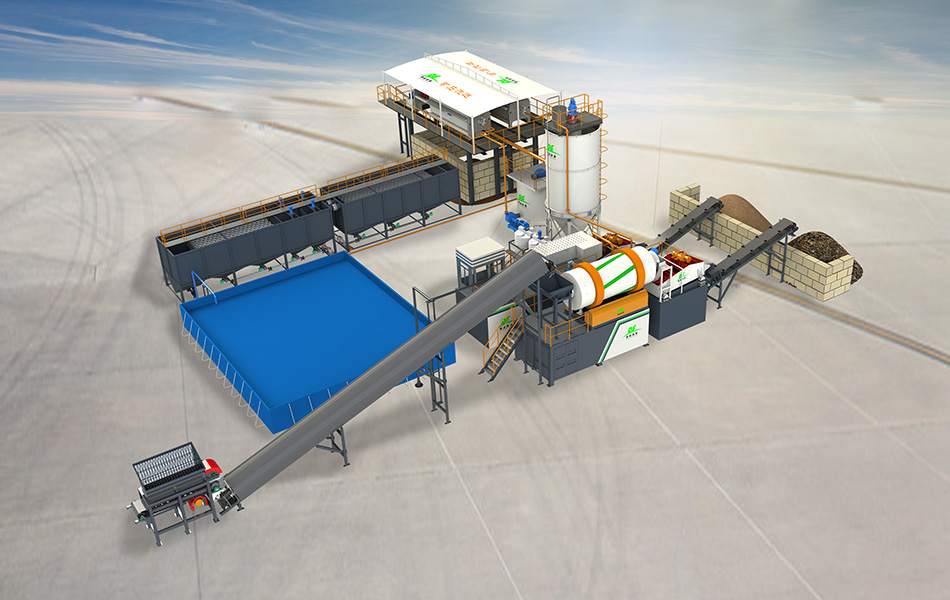
Soil washing is a physical-chemical separation process. Contaminated soil is mixed with water and, where required, a washing agent. The mixture is vigorously scrubbed in a rotating drum so that oil films and soil aggregates are broken down. The resulting slurry is then classified by particle size, concentrated, dewatered and treated. Clean coarse material is recovered for reuse, while fine sludge is handled separately and process water is recycled.
For petroleum hydrocarbon contamination below 50,000 mg/kg, a well-designed oil contaminated soil washing plant can achieve high removal efficiency across sandy, loamy and silty-clay soils. Heavier bituminous or solidified oily sludge above that concentration normally requires alternative or combined treatment such as thermal desorption.
Step-by-Step: How to Remediate Oil-Contaminated Soil by Washing
Step 1: Excavation and Pre-Treatment
Contaminated soil is excavated and delivered to a pre-treatment area. An ALLU bucket or a vibrating grizzly feeder breaks up lumps and removes oversized debris. The material is then fed by belt conveyor to the scrubbing section at a controlled water-to-soil ratio of around 2.5:1.
Step 2: Drum Scrubbing with Washing Agent
In the rotary drum scrubber, soil particles collide and abrade against each other while lifting bars and high-elasticity wear-resistant liners intensify the scrubbing action. A washing agent is dosed at this stage to promote the separation of petroleum hydrocarbons from particle surfaces. The mixture moves from the feed end to the discharge end and is released as a slurry.
Step 3: Primary Screening and Classification
The slurry passes over a primary hydroscreen. Material larger than 2 mm is separated and, after crushing, can be sent to a biopile for final polishing. Material smaller than 2 mm is pumped into a high-efficiency soaking and classification module.
Step 4: Soaking, Classification and Oil Recovery
Inside the soaking module, the washing agent continues to dissolve and react with petroleum hydrocarbons. An oil trap at the rear of the module collects floating oil and scum, which is transferred to a licensed hazardous waste facility. Fine sand in the 0.15-2 mm range is separated by hydrocyclones and dewatering screens and can be directed to a biopile or reused depending on the final test results.
Step 5: Thickening, Filtration and Sludge Management
Slurry finer than 0.15 mm is stored in a deep cone thickener where flocculant (PAM) accelerates settling. The clear overflow goes to the wastewater treatment section, while the thickened underflow is pumped to a plate-and-frame filter press. The press produces filter cakes with low moisture content for further disposal or biological treatment.
Step 6: Wastewater Treatment and Water Recycling
All process water is collected in a wastewater treatment module. After primary inclined-tube sedimentation, the water passes through four reaction tanks where PAC, PAM and hydrogen peroxide are dosed under stirring and aeration. Oxidation removes dissolved organic pollutants, and after secondary sedimentation the clean water returns to the washing circuit. Recovery rates of 90% or more dramatically reduce fresh water consumption.
Key Equipment in an Oil Contaminated Soil Treatment Machine
A complete oil contaminated soil washing plant from Desen Environmental integrates seven modules:
- Hopper feeder module with variable frequency speed control and breaking teeth for uniform, lump-free feeding.
- Drum scrubbing module with a high-efficiency rotary drum scrubber and high-pressure cleaning system.
- Primary screening module using self-synchronized dual-motor vibrating screens to separate material above and below 2 mm.
- Soaking, classification and concentration module combining soaking tanks, spiral classifiers, hydrocyclones and an oil trap.
- Deep cone thickener module for gravity-based slurry concentration.
- Plate-and-frame filter press module for final dewatering.
- Integrated wastewater treatment module with flocculation, oxidation and recycling.
Capacity ranges from 15 to 100 tonnes per hour, making the system suitable for both small emergency projects and large regional remediation programs. A 30 t/h line typically occupies about 1,200 m2, can be commissioned within 15 days, and is operated by only three to four people per shift. DCS distributed control with remote monitoring allows operators and regulators to track run parameters in real time.
Real-World Oil Contaminated Soil Remediation Projects
Middle East Oil-Contaminated Soil Washing Project
Desen supplied a 25-30 t/h mobile washing line for a Middle East project treating approximately 300,000 m3 of sandy soil contaminated with an average of 5-8% petroleum hydrocarbons, including land-based oil spills. The combined strategy of soil washing followed by bioremediation reduced hydrocarbon levels to meet strict closure criteria and allowed the treated sand to be returned to the site.
Ningxia Petroleum Hydrocarbon Remediation Project
In Ningxia, China, a 30 t/h soil washing plant treated about 180,000 m3 of sandy soil contaminated with petroleum hydrocarbons (C6-C9 and C10-C40), benzene, ethylbenzene, benzo(a)pyrene and chloroform. The washing line worked together with biopile treatment to achieve the remediation targets for a complex industrial site.
Soil Washing vs. Other Remediation Technologies
Compared with thermal desorption, soil washing consumes far less energy and produces lower carbon emissions. Compared with simple bioremediation alone, soil washing removes the bulk of contamination quickly, shortening overall project duration. It also works well in combination: washing handles the main contaminant mass while biopiles or bio-treatment polish residual concentrations. This makes an oil contaminated soil treatment machine a flexible core unit in any remediation train.
Conclusion and How to Get Started
If you need to remediate oil-contaminated soil at a former refinery, petrol station, oil field or industrial site, start by having the soil characterized: contaminant type, concentration, particle size distribution and moisture content. Then select a washing plant capacity that matches your project volume and schedule. Desen Environmental Technology Co., Ltd. has delivered more than 1,000 remediation projects in over 100 countries and is ready to help you design, supply and commission the right oil contaminated soil washing system.