Chromium-Contaminated Soil Remediation: How Soil Washing Treats Chromium and Smelting Sites
Chromium and smelting sites are among the most demanding brownfield locations to remediate. Chromium contamination, especially hexavalent chromium, is toxic, mobile and difficult to remove from soi
Chromium and smelting sites are among the most demanding brownfield locations to remediate. Chromium contamination, especially hexavalent chromium, is toxic, mobile and difficult to remove from soil. Soil washing has proven to be an effective technology for these sites, combining physical scrubbing with chemical treatment to separate, wash and stabilize contaminated soil. This article explains how soil washing is used for chromium-contaminated soil remediation, which process steps are involved, and what project experience shows.
Why Chromium-Contaminated Soil Is Difficult to Remediate
Chromium exists in soil in several forms. Trivalent chromium is relatively stable and less mobile, while hexavalent chromium is highly soluble and toxic. At former chromate production plants and smelting facilities, decades of production left behind contaminated soil, slag and process residues. The main challenges for remediation projects are:
- High contaminant concentrations in hot spots such as slag piles and former production areas.
- Deep and heterogeneous contamination that varies sharply across the site.
- Fine soil particles that bind chromium strongly and are difficult to treat.
- Large volumes of soil that must be processed within a reasonable time frame.
Because the contaminated volume is often very large, the remediation technology must combine high throughput with reliable contaminant removal. This is where ex-situ soil washing has an advantage over methods that treat the soil in place.
How Soil Washing Works for Chromium Sites
Soil washing is an ex-situ remediation technology that treats excavated soil in a purpose-built plant. The process combines physical separation with chemical washing, so both coarse and fine fractions are handled correctly.
Scrubbing and Size Classification
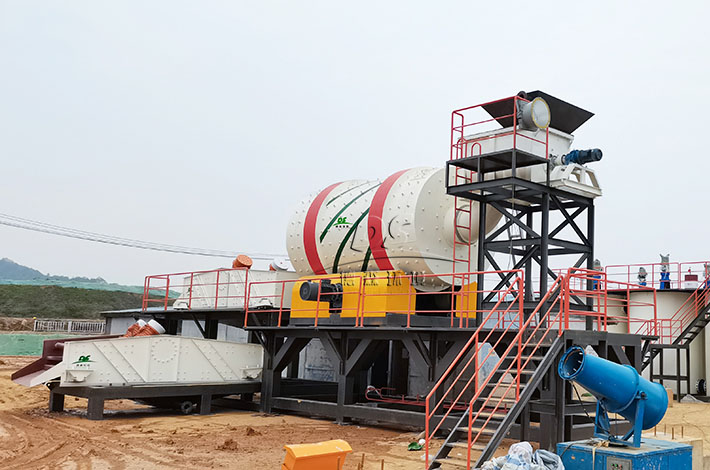
Excavated soil is first screened to remove oversized materials and debris. The remaining soil is fed into a drum scrubber, where particles are rubbed against each other in water, breaking down agglomerates and releasing contaminants from the surface of sand grains. The slurry then passes through hydrocyclones and screw classifiers, separating the soil into coarse sand and fine fractions. Because contaminants tend to bind to fine particles, this separation concentrates the contamination into a smaller volume of soil, which can then be treated more intensively.
Chemical Washing and Reduction
The fine fraction is mixed with washing reagents in a soaking and classifying module. For chromium-contaminated soil, the chemical stage can include reduction of hexavalent chromium to the less mobile trivalent form, together with dissolution and flushing of soluble chromium compounds. The mixing action of the module improves the contact between reagents and contaminated particles, increasing the efficiency of the chemical reaction and reducing reagent consumption.
Solid-Liquid Separation and Water Treatment
After chemical washing, the slurry is thickened in a deep cone thickener and dewatered by a plate and frame filter press. The dewatered cake can be sampled and, if necessary, treated further before disposal or reuse. Process water is collected, treated and recycled back into the washing circuit, so the plant does not create a secondary wastewater problem and fresh water demand stays low.
Project Experience with Chromium and Smelting Sites
Desen Environmental has delivered soil washing systems for chromium salt and smelting sites in China. In Changsha, Hunan province, a chromium salt smelting site remediation project processes 90 tonnes per hour, treating soil contaminated by decades of chromate production. Additional smelting site projects in Hunan, also operating at 90 tonnes per hour, confirm that high-throughput soil washing can meet the demands of large industrial sites while keeping the whole treatment train automated and controllable.
These projects show two important lessons. First, a well-designed scrubbing and classification line can handle the mixed soil textures found on industrial sites, from sandy fill to clay-rich layers. Second, integrating water treatment into the plant keeps the operation running continuously, which matters on large sites where stopping the line means losing production time.
Key Advantages for Smelting Site Remediation
- High throughput: plants can be designed for 20 to 90 tonnes per hour or more, matching the scale of large industrial sites.
- Contaminant concentration: size classification reduces the volume of heavily contaminated fine soil that needs special treatment.
- Closed water loop: process water is recycled, reducing fresh water use and eliminating uncontrolled discharge.
- Modular delivery: fixed, skid-mounted and mobile configurations allow phased installation and relocation between sites.
- Automated control: DCS-based control with cloud monitoring keeps the plant running reliably and makes the process transparent to regulators and clients.
Considerations for Chromium Remediation Projects
- Site investigation: contaminant distribution, chromium speciation and soil texture should be characterized before the process is selected.
- Treatment targets: the intended future use of the soil determines how clean the washed material must be.
- Combined treatment: soil washing can be combined with other technologies, such as stabilization or biological treatment, for residual contamination.
- Regulatory requirements: sampling and monitoring plans should be agreed with the regulator early in the project.
- Pilot testing: a small-scale trial on site-specific soil confirms reagent dosages and expected removal rates before full-scale equipment is committed.
Conclusion
Chromium-contaminated soil remediation is demanding, but soil washing has repeatedly shown that it can handle the scale and complexity of smelting and chromate production sites. By combining scrubbing, classification, chemical washing and water recycling, a well-designed plant can treat large volumes of soil with efficient use of water and energy. Desen Environmental has delivered high-throughput soil washing systems for chromium and smelting sites in China and can adapt the technology to projects worldwide. Contact the Desen team to discuss your remediation requirements.