Mobile Solid-liquid Separation Plant for Efficient Soil Washing and Slurry Dewatering
Why Solid-liquid Separation Is Critical in Soil Washing. Soil washing generates large volumes of slurry that contain fine particles, sand and dissolved contaminants. If this slurry is handle
Why Solid-liquid Separation Is Critical in Soil Washing
Soil washing generates large volumes of slurry that contain fine particles, sand and dissolved contaminants. If this slurry is handled as raw waste, haulage and disposal costs rise quickly and valuable recoverable material is lost. Solid-liquid separation is the stage where the slurry is concentrated, dewatered and split into clean solids, filter cake and process water, so that each fraction can be managed or reused in the most economical way.
Reduces slurry volume and cuts transport and disposal costs
Recovers fine sand and aggregates for reuse
Produces filter cake with low moisture content for safe handling
Returns process water to the washing circuit for recycling
Plant Configuration and Key Modules
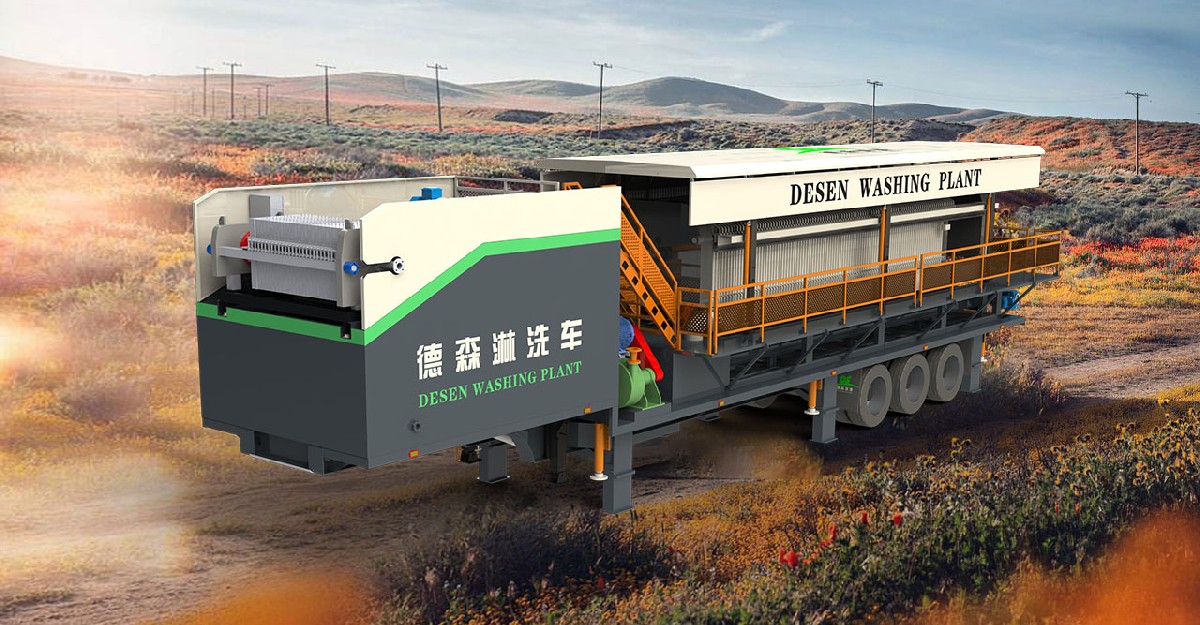
The mobile solid-liquid separation plant integrates the full dewatering chain on a single mobile platform, which can be relocated between project sites and commissioned quickly without heavy civil works.
High-efficiency Deep Cone Thickener
Slurry is fed into a deep cone thickener where fine particles settle by gravity and are further compacted by a slowly rotating stirrer. Flocculant such as PAM is added to accelerate settling, producing clear overflow and a dense underflow for the next stage.
Plate and Frame Filter Press
The thickened slurry is pumped into a plate and frame filter press for solid-liquid separation. The pressure difference across the filter cloth forces water through the cloth while solids are retained as filter cake. The cake has low moisture content and can be transported for final disposal, while the filtrate is collected and treated.
Integrated Process Water Treatment
Overflow from the thickener and filtrate from the filter press are sent to a water treatment unit, where suspended solids are removed so that the water can be recycled as washing water, reducing fresh water consumption.
How the System Works
A typical operating sequence for the mobile solid-liquid separation plant is:
Slurry from the washing or classifying stage is pumped into the deep cone thickener
Flocculant is dosed to accelerate settling and concentration
Overflow water enters the treatment unit and is recycled
Thickened underflow is fed to the plate and frame filter press
Filter cake is discharged for off-site disposal or further treatment
Field Applications
The mobile solid-liquid separation plant has been applied in municipal and remediation projects where rapid deployment and a compact footprint are required. In a trench and dredged sludge disposal project in Jiangxi, a modular system processed 15 t/h of trench sludge with a total installed power of 224.85 kW and a two-person shift. In an urban pipeline sludge project in Guangzhou Nansha, the system was configured with feeding, scrubbing and classifying modules with PLC control to process 8 t/h of pipeline sludge.
Key Benefits
Mobile and relocatable design for multi-site projects
Compact footprint with fast installation and commissioning
DCS distributed control with remote monitoring
Low operating cost with reduced labor and energy demand
Conclusion
For contractors and remediation specialists who need dependable dewatering capacity at multiple sites, the mobile solid-liquid separation plant offers a practical balance of performance, mobility and operating cost. Zhengzhou Desen Environmental Technology Co., Ltd. delivers this system as part of a complete soil washing and slurry treatment portfolio. For more information, contact the Desen team or visit www.materialwashing.com.