Petroleum Soil Remediation Engineering
Petroleum soil remediation engineering guide: process design, equipment selection and field data from Desen Environment.
Petroleum Soil Remediation Engineering: Turning TPH Tonnes into Reusable Fill
Nobody buys a soil washing plant for the way it looks on a brochure. They buy it because a deadline is attached to a pile of contaminated dirt, and the pile keeps getting bigger while the budget does not. Petroleum soil remediation engineering is the discipline of closing that gap: matching the right process train to a specific TPH profile, then running it hard enough to hit the cleanup target without burning the schedule. This article explains how that engineering is done, what the equipment choices mean in the field, and what real projects reveal about the difference between a washing line that works and one that merely runs.
Technical Principles: What the Washing Train Actually Does
Petroleum soil remediation through washing rests on one stubborn fact: hydrocarbons prefer fine particles. Silt and clay carry most of the TPH load because they offer surface area and organic matter that oil clings to, while sand and gravel stay comparatively clean. A washing train exploits that split in three moves:
- Attrition scrubbing — high-shear mixing in a drum scrubber or attrition cell breaks soil aggregates and strips oil films off particle surfaces.
- Surfactant-assisted desorption — a dosed washing solution lifts residual hydrocarbons from fines without creating a secondary waste stream.
- Classification and dewatering — hydrocyclones, screens and a filter press divide the stream into clean sand, concentrated fines and recyclable process water.
The mass balance does the rest. If the fines fraction is 20 to 30 percent of the feed, then washing treats the entire volume but only sends that small concentrate for further treatment or disposal. That single ratio decides whether a project makes sense.
Technical Advantages: Why Engineering Discipline Wins
Field teams choose mobile and modular systems from Zhengzhou Desen Environmental Technology Co., Ltd. (Desen Environment) for reasons that survive contact with a real site:
- On-site processing — clean sand returns to the excavation, haulage disappears, and landfill bills shrink to the concentrate only.
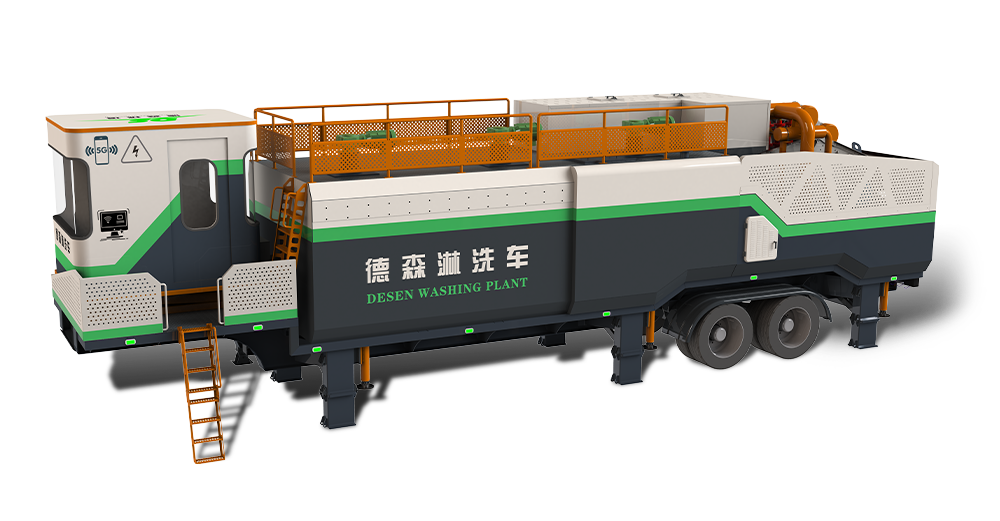
- Short mobilisation — a skid-mounted plant commissions in days, which matters when the regulator's clock is running.
- Controllable endpoint — treatment targets are set per lot and verified by sampling, so the outcome is documented rather than assumed.
- Lower energy and carbon — no heating stages, no truck fleets, and a closed water loop that keeps fresh-water use near zero.
None of this is automatic. Bench-scale tests on the actual soil decide reagent type, dosage and scrubbing time before the plant is sized. Skip that step and the first week on site becomes an expensive tutorial.
Case Analysis: A Tank Farm Cleanup in Numbers
Desen Environment recently engineered a washing campaign for a decommissioned tank farm holding roughly 45,000 tonnes of diesel-contaminated sandy loam, with TPH averaging 4,800 mg/kg. The team ran treatability tests, then mobilised a modular plant sized at 120 tonnes per hour. Scrubbing plus flotation brought the sand fraction below 500 mg/kg in six weeks; the fines slurry, about 18 percent of the volume, was dewatered and routed for thermal treatment. The client reused 80 percent of the treated soil as backfill. The economics followed the mass balance: disposal cost landed near a third of the haul-and-dump baseline.
FAQ: Engineering Questions from Site Owners
Which TPH levels can a washing plant handle?
Practical experience points to feed concentrations up to roughly 50,000 mg/kg for sandy and loamy soils. Heavily weathered or clay-bound material may need pre-treatment or a polishing step, which is why the pilot test comes first.
How long does commissioning take?
Modular systems from Desen Environment typically commission in seven to ten working days, including water-circuit testing and operator training.
Can the washed soil be reused on site?
Yes, when lab results meet the agreed screening values. Most projects return 60 to 80 percent of the volume to the site as reusable fill.
What does Desen Environment provide?
Desen Environment supplies the full petroleum soil remediation engineering package — process design, treatability testing, modular equipment and on-site commissioning. Send your site data through materialwashing.com and the team will size a train for your material.