Mine Tailings Washing and Classification: How Modular Equipment Improves Recovery and Supports Sustainable Mine Site Closure
How modular mine tailings washing and classification equipment recovers usable aggregate, cuts waste volume, and supports responsible mine site closure.
Mine Tailings Washing and Classification: How Modular Equipment Improves Recovery and Supports Sustainable Mine Site Closure
Every mine that has operated for years leaves behind a stockpile that most people walk past without a second thought. Mine tailings are that leftover material, and for a growing number of mining companies they are also a missed opportunity. Instead of locking value into a waste dump or paying steadily rising disposal fees, operators are turning to mine tailings washing and classification systems that separate usable aggregate from fine sludge, cut the volume that must be contained, and support a cleaner path to site closure. This article explains how the technology works, where it delivers the biggest gains, and what a real project looks like in the field.
Why Mine Tailings Washing Matters
Raw tailings are a mixture of fine sand, silt, clay, residual ore particles and the process water used during extraction. Left untreated, they sit in tailings dams that require permanent monitoring and maintenance. Treating them with washing and classification equipment changes the picture. The coarse fraction becomes sand and gravel that can be reused in backfill, road base or aggregate applications, while the fine fraction shrinks to a much smaller volume that is easier to manage. For operations facing stricter environmental rules, higher water costs or limited dam capacity, this is not a theoretical benefit. It is a direct reduction in both liability and operating expense.
How the Washing and Classification Process Works
The principle behind mine tailings washing is straightforward but the execution requires careful process control. The separation relies on differences in settling velocity and on the way water and mechanical energy break apart loosely bound material. A complete system is built from four core units.
Attrition Scrubbing
In the scrubbing unit, high-intensity mixing breaks down clay lumps and strips surface coatings from sand grains. This step is essential because tailings often contain agglomerated fines that hide clean aggregate inside. Once the material is disaggregated, the next stages can do their job properly.
Screening and Classification
Screening removes oversized debris, while hydrocyclones and spiral classifiers split the stream by particle size. The result is a clean sand and gravel product on one side and a fine slurry on the other. The cut point can be adjusted to match the local aggregate specification, which makes the system flexible enough for different ore types and site requirements.
Solid-Liquid Separation and Water Treatment
The fine slurry is thickened and dewatered into a filter cake, and the water is treated and recycled back into the process. This closes the water loop and prevents the discharge of turbid effluent, a point that matters more and more as water permits become harder to obtain.
Key Advantages of the Modular Approach
Desen Environment builds its mine tailings washing and classification plants on skid-mounted, modular frames, and that choice changes the economics of a project in several ways.
- Fast deployment. Modules arrive on standard trailers and need only a level, hard-standing area. No permanent foundations or long civil works are required, so commissioning happens in weeks rather than months.
- Low operating cost. The closed water circuit cuts fresh water demand, and the automated PLC and DCS control system keeps manpower to a minimum while maintaining stable process conditions.
- Scalable capacity. Plants can be sized from roughly 30 tons per hour up to much larger throughputs, and additional modules can be added as production grows.
- Recovered value. Sand and gravel from the plant can be sold or reused instead of being buried, turning a disposal cost into a revenue line.
All of this is backed by the engineering team at Zhengzhou Desen Environmental Technology Co., Ltd., the company behind the materialwashing.com product platform, where detailed equipment specifications and application guidance are published for international customers.
Case Study: Mine Tailings Washing Project in Hebei, China
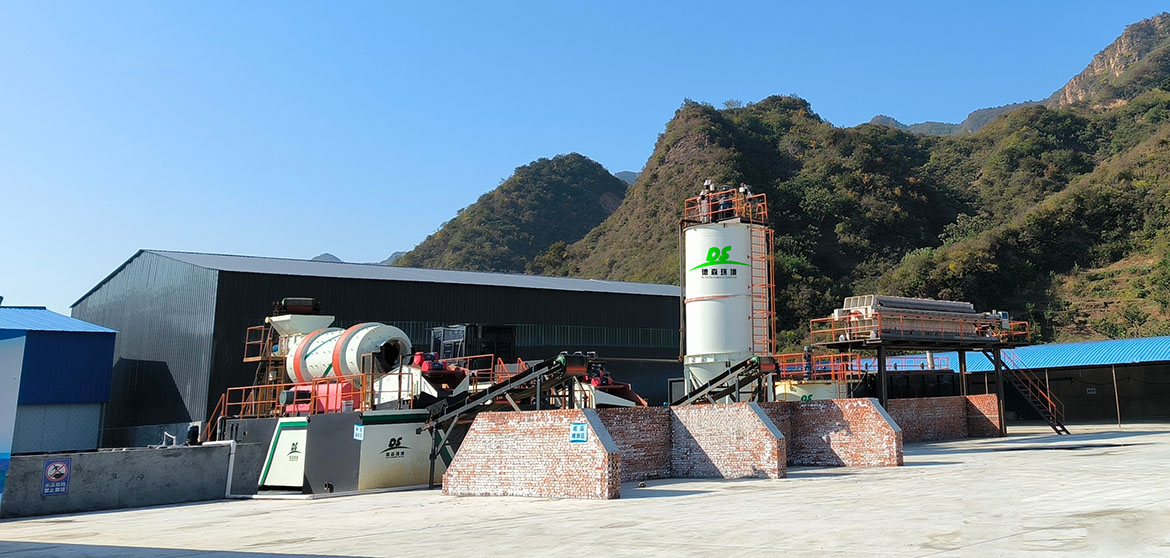
A concrete example of this approach in action is the mine tailings washing and classification treatment project in Hebei, China, delivered by Desen Environment. The plant processes roughly 30 tons per hour of tailings from a local mining operation. Through scrubbing, screening and hydrocyclone classification, the system separates clean aggregate from fine sludge, reduces the volume sent to disposal, and returns clarified water to the process. The project demonstrates that a modular washing and classification system can be commissioned quickly and run reliably under real site conditions, which is exactly what operators need when they are balancing production schedules with environmental commitments.
Frequently Asked Questions
Can mine tailings washing handle high clay content?
Yes. High-clay feed is one of the main reasons operators choose a washing plant in the first place. Attrition scrubbing disaggregates the clay, and the classification circuit then separates the fine material from the coarser sand. The system is designed around the actual feed characteristics, so the result is reliable even on sticky material.
How much of the tailings can be recovered as aggregate?
It depends on the ore type and particle size distribution, but on typical tailings a significant share of the feed can be recovered as reusable sand and gravel. A laboratory test on a representative sample is the standard way to determine the expected recovery rate before the plant is sized.
What happens to the fine fraction after washing?
The fines are thickened and dewatered into a filter cake, which concentrates the material into the smallest practical volume. This cake is easier to transport and easier to dispose of responsibly, and in some cases it can be further processed for its residual mineral value.
Is the equipment suitable for remote mine sites?
Yes. The skid-mounted, modular design is made for remote locations. Units are transportable on standard trailers, assembly requires minimal site preparation, and the control system can be monitored remotely through the 5G-connected PLC, so a small local crew can operate the plant with support from the Desen service team.
How do I get a mine tailings washing system specified for my project?
Start by sending feed samples and site details to Desen Environment. The engineering team runs process tests, proposes a flowsheet, and supplies a budget quotation. All technical documentation and contact channels are available on materialwashing.com, so the conversation can begin with a short inquiry form.
Mine tailings are no longer just a problem to store. With the right washing and classification equipment, they become a manageable resource, a smaller environmental footprint, and a measurable line item in the mine's favor. If your operation is facing rising disposal pressure, it may be time to look at the tailings pile differently.