Mobile Soil Washing Plant Application in Middle East Oil Pollution Sites
Mobile Soil Washing Plant Application in Middle East Oil Pollution SitesThis case study examines the application of a mobile soil washing plant in remediating oil-contaminated soil at oilfield sites in the Middle East, covering project background, site challenges, the deployed solution, and verif
Mobile Soil Washing Plant Application in Middle East Oil Pollution Sites
This case study examines the application of a mobile soil washing plant in remediating oil-contaminated soil at oilfield sites in the Middle East, covering project background, site challenges, the deployed solution, and verified operational results from a flagship project in Abu Dhabi.
Project Background: Oil-Contaminated Soil in Middle East Oilfields
Decades of petroleum exploration and production have left large areas of contaminated soil across the Middle East. In the Abu Dhabi oilfield region, ongoing extraction activities have caused widespread crude oil contamination that local regulators require to be treated to a reusable standard. The affected soil contains a high proportion of weathered crude oil, making conventional excavation-and-disposal approaches neither environmentally nor economically sustainable.
Site Challenges
The project site presented several conditions that ruled out fixed treatment infrastructure:
High oil content: Average oil content in the contaminated soil reached approximately 8%, well above the range that standard biological treatment alone can address in a reasonable timeframe.
Extreme climate: Summer temperatures in Abu Dhabi regularly exceed 50 degrees Celsius, placing severe stress on equipment cooling, reagent stability, and operator safety.
Limited on-site infrastructure: The oilfield location had no concrete foundations, limited water supply, and constrained power availability, making permanent plant construction impractical.
Strict environmental requirements: Treated soil had to meet UAE environmental protection standards before reuse, requiring verifiable residual oil concentrations.
Solution: DS-MSW-100 Mobile Soil Washing Plant
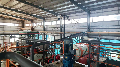
Desen Environment supplied a DS-MSW-100 mobile soil washing and remediation plant based on a thermal-chemical washing process. The complete system is integrated into standard shipping containers and can be transported by road, rail, or sea. After arrival on site, the plant was commissioned and put into operation within 24 hours, with no concrete foundation work required.
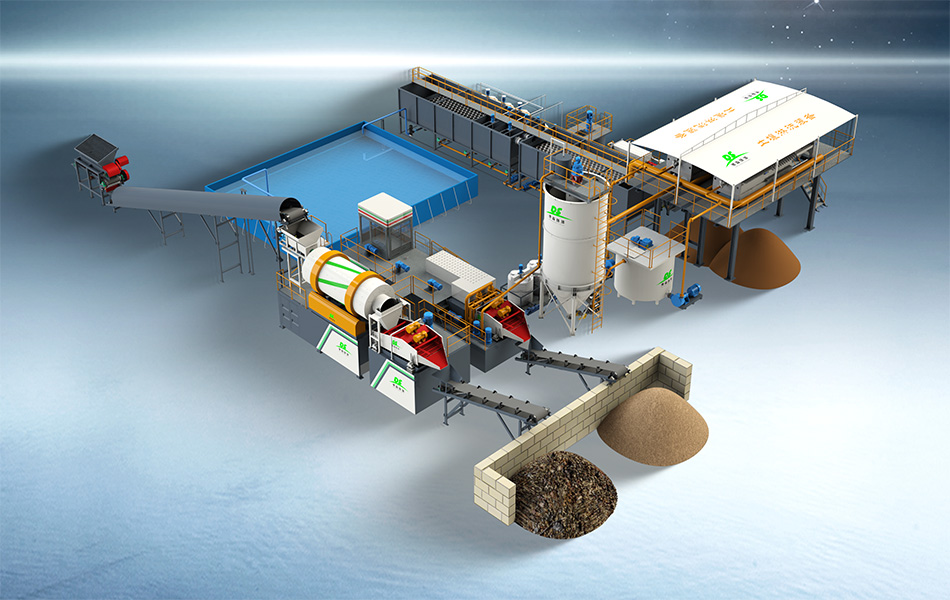
The mobile washing train combines the company's established unit operations into a single towable system:
Feeding and screening module: Bar-type screening removes oversize material and ensures uniform feeding of sticky, clay-bearing soil.
High-efficiency scrubbing unit: Intense mechanical scrubbing detaches oil films from soil particles and disperses contaminants into the slurry phase.
Classification and selection module: Spiral classifiers and hydrocyclones separate fine particles and improve reagent contact efficiency.
Solid-liquid separation and water treatment: Filter presses devater the concentrated slurry, while the integrated water treatment loop recycles process water for continuous reuse.
PLC-based control with centralized operation and monitoring allows a small crew of two to three operators per shift to manage the entire washing train.
Implementation and Verified Results
The DS-MSW-100 plant has treated approximately 100,000 tonnes of oil-contaminated soil at the Abu Dhabi site. Key verified results include:
Processing capacity: Steady throughput of 100 tonnes per hour under normal operating conditions.
Treatment outcome: Residual oil content in treated soil reduced to 2,000 mg/kg or below, compliant with UAE environmental standards.
Resource recovery: Approximately 5,000 tonnes of crude oil were recovered during the washing process and routed for reuse or proper disposal.
Operational stability: The plant has operated continuously and reliably for more than six months, with water recycling rates above 90%.
The client's evaluation of the equipment's treatment effectiveness and operational stability was highly positive, and the project has become a reference case for Desen Environment's mobile soil washing technology under hot, high-salinity, desert conditions.
Process Highlights for Oil-Contaminated Soil
The thermal-chemical washing route applied in this project is tailored to the physical behavior of weathered crude oil in sandy desert soil. Because oil films bind tightly to fine particle surfaces, simple rinsing is not sufficient. The scrubbing stage applies controlled mechanical energy to detach oil films, after which the slurry passes through classification units that separate clean coarse fractions from the finer contaminated fractions. Chemical additives improve phase separation and help emulsified oil report to the recovered-oil stream, while the filter press dewaters the remaining solids into a stable cake suitable for further treatment or disposal. Every water stream is routed through the integrated treatment loop, so fresh-water consumption stays low despite the arid local climate. This combination of mechanical scrubbing, classification, chemical conditioning, and water recycling forms a repeatable process train that can be scaled by adding parallel modules when project tonnage increases.
Why a Mobile Washing Plant Fits Middle East Oilfield Projects
The Abu Dhabi project illustrates several advantages of mobile soil washing plants for oil pollution sites in the region:
Rapid deployment: Containerized, towable modules eliminate civil works and shorten project startup by more than 80% compared with fixed plants.
Mobility between sites: One set of equipment can be relocated between oilfields and reused across multiple plots, improving asset utilization.
Closed-loop water management: High recycling rates matter in water-scarce regions and support strict discharge compliance.
Adaptability to harsh environments: The system tolerates high ambient temperatures and sandy, high-salinity soil while maintaining stable treatment performance.
Experience and Outlook for Regional Projects
This project was Desen Environment's first soil remediation project in the Middle East and laid a foundation for further market expansion. The verified combination of high throughput, compliant treated-soil quality, and reliable operation under extreme conditions demonstrates that mobile soil washing plants are a practical option for large oil-contaminated sites where fixed infrastructure is not viable. For oilfield operators and remediation contractors evaluating treatment alternatives, a mobile washing approach shortens lead time, reduces capital tied to one site, and delivers auditable end-of-treatment results.
Contact Desen Environment
For more information about mobile soil washing plants and oil-contaminated soil remediation solutions, visit www.materialwashing.com or contact the Desen technical team for project-specific equipment selection and process design.
This article is based on Desen Environment's documented project data and is provided for informational purposes.