Washed Soil Stockpile Sampling Protocol: Proving the Pile Meets Its Reuse Criteria
How to build a washed soil stockpile sampling protocol: lot boundaries, increment counts, sample pad practice, moisture basis and chain of custody that make a reuse decision defensible.
Washed Soil Stockpile Sampling Protocol: Proving the Pile Meets Its Reuse Criteria
Washed soil does not leave a plant as a single uniform material. It leaves as a series of stockpiles, each built from whatever the line was processing that shift: a different feed batch, a different moisture content, sometimes a different cut point. When a regulator, a client's verifier or an end user asks whether a pile is clean enough to reuse, the answer rests on a sample of a few hundred grams taken from several thousand tonnes. The protocol behind that sample is what makes the number defensible. This article sets out how to build one on a working site.
Why the Stockpile Decides Acceptance, Not the Sample
A laboratory result is only as meaningful as the material it represents. Two projects can send identical subsamples to the same laboratory and read the same concentration, yet one lot is accepted and the other rejected, because the sampling differed. The pile is the population; the sample is an estimate of it. Increment count, depth, pattern and compositing all exist to keep that estimate honest.
Lifts and discharge points create layers
A stockpile built by a conveyor is not homogeneous. Coarse material rolls to the toe, fines stay near the discharge point, and each lift traps a surface layer that becomes an internal boundary. If the line changed feed or reagent dose halfway through the day, the pile records that change in horizontal bands. Sampling only the crest, or only the face nearest the haul road, samples the easiest material rather than the pile. A defensible pattern walks the perimeter at a fixed interval, takes increments at two or three depths, and includes the toe where coarse material has segregated.
How many increments are enough
Increments buy representativeness; mass does not. Ten increments of 200 g combined and reduced properly will outperform a single 5 kg grab sample. Many project specifications land between one composite per 250 and 500 tonnes of washed product, with a floor on the number of increments per composite, commonly ten to fifteen, regardless of pile size. Where the material is visibly variable, or the cut point changed mid-run, the better response is to split the pile into lots, not to sample harder.
Building the Protocol on Site
The protocol has to survive a working site: excavators moving, decks running, dust in the air. Practical arrangements matter as much as the wording of the plan.
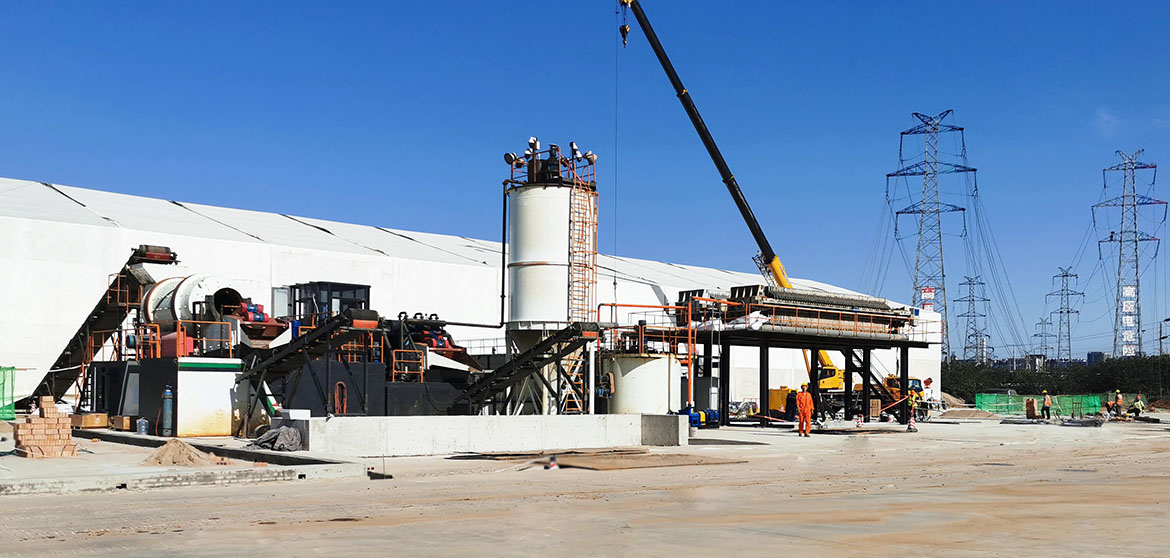
Sample pad, tools and cross-contamination
Dedicate a small area away from the plant for opening, quartering and bagging. One clean shovel and one auger per lot, washed between lots, stops the previous pile's fines from travelling into the next composite. Bags should be labelled before filling, not after. Where the feed is visibly contaminated, gloves and a change of outer layer at the pad keep exposure and carry-over in check.
Moisture, drying and sub-sampling
Washed soil arrives wet, and wet material is hard to split evenly. Drying before reduction changes the basis of the result, so the protocol should state whether concentrations are reported on a dry-weight basis and at what stage the sample was dried. Field moisture matters for the reuse decision itself: a pile that passes on metals may still fail a placement criterion because it is too wet to compact. Recording moisture at the sample pad, not only in the laboratory, closes that gap.
- One composite per lot, boundaries agreed before sampling starts
- Increments at fixed intervals around the perimeter, at two or three depths
- Individual increment weights recorded, not just total mass
- Bags labelled with lot ID, date and the run they came from
- Chain-of-custody sheet signed at the pad, at hand-over and at the lab
- A retained portion of each composite held until release
From Result to Release Decision
What a passing result does not prove
A pass on the analysed parameters releases the lot against those parameters only. It does not certify the pile as uniform, and it does not cover a contaminant that was never on the test list. Where site history points to an unexpected element, or the feed changed mid-run, adding one indicator parameter to the suite is cheaper than re-sampling a released pile. It also helps to state the decision rule in advance: single composite, or composite plus a duplicate, and what happens when the two disagree.
Tracing a pile back to its run
The most useful field record is a simple one: which pile came from which run, on which day, at which settings. When a result is borderline, that record lets the plant check the parameters used for that run, such as reagent dose, wash water ratio and retention time, instead of guessing. On a modular line it is usually a page in the operator log; on a mobile plant, a photograph of the control panel and a note in the daily sheet. Either way, it turns a sampling programme into a process control loop.
A sampling protocol is not paperwork bolted onto the end of a washing project. It is the step that converts tonnes of treated material into a product someone is willing to accept. Desen Environmental supplies modular and mobile washing plant for contaminated soil, and works with project teams on the verification arrangements around it.