Mobile Soil Washing Plant for Heavy Metal Contaminated Soil Remediation
How mobile soil washing plants remediate heavy metal contaminated soil on site: process flow, advantages over fixed plants, a China project case, and FAQ from Desen Environment.
Heavy metal contamination is among the most persistent threats facing brownfield sites, former smelters, mining areas, and industrial parks around the world. Unlike organic pollutants, metals such as lead, arsenic, cadmium, chromium, and zinc do not biodegrade — they remain in soil indefinitely, migrating into groundwater and entering the food chain unless the soil is actively treated.
Among available remediation technologies, the mobile soil washing plant has emerged as one of the fastest and most cost-effective solutions for heavy metal soil remediation. By bringing the entire treatment process directly to the contaminated site, mobile soil washing equipment eliminates transport risks, shortens project schedules, and recovers the majority of treated soil for safe reuse. This article explains how mobile soil leaching technology works, its advantages over fixed installations, and what project owners should consider when deploying it on heavy metal contaminated land.
Why Heavy Metal Contaminated Soil Demands Physical Separation
In most contaminated sites, heavy metals are not distributed evenly across all soil particles. Research and field data consistently show that metals concentrate in the fine fractions — silt and clay below 0.063 mm — because fine particles have a large specific surface area and strong adsorption capacity. Coarse fractions such as gravel and sand typically carry far lower contaminant loads.
A soil washing system exploits this distribution. Through wet scrubbing, particle size classification, and targeted chemical leaching, the process divides contaminated soil into:
- Clean coarse fractions (60-85% by mass): gravel and sand that meet reuse criteria after washing
- Contaminated fine fraction (15-40%): a concentrated sludge that is dewatered by filter press and sent for stabilized disposal or further treatment
Instead of landfilling 100% of excavated soil, only the concentrated fine residue leaves the site — dramatically cutting disposal cost and preserving landfill capacity.
How a Mobile Soil Washing Plant Works
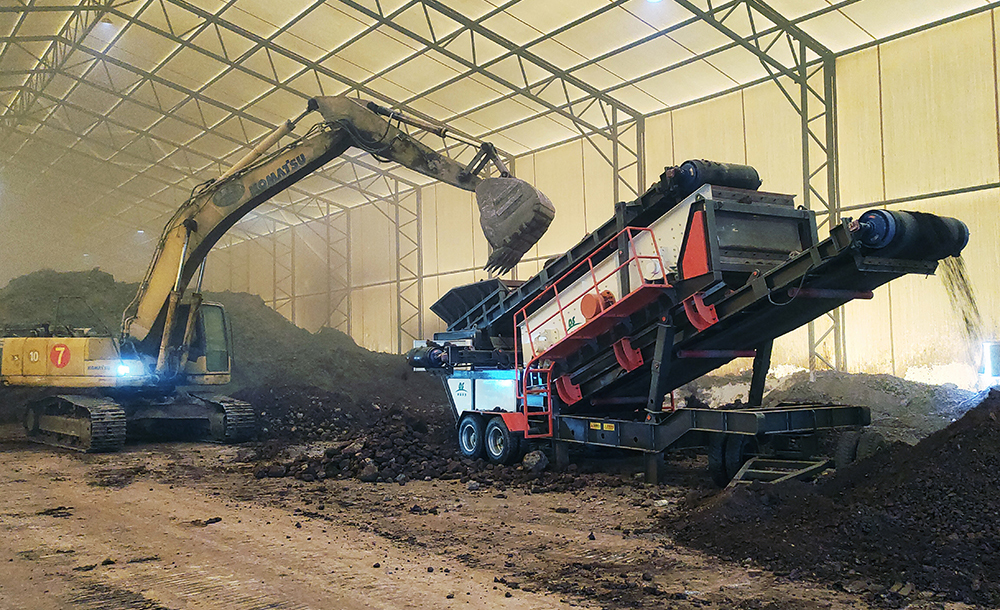
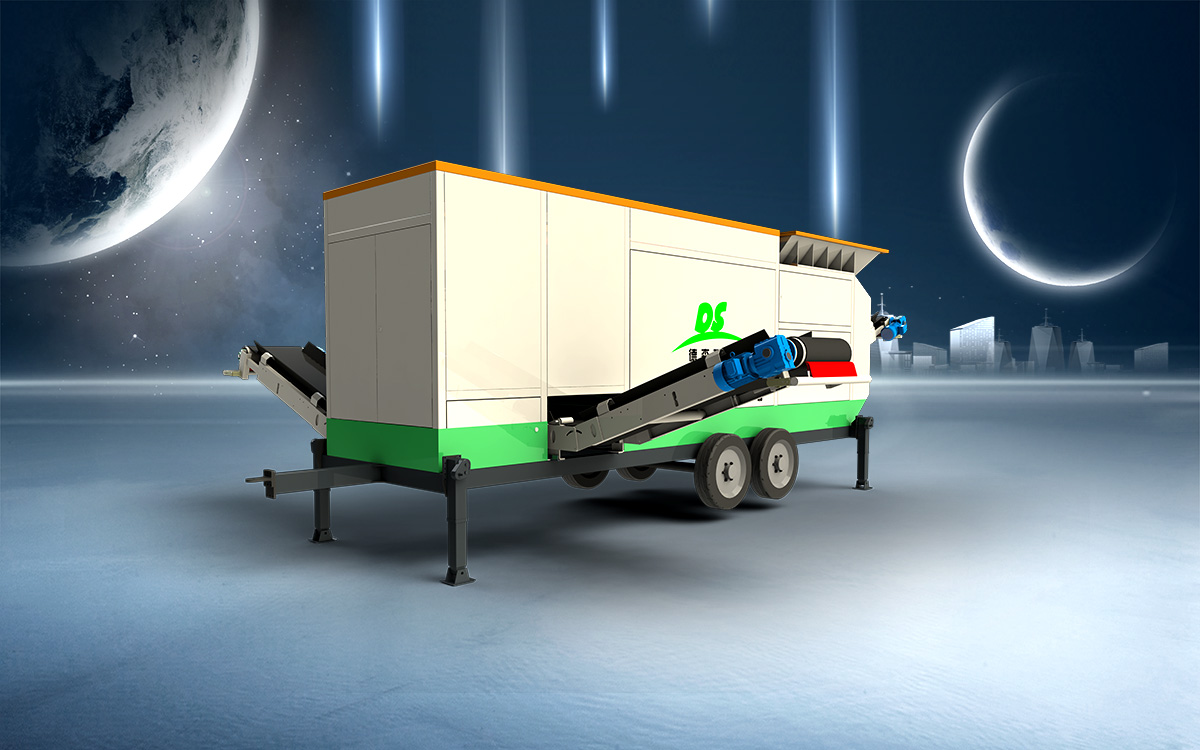
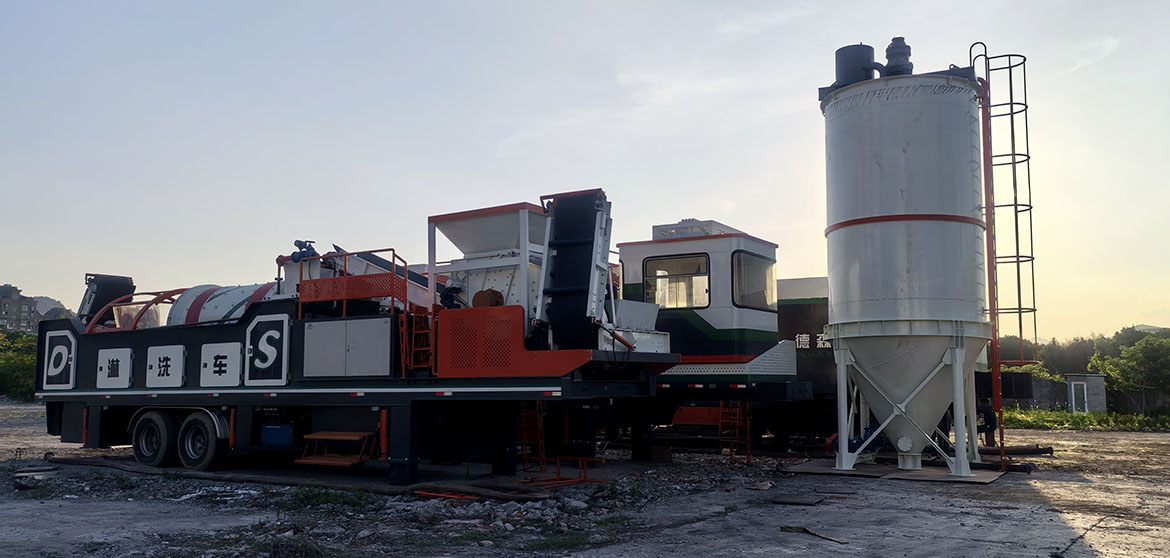
A modern mobile soil washing plant integrates the full treatment train onto truck-mounted chassis or containerized modules. A typical process flow includes:
- Feeding and pre-screening: Excavated soil passes a grizzly screen to remove oversize debris, then enters a controlled feed hopper.
- Drum scrubbing: A rotating drum scrubber applies high-energy attrition, liberating metal-bearing fines from coarse particle surfaces.
- Leaching and chemical enhancement: Where metals are chemically bound, washing agents such as chelating reagents or mild acids are dosed to transfer metals into the liquid phase.
- Multi-stage classification: Vibrating screens, hydrocyclones, and spiral classifiers separate the washed soil into defined size fractions and rinse away residual reagents.
- Sludge dewatering: The contaminated fine slurry is thickened and pressed into dry filter cake by a high-pressure filter press.
- Closed-loop water treatment: Process water is treated, metals are precipitated and captured, and more than 90% of water is recycled back into the circuit.
The entire plant can be transported by standard trucks, positioned on a compacted pad, and commissioned within days — no permanent foundations or civil works required.
Key Advantages of Mobile Soil Washing Equipment
- On-site treatment, zero haulage: Contaminated soil never leaves the site, avoiding transport permits, road risks, and per-tonne haulage fees.
- Rapid mobilization: Setup in 3-7 days versus months of construction for a fixed plant.
- High removal efficiency: Field projects routinely achieve 85-95% removal of lead, cadmium, arsenic, and zinc from the treated coarse fractions.
- Volume reduction: Disposal volumes are cut by 60-85%, which is usually the single largest cost saving in a remediation budget.
- Flexible capacity: Units are available from 10 to 50 tonnes per hour and can operate in series for larger sites.
- Intelligent control: Modern plants use PLC/DCS automation with remote monitoring, enabling stable operation with a small site crew.
Engineering Practice: Heavy Metal Site Remediation in China
As a leading manufacturer in this field, Desen Environment (Zhengzhou Desen Environment Technology Co., Ltd.) has deployed mobile soil leaching vehicles and modular washing plants on multiple heavy metal remediation projects across China, including former smelting sites and chemical industry parks contaminated with lead, arsenic, and cadmium.
In a representative project, a Desen mobile washing unit processed lead-contaminated soil at 20 tonnes per hour. After drum scrubbing, two-stage cycloning, and chelating-agent enhanced leaching, more than 80% of the soil mass was recovered as clean backfill meeting local screening values, while the fine residue was dewatered to below 25% moisture content for secure disposal. The full campaign — mobilization, treatment, and demobilization — was completed within the construction season, a timeline no fixed facility could match.
Mobile vs Fixed Soil Washing Plants: Which Should You Choose?
Mobile equipment is the preferred choice when the contaminated volume is site-specific and finite, when regulations restrict off-site movement of hazardous soil, or when schedule pressure demands fast deployment. Fixed installations remain attractive for centralized treatment hubs serving many small sites in a region. Many contractors adopt a hybrid strategy: skid-mounted modular units that combine near-fixed throughput with relocatable flexibility.
Frequently Asked Questions (FAQ)
Q1: What heavy metals can soil washing remove?
Lead (Pb), cadmium (Cd), arsenic (As), chromium (Cr), zinc (Zn), copper (Cu), nickel (Ni), and mercury (Hg) are all treatable. Removal efficiency depends on particle-size distribution and how the metals are bound in the soil matrix.
Q2: How much soil can be recovered for reuse?
Typically 60-85% of the feed mass, depending on the fines content. A laboratory washing test on representative samples gives an accurate prediction before equipment mobilization.
Q3: Does the process consume large amounts of water?
No. Closed-loop water treatment recycles over 90% of process water; net consumption is usually 0.3-0.8 m3 per tonne of soil.
Q4: How long does it take to deploy a mobile soil washing plant?
Transport, positioning, and commissioning are normally completed within one week, and treatment can begin immediately after performance verification.
Conclusion
For heavy metal contaminated sites, the mobile soil washing plant delivers a rare combination of speed, treatment performance, and cost control. By concentrating contamination into a small fine fraction and recovering the bulk of the soil for reuse, mobile soil leaching equipment turns a disposal problem into a resource recovery opportunity.
Desen Environment (materialwashing.com) designs and manufactures mobile soil washing vehicles, modular leaching plants, and complete soil remediation systems. Contact our engineering team for a laboratory washing test and a tailored heavy metal remediation proposal.