Soil Washing Process Flow and Technical Advantages: A Complete Guide to Leaching Remediation Technology
Detailed analysis of the complete soil washing process flow—from pre-screening to water recycling—with a focus on technical advantages and real case data from Desen Environment.
Soil washing has become the cornerstone technology for contaminated soil remediation worldwide. Whether dealing with heavy metals, petroleum hydrocarbons, or complex mixed contamination, understanding the complete soil washing process flow is essential for project owners and environmental engineers planning an effective treatment strategy.
This article provides a comprehensive breakdown of how modern soil leaching systems operate — from raw feed acceptance through final effluent discharge — along with a clear analysis of why this technology continues to outperform alternatives on cost, speed, and cleanup performance. The guide reflects real-world deployments by Desen Environment, a leading manufacturer of mobile soil washing plants based in Zhengzhou.
The Complete Soil Washing Process Flow
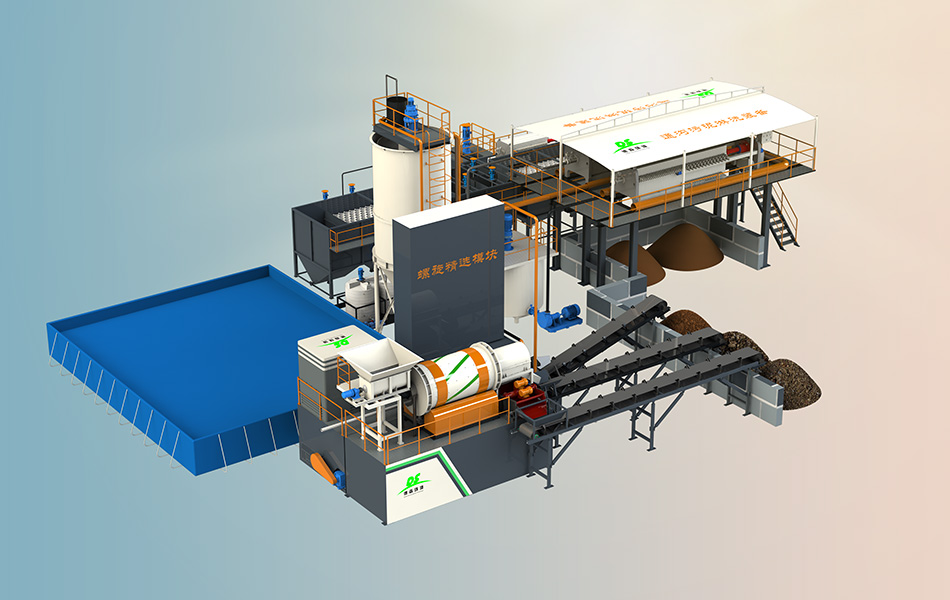
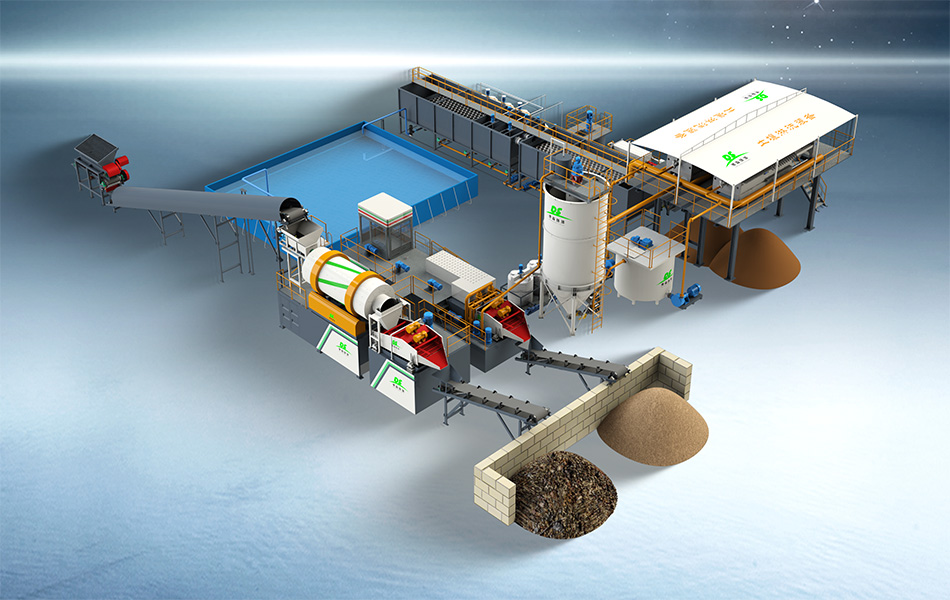
A full-scale soil leaching equipment line integrates six core stages that work together continuously. Each stage addresses a specific physical or chemical challenge inherent to contaminated soil treatment.
Stage 1: Feed Preparation and Pre-Screening
Excavated material enters through an excavator-fed hopper, where it passes a grizzly or scalping screen to remove oversized debris — large rocks, wood fragments, concrete chunks. This step protects downstream rotating equipment from damage and prevents blockage in the scrubbing circuit.
Stage 2: Wet Scrubbing and Attrition Cleaning
The cleaned feed is mixed with process water and fed into a drum scrubber or paddle-type attrition cell. Rotational motion and internal lifters create high-energy collisions between particles, stripping contaminant coatings from gravel surfaces and releasing fine-grained material where most pollutants concentrate.
Stage 3: Chemical Leaching Enhancement
In many remediation scenarios — particularly those involving heavy metals or recalcitrant organic compounds—physical separation alone is insufficient. Washing agents are dosed into the scrubbing zone to chemically mobilize bound contaminants:
- Mild acids (citric, oxalic) for metal extraction from carbonate and oxide phases
- Chelating agents (EDTA variants) for tightly complexed heavy metals such as lead and cadmium
- Surfactant solutions for mobilizing petroleum hydrocarbons and PAHs adsorbed onto fine particles
Stage 4: Multi-Stage Particle Classification
The washed slurry enters a cascading classification system that sorts material by particle size:
- Vibrating screens (typically at 1 mm and 0.063 mm cut-points) separate clean coarse fractions from contaminated fines.
- Hydrocyclone clusters provide fine classification below the screen range, producing a concentrated underflow of silt-clay sludge.
- Spiral classifiers or sedimentation tanks act as polishing stages to further purify recycled water and recover additional coarse sand from suspended material.
Stage 5: Sludge Dewatering and Concentrated Waste Handling
The fine-particle slurry containing the bulk of remaining contaminants is thickened in a settling cone or continuous clarifier, then fed to a high-pressure filter press. The resulting filter cake—typically at 25-40% moisture—is removed for off-site disposal, stabilization, or thermal treatment.
Stage 6: Closed-Loop Water Treatment and Recycling
Process water is never discharged directly. Instead, it passes through coagulation-flocculation conditioning followed by settling filtration that removes residual suspended solids and precipitated metals. Cleaned water returns to the scrubbing circuit with a typical recycling rate above 90%, reducing freshwater intake to just 0.3-0.8 cubic metres per tonne of processed soil.
Technical Advantages Over Alternative Remediation Technologies
The soil washing process offers several decisive advantages compared with in-situ flushing, thermal desorption, and bioremediation:
- Rapid treatment cycle: A mobile plant processes 10-50 tonnes per hour from the moment commissioning is complete. Full site turnaround often takes only weeks to a few months.
- High contaminant removal efficiency: Field data consistently show lead and zinc reduction of over 90% in sand/silt fractions; TPH removal exceeding 95-98% with surfactant enhancement.
- Dramatic volume reduction: Only the fine-particle fraction (typically 15-40%) requires off-site disposal, cutting total waste volumes by two-thirds or more compared to wholesale excavation-and-landfill approaches.
- Rapid return of treated soil: Clean coarse fractions meeting screening criteria can be reused as backfill on site within the same campaign.
- Economies of scale through modular design: Multiple units operate in parallel or series without requiring new civil works. Desen Environment's skid-mounted systems ship complete with integrated control panels, enabling plug-and-play installation at any prepared site pad.
- Digital monitoring and optimization: PLC-based automation continuously monitors flow rates, chemical dosing, pH levels, and product quality—allowing real-time adjustment without halting production.
Case Example: Heavy Metal Soil Remediation with a Continuous Washing Line in China
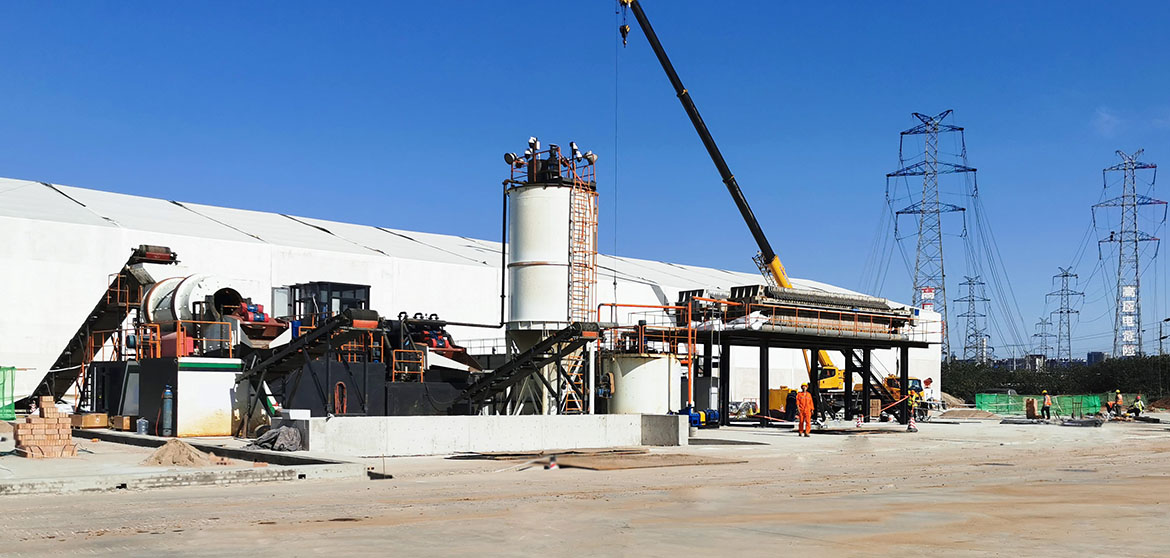
Zhengzhou Desen Environment Technology Co., Ltd. deployed an integrated mobile soil leaching line at a former non-ferrous smelting site near Anyang, Henan Province. The project involved treating approximately 18,000 tonnes of lead-contaminated topsoil to meet the GB36600 Class II screening values.
The treatment train consisted of a drum scrubber with surfactant dosing, dual-stage hydrocycloning at cut-points of 1.25 mm and 0.074 mm, an automated chelating-agent injection system for enhanced metal extraction, and two parallel high-pressure filter presses operating in shift mode.
Key results:
- Average throughput: 22 tonnes/hour, sustained over 14 working shifts per week
- Clean fraction recovery rate: 76% of total feed mass meeting screening criteria after washing and classification
- Pb removal from coarse fractions: mean concentration reduced from 2,800 mg/kg to below 150 mg/kg — a removal efficiency exceeding 94%
- Total treatment period: 6 months, including mobilization and demobilization
- Capture rate of process water: >93% closed-loop recycling across the entire campaign
The client reported total remediation cost savings of roughly 40% compared to a baseline excavation-and-landfill alternative, primarily driven by dramatically reduced disposal volumes and zero soil transport fees.
How Designto Match Your Site's Soil Washing Needs
Selecting the right soil washing process configuration depends on several project-specific parameters:
- S contaminant type and concentration: Heavy metals call for chelating enhancement; petroleum hydrocarbons benefit from surfactants or thermal conditioning.
- Particle size distribution (PSD): High fines content (>30%) means greater leaching volume but also higher recovery of coarse material—the economics favour washing over wholesale disposal.
- Site access and footprint: Mobile skid-mounted plants fit within 40-foot container dimensions; fixed installations can deliver capacities above 100 tonnes/hour for long-duration projects.
- Cleanup targets: Screening values dictate the number of classification stages required. Tighter limits may necessitate secondary polishing hydrocyclones or additional chemical dosing cycles.
The engineering team at Desen Environment (materialwashing.com) offers free laboratory washing tests to determine optimal process parameters before equipment is committed, ensuring that the chosen configuration delivers results within your regulatory budget and schedule constraints.
Frequently Asked Questions About Soil Washing Process
Q1: What contaminants can a soil leaching plant treat?
Heavy metals (Pb, Cd, Zn, Cu, Cr, As), petroleum hydrocarbons (TPH, PAHs), and certain pesticides. The method is most effective when contamination concentrates in the fine-particle fraction.
Q2: How much water does a soil washing system consume?
With closed-loop treatment, net consumption stays at 0.3-0.8 m³/tonne of processed material. Makeup water compensates for evaporation and filter-cake carry-off only.
Q3: Can soil washing meet strict Chinese regulatory limits?
Yes. Desen Environment's systems are designed to comply with GB36600-2018, HJ 25.7 remediation technical guidelines, and equivalent international standards including US EPA RCRA cleanup criteria.
Q4: What is the typical lead time for a mobile washing plant?
Standard units ship within 30-45 days from order confirmation; custom configurations typically require 60-90 days. On-site commissioning adds another one to two weeks.
Q5: Does the process generate significant wastewater discharge?
The design philosophy is zero-discharge where regulations permit. Filter-backwash effluents are recirculated; only periodic blowdown—treated and metal-precipitated before release—is required, usually below 1% of total circulation.
Conclusion
The soil washing process flow, when configured with the right combination of scrubbing strength, chemical enhancement, particle classification, and water recycling, delivers one of the fastest and most cost-effective paths to regulatory compliance on contaminated land projects. Mobile units from manufacturers like Desen Environment (郑州德森环境) make it possible to begin treatment within days—not months—of site mobilization.
Contact Desen Engineering at materialwashing.com for a complimentary soil washing test and a project-specific leaching process design tailored to your contamination profile, regulatory targets, and timeline requirements.