Skid-Mounted vs Fixed Soil Washing Plant: Complete Equipment Selection Guide
Skid-mounted vs fixed soil washing plant: a complete selection guide covering process design, throughput, mobilization time, cost per tonne, haulage economics, case study and FAQs from Desen Environment.
Choosing between a skid-mounted soil washing plant and a fixed soil washing plant is one of the most consequential decisions a contaminated site owner or remediation contractor makes. The choice determines mobilization cost, project schedule, throughput capacity, permitting complexity, and ultimately the cost per tonne of treated soil. Yet many projects select equipment based on habit or availability rather than a structured evaluation of site conditions.
Desen Environment (Zhengzhou Desen Environment Technology Co., Ltd.) designs and manufactures both configurations of soil washing equipment, and through its technical platform materialwashing.com supports clients in Asia, the Middle East, Africa, and South America. This selection guide sets out the engineering logic, cost drivers, and decision criteria that determine whether a skid-mounted soil washing plant or a fixed soil washing plant delivers better project economics.
How Soil Washing Works: A Common Technical Foundation
Before comparing configurations, it is important to recognize that both a skid-mounted soil washing plant and a fixed soil washing plant use the same core physical separation principle. Contaminants — heavy metals, petroleum hydrocarbons, PAHs, pesticides — concentrate preferentially in the fine silt and clay fraction because of its very high specific surface area and organic carbon content. Soil washing separates that contaminated fine fraction from the clean coarse sand and gravel, reducing the volume requiring disposal or intensive treatment by 60% to 90%.
A complete soil washing circuit from Desen Environment normally includes:
- Feed preparation and pre-screening: removal of oversize debris, concrete, roots, and foreign objects
- Attrition scrubbing: high-shear mechanical scrubbing that liberates contaminants bonded to particle surfaces
- Hydrocyclone classification: multi-stage cyclones splitting the slurry into coarse, medium, and fine size fractions
- Dewatering screens and spiral classifiers: recovery of clean, drained sand product
- Flotation or chemical dosing: optional stages for hydrocarbon or specific metal removal
- Thickening and filter pressing: dewatering the contaminated fines to 35%-45% solids
- Water treatment and recycling: closed-loop recovery of 85%-95% of process water
The difference between skid-mounted and fixed soil washing plants is therefore not the process chemistry, but how the process modules are packaged, transported, installed, powered, and decommissioned.
Skid-Mounted Soil Washing Plant: Characteristics and Advantages
A skid-mounted soil washing plant packages each process stage onto a structural steel skid or container frame that can be lifted by crane, transported on a standard flatbed trailer, and connected on site with quick-couple pipe and cable connections. Desen Environment's skid-mounted series typically covers throughput ranges from 20 to 150 tonnes per hour, with individual skids sized to fit within standard 20-foot or 40-foot shipping envelopes.
Key Advantages of Skid-Mounted Soil Washing Equipment
- Fast mobilization: Installation and commissioning typically takes 7 to 20 days, versus 3 to 8 months for a fixed soil washing plant. Foundations are minimal — often compacted gravel pads or light concrete footings rather than deep reinforced structures.
- Redeployability: The same skid-mounted soil washing plant can serve multiple sites over its life. A contractor amortizing capital across five or six projects achieves a far lower effective cost per tonne than one dedicating equipment to a single site.
- Lower permitting burden: Temporary treatment facilities usually face simpler approval pathways than permanent installations, and avoid long-term land-use commitments.
- On-site treatment eliminates haulage: Treating soil where it lies removes trucking cost, traffic impact, carbon emissions, and off-site liability. On large urban sites, avoided haulage alone often exceeds the entire treatment cost.
- Modular capacity scaling: Additional skids can be added to raise throughput, or the circuit reduced for smaller campaigns, without redesigning the plant.
- Reduced decommissioning cost: At project completion, the plant is disconnected and trucked away; there is no demolition of concrete structures or site restoration of a permanent footprint.
Limitations of Skid-Mounted Configurations
- Peak throughput is generally lower than a purpose-built fixed soil washing plant of equivalent investment
- Transport envelope constraints limit the size of individual vessels, thickeners, and filter presses
- Repeated mobilization causes mechanical wear and requires disciplined maintenance between deployments
- Weather protection and noise attenuation are more limited than in an enclosed building
Fixed Soil Washing Plant: Characteristics and Advantages
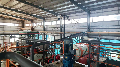
A fixed soil washing plant is a permanent installation built on engineered foundations, usually within or adjacent to a soil treatment centre, quarry, industrial park, or large mining operation. Vessels, conveyors, and structures are erected in place, allowing much larger equipment sizes and fully integrated material handling.
Key Advantages of a Fixed Soil Washing Plant
- Higher sustained throughput: Fixed installations routinely operate at 200 to 500 tonnes per hour, well beyond typical skid-mounted capacity, making them ideal for regional soil treatment centres receiving material from many sites.
- Lower long-run unit cost: When annual tonnage is high and stable, spreading capital across many years of continuous operation yields the lowest cost per tonne of any soil washing configuration.
- Deeper process integration: Permanent plants can incorporate large thickeners, high-capacity membrane filter presses, advanced water treatment, thermal desorption, and automated control rooms that cannot be shipped as skids.
- Superior environmental controls: Fully enclosed buildings with dust extraction, vapour capture, noise attenuation, and impermeable containment simplify compliance in sensitive locations.
- Operational stability: A trained resident crew, on-site laboratory, and stocked spare parts inventory drive higher availability and more consistent product quality.
Limitations of Fixed Soil Washing Plants
- High upfront capital and civil works cost, with long payback periods
- Extended permitting and construction timelines, often 12 to 24 months to first production
- Contaminated soil must be hauled to the plant, adding transport cost and off-site liability
- Asset is stranded if the regional feedstock supply declines
Side-by-Side Comparison: Selection Criteria
The table below summarizes the decision factors Desen Environment applies when advising clients on soil washing plant selection:
- Project volume: Below 150,000 tonnes generally favours a skid-mounted soil washing plant; above 300,000 tonnes per year of sustained feed favours a fixed soil washing plant
- Number of sites: One site only → either option; multiple dispersed sites → skid-mounted
- Project duration: Under 24 months → skid-mounted; more than 5 years of continuous operation → fixed
- Site access: Constrained urban plots with limited laydown area → skid-mounted modular layout
- Haulage distance: Long distances to any existing treatment centre strongly favour on-site skid-mounted treatment
- Regulatory setting: Highly sensitive receptors nearby → enclosed fixed plant, or fully containerized skid units with vapour capture
- Capital structure: Limited capital or project-financed work → skid-mounted; long-term infrastructure investment → fixed
Indicative Cost Comparison
Cost per tonne is the metric that matters, and it depends heavily on utilization. Typical ranges observed across Desen Environment projects:
- Skid-mounted soil washing plant, single project: USD 30-70 per tonne all-in, including mobilization and demobilization
- Skid-mounted plant across 4+ redeployments: USD 18-40 per tonne, as capital is amortized over multiple contracts
- Fixed soil washing plant at high utilization: USD 12-30 per tonne excluding haulage
- Fixed plant including 80 km haulage: USD 35-75 per tonne, often erasing the fixed-plant advantage
- Excavate and landfill benchmark: USD 120-350 per tonne
The decisive insight is that haulage frequently dominates the comparison. Once round-trip trucking exceeds roughly 50-70 kilometres, the lower unit processing cost of a fixed soil washing plant is typically consumed by transport expense, and on-site skid-mounted treatment becomes the economically superior choice.
Engineering Case Study: Urban Redevelopment Site, Jiangsu Province
A 6.5-hectare former chemical works in Jiangsu Province required treatment of 92,000 tonnes of soil contaminated with lead, zinc, and residual petroleum hydrocarbons prior to residential redevelopment. The nearest licensed fixed soil washing plant was 118 kilometres away by road.
Desen Environment conducted treatability testing and compared two options:
- Option A — haul to fixed plant: estimated treatment at USD 22 per tonne plus USD 31 per tonne haulage, totalling approximately USD 4.88 million, with 4,600 truck movements through residential streets
- Option B — on-site skid-mounted soil washing plant: a 100 t/h modular circuit comprising six skids, installed in 16 days, at USD 41 per tonne all-in, totalling approximately USD 3.77 million
Results of the selected on-site skid-mounted approach:
- Total treatment duration: 7.5 months of production
- Clean coarse fraction recovered: 71% of feed mass, reused on site as engineered backfill
- Lead reduced from an average 1,840 mg/kg to 268 mg/kg in the coarse product
- TPH reduced from 6,300 mg/kg to below 480 mg/kg
- Process water recycled at 91%, minimizing freshwater draw
- Net saving versus the haul-to-fixed-plant option: approximately USD 1.11 million, plus elimination of 4,600 heavy truck movements
The same skid-mounted soil washing plant was subsequently demobilized and redeployed to two further projects, reducing effective capital cost per tonne on later contracts.
Design Details That Matter in Skid-Mounted Soil Washing Equipment
Not all modular soil washing equipment is equally practical. When evaluating a skid-mounted soil washing plant, Desen Environment recommends verifying:
- True transportability: every skid within legal road width, height, and axle-load limits without special permits
- Quick-connect interfaces: flanged pipe spools, plug-in power distribution, and pre-terminated control cabling to compress commissioning time
- Wear part accessibility: cyclone liners, screen panels, and pump wet ends replaceable without dismantling the skid
- Integrated water treatment: on-board thickening and filtration so the plant does not depend on site infrastructure
- Automated control: PLC control with remote monitoring, allowing a small operating crew and rapid process tuning
- Flexible reagent dosing: capability to switch between metal-targeted chemistry and hydrocarbon surfactant dosing as feed changes
Frequently Asked Questions
Q1: Can a skid-mounted soil washing plant achieve the same treatment quality as a fixed plant?
Yes. Separation performance is governed by process design — attrition energy, cyclone cut points, residence time, and reagent chemistry — not by whether the equipment is skid-mounted or permanently installed. A correctly specified skid-mounted soil washing plant achieves the same contaminant removal efficiency as a fixed soil washing plant treating the same feed.
Q2: How long does it take to mobilize a skid-mounted soil washing plant?
Desen Environment typically completes delivery, assembly, wet commissioning, and first production within 7 to 20 days once site preparation is finished, depending on circuit complexity and throughput. A fixed soil washing plant of comparable capacity requires months of civil works before commissioning can begin.
Q3: What minimum project size justifies a dedicated soil washing plant?
As a rule of thumb, projects above roughly 10,000 tonnes justify on-site soil washing rather than excavate-and-dispose. Below that threshold, mobilization cost dominates, and either a shared regional plant or an alternative treatment approach usually gives better value.
Q4: Can a soil washing plant handle both heavy metals and petroleum hydrocarbons?
Yes. Desen Environment configures dual-chemistry circuits that combine attrition scrubbing and hydrocyclone classification for metals with flotation and surfactant dosing for hydrocarbons. Mixed-contaminant sites are common, and treatability testing determines the optimal reagent regime and stage sequence.
Q5: What happens to the contaminated fine fraction after soil washing?
The fines are thickened and filter-pressed to a stackable cake, typically representing 10% to 30% of the original mass. Depending on residual concentrations and local regulation, the cake is stabilized, thermally treated, or disposed of at a licensed facility. Because the volume is greatly reduced, downstream cost falls proportionally.
Q6: Does Desen Environment support equipment selection before purchase?
Yes. Desen Environment provides bench-scale treatability testing, mass-balance modelling, and comparative cost analysis of skid-mounted versus fixed soil washing plant options so that clients can make the selection on evidence rather than assumption.
Making the Right Selection with Desen Environment
There is no universally superior configuration. A fixed soil washing plant wins where feedstock is large, continuous, and centralized. A skid-mounted soil washing plant wins where sites are dispersed, schedules are compressed, haulage is long, or capital must be recovered across multiple contracts. The correct answer emerges from honest analysis of volume, duration, distance, and utilization.
Zhengzhou Desen Environment Technology Co., Ltd. manufactures both skid-mounted and fixed soil washing equipment, with more than 200 completed remediation and washing projects worldwide. The engineering team supports clients from initial soil characterization and treatability testing through plant design, manufacturing, installation, commissioning, and operator training.
To discuss which soil washing plant configuration suits your contaminated site, visit materialwashing.com or contact Desen Environment directly. Preliminary technical assessment and indicative cost modelling are provided at no charge for qualified projects.