Oily Soil Hot Washing Treatment Technology and Equipment Selection Guide
油污土壤热洗处理技术与设备选型指南:热洗原理、工艺流程、TPH分级选型标准与4.2万吨油泥场地工程案例(除油率93.6%、砂回收64%)。Desen Environment 提供,materialwashing.com
Oil-contaminated soil is one of the most widespread industrial soil problems in China. Drilling pads, tank farms, refinery yards, pipeline leak corridors, truck depots and oil sludge landfarms all generate soils loaded with total petroleum hydrocarbons (TPH) ranging from a few thousand mg/kg up to 20% by weight. Oily soil hot washing — hot water and surfactant-assisted washing of petroleum-impacted soil — has become the mainstream physical treatment route for these materials because it removes hydrocarbons quickly, recovers usable oil, and returns clean mineral solids for on-site reuse.
Desen Environment (Zhengzhou Desen Environment Technology Co., Ltd., 郑州德森环境) designs and manufactures modular hot washing plants for oil-contaminated soil and oily sludge, with international project delivery through materialwashing.com. This guide explains the working principle of oily soil hot washing, key process parameters, how to select the right equipment configuration for a given TPH profile, an engineering case with measured results, and answers to the questions most often raised by site owners and EPC contractors.
Why Hot Washing Works for Oil Contaminated Soil
Petroleum hydrocarbons bind to soil in three ways: as free oil in pore space, as a viscous film coating sand and gravel surfaces, and as strongly adsorbed molecules on clay and organic matter. Cold water alone cannot break the oil film — viscosity is simply too high at ambient temperature.
Hot washing attacks the problem on three fronts simultaneously:
- Thermal effect: raising wash water to 60–85 °C reduces crude oil viscosity by one to two orders of magnitude, so the oil film releases from mineral surfaces instead of smearing.
- Chemical effect: a low dose of biodegradable surfactant or alkaline agent (0.1%–0.5%) lowers interfacial tension, promotes roll-up of the oil droplet and prevents re-deposition on cleaned grains.
- Mechanical effect: attrition scrubbing at 65%–75% solids density applies grain-on-grain shear that physically strips residual hydrocarbon from sand surfaces.
Because oily soil hot washing operates below 100 °C, it consumes far less energy than thermal desorption (300–550 °C) and produces no combustion flue gas train, which is why it is increasingly specified for medium-TPH soils where incineration or desorption would be economically excessive.
Hot Washing Process Flow for Petroleum Contaminated Soil
1. Feeding and Coarse Screening
Excavated oily soil is loaded into a heavy-duty hopper with a vibrating grizzly. Oversize (>50 mm) rock, weathered concrete and scrap steel are rejected. Spray bars pre-wet the feed to suppress hydrocarbon vapour and dust at the loading point.
2. Hot Attrition Scrubbing
The core unit. Soil enters a jacketed or steam-injected attrition scrubber where counter-rotating impellers hold the slurry at 60–85 °C for 5–12 minutes. Retention time is the single most important design variable: light diesel-range organics liberate in 4–6 minutes, while weathered heavy crude and asphaltene-rich sludge may require 10–15 minutes plus a second scrubbing stage.
3. Oil–Water–Solid Separation
Liberated oil is skimmed from the scrubber overflow and from a downstream gravity separator or dissolved air flotation (DAF) cell. Recovered oil, typically 85%–95% purity after a decanter polishing step, can be sold back to a refinery or re-used as plant fuel — an important revenue offset on high-TPH projects.
4. Classification and Sand Recovery
The scrubbed slurry passes through hydrocyclones and dewatering screens. The coarse fraction (0.075–10 mm) discharges as clean sand at roughly 12%–15% moisture. On most projects this represents 55%–75% of the original excavated mass and can be reused as backfill, road subbase or pad material after verification sampling.
5. Fines and Water Circuit
Cyclone overflow carrying silt, clay and residual emulsified hydrocarbon reports to a thickener, then a filter press producing 55%–65% dry cake for further treatment or licensed disposal. Clarified hot water is returned to the wash circuit — closed-loop recovery above 90% keeps both fresh-water demand and heating cost low, since recycled water re-enters the process already warm.
Equipment Selection: Matching the Plant to the Soil
Choosing oil contaminated soil treatment equipment is not a catalogue exercise. Desen Environment bases every configuration on four site variables:
- TPH level and oil type: below 3% TPH, single-stage hot washing usually meets targets. Between 3% and 10%, add a second scrubber and a dedicated oil recovery loop. Above 10%, pre-separate free oil with a three-phase decanter before washing.
- Fines content: soils with more than 30% material under 75 μm need larger thickening and filtration capacity, because the fines fraction — not the sand — becomes the throughput bottleneck.
- Throughput and project duration: 10–30 t/h skid-mounted units suit campaigns under 20,000 tonnes; 50–120 t/h modular trains are justified for long-term refinery or oilfield programmes.
- Site constraints: available power, water source, ambient temperature and footprint determine whether the heating source is steam, hot-water boiler or electric, and whether the plant is containerised, skid-mounted or trailer-mounted.
Hot Washing vs Thermal Desorption
Hot washing wins on operating cost, mobility and sand reuse rate for sandy and gravelly soils with moderate contamination. Thermal desorption remains necessary for very high-boiling residues, chlorinated compounds or clay-dominant soils where washing liberation is poor. Many large sites use both: hot washing as the bulk-volume workhorse, desorption as a polishing route for the small filter-cake stream.
Engineering Case: Oilfield Sludge Pit Remediation, Northwest China
A crude oil production base required remediation of 42,000 tonnes of historical sludge-pit soil, average TPH 6.8% with peaks above 14%, dominated by weathered heavy crude with high wax content.
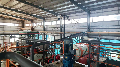
Desen Environment supplied a 40 t/h modular hot washing train comprising a grizzly feeder, twin steam-heated attrition scrubbers, a three-phase decanter for oil recovery, a 250/100 hydrocyclone cluster, dewatering screens, a high-rate thickener and a 1,500 mm membrane filter press.
- TPH removal efficiency: 93.6% average; treated sand consistently below 1,000 mg/kg TPH, meeting the agreed site reuse criterion
- Clean sand recovery: 64% of feed mass returned to the site as engineered backfill
- Oil recovered: approximately 1,750 tonnes of hydrocarbon, reused as boiler fuel on site
- Water recycle rate: 91%, with make-up water limited to filter-cake moisture and evaporation losses
- Availability: 89% plant uptime over a 7-month campaign, including winter operation with trace-heated pipework
Frequently Asked Questions
What TPH range is suitable for hot washing?
Practical range is roughly 5,000 mg/kg to 15% TPH. Below that, simpler surfactant washing or biopile treatment may be cheaper; above it, free-oil pre-separation should be added ahead of the wash circuit.
Does hot washing work on clay-rich oily soil?
Partially. Clay binds hydrocarbon strongly and reports to the fines stream, so recovery of reusable sand drops. Desen Environment runs bench-scale washability tests on a 20–50 kg sample before quoting, so the achievable clean-fraction yield is known before capital is committed.
How much water and energy does the process consume?
Typical figures are 0.3–0.6 m³ of make-up water per tonne of soil and 40–90 kWh equivalent per tonne, depending on wash temperature and ambient conditions. Closed-loop recycling of hot water is the main lever for reducing both.
How long does installation take?
Modular and skid-mounted plants are typically commissioned in 7–15 days after arrival on site, covering pad levelling, power and water tie-in, module interconnection and operator training.
What happens to the filter cake?
The oily fines cake is either sent to licensed thermal treatment, stabilised for permitted landfill, or — where regulation allows — processed further into fuel-blend feedstock. Cake volume is normally 20%–30% of the original soil mass.
Conclusion
For petroleum-impacted soils and oily sludge, hot washing delivers a rare combination: high hydrocarbon removal, recovered oil with commercial value, reusable clean sand, and a mobile plant footprint that can follow the excavation front. Correct equipment selection — scrubber retention time, oil recovery loop, fines handling capacity and heating method — determines whether a project meets its targets on the first pass.
Desen Environment — Zhengzhou Desen Environment Technology Co., Ltd. (郑州德森环境) — engineers modular oily soil hot washing systems from 10 t/h to 120 t/h, backed by laboratory washability testing, process guarantees and international commissioning support. Request a project-specific configuration at materialwashing.com.