Salt-Affected Soil Remediation: Soil Washing and Desalination for Saline Contaminated Land in the Middle East
Salt-affected and saline contaminated soil is one of the most distinctive environmental challenges in the Middle East. Along the Arabian Gulf coast and in the oil-producing eastern provinces of the
Salt-affected and saline contaminated soil is one of the most distinctive environmental challenges in the Middle East. Along the Arabian Gulf coast and in the oil-producing eastern provinces of the region, affected soils commonly show electrical conductivity (EC) of 8 to 30 dS/m and a sodium adsorption ratio (SAR) of 10 to 50, levels that classify them as severely saline or sodic. For land owners, urban developers and national oil companies operating under tightening ESG obligations, restoring this land is no longer optional. This article explains why physical soil washing combined with desalination has become one of the most mature engineering routes for saline contaminated soil remediation, and why modular and mobile soil washing plants are well suited to desert conditions.
Where the Salt Comes From
High salinity in the Middle East is not a single-cause problem. It is the result of several overlapping processes that are common in arid coastal regions.
Main Sources of Soil Salinization
- Seawater intrusion. Coastal groundwater in areas such as the UAE coastline, Saudi Arabia's Eastern Province and parts of Qatar has been progressively salinized by seawater ingress, raising chloride and sodium concentrations in the unsaturated zone.
- Oilfield produced water. Produced water from oil and gas operations can carry total dissolved solids of 50,000 to 250,000 mg/L. Historical spills and leaks have left sodium and chloride accumulated in surface soils.
- Desalination brine and industrial effluent. The Middle East holds roughly half of the world's desalination capacity; concentrated brine and high-salinity industrial discharge contribute salts to surrounding land.
- Saline irrigation and high evaporation. In Saudi Arabia more than 40% of irrigated land relies on groundwater, and annual evaporation of 2,000 to 3,000 mm drives strong upward salt accumulation, a process known as secondary salinization.
Why Salinity Damages Land
- High salt concentrations suppress microbial activity, which slows natural attenuation and later agricultural recovery.
- Salt ions can mobilize heavy metals by forming soluble chloride complexes, increasing the risk of groundwater contamination.
- Sodium-dominated soils lose structure and become compacted with poor drainage.
- Vegetation establishment becomes extremely difficult, reducing the reuse value of the land.
Why Soil Washing and Desalination Is the Right Answer
Traditional biological approaches perform poorly in saline conditions because the osmotic stress from high EC inhibits the microorganisms on which bioremediation depends, and in-situ flushing carries risks of uncontrolled salt or contaminant migration. By contrast, ex-situ soil washing with a dedicated desalination step is a physical process that does not depend on biological activity and works rapidly on the sandy, free-draining soils that dominate the region.
In the Gulf states, soil washing already occupies a leading position in remediation technology selection. Market estimates place the GCC soil remediation market at roughly USD 1.2 to 1.6 billion in 2025, and saline contamination accounts for an estimated 20 to 30% of remediation investment in the Middle East. The technique is attractive because it achieves several goals at once: it removes soluble salts from the soil matrix, it leaves 70 to 90% of the soil volume available for reuse, and it sharply reduces the volume that must be transported or disposed of.
How a Soil Washing and Desalination Plant Works
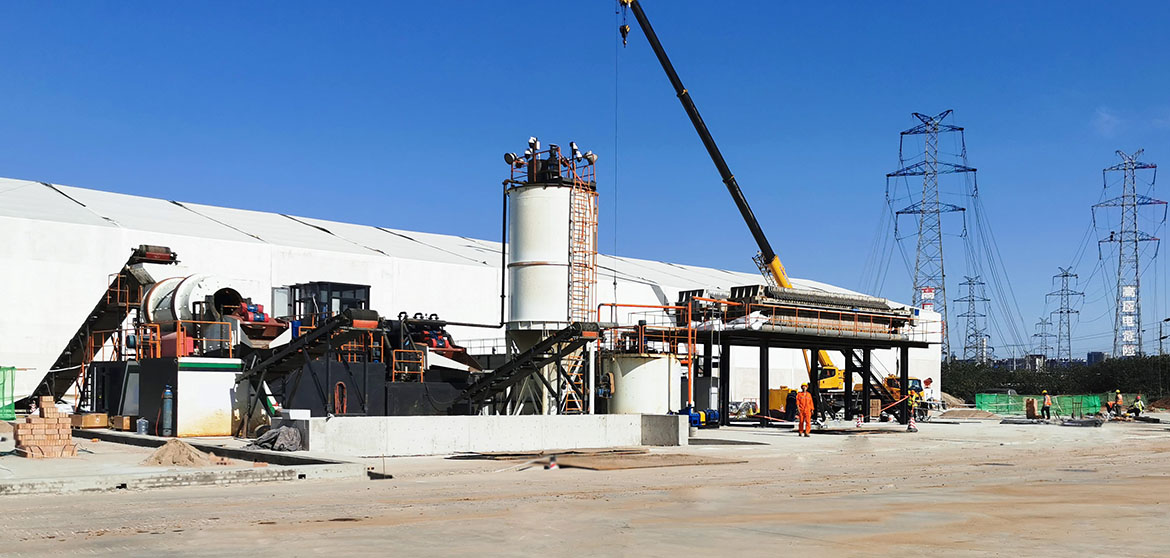
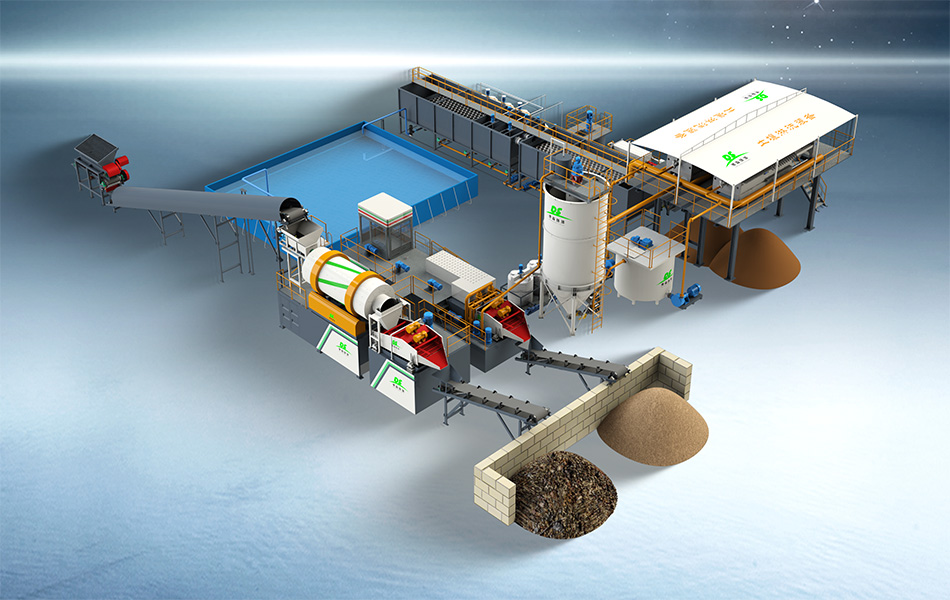
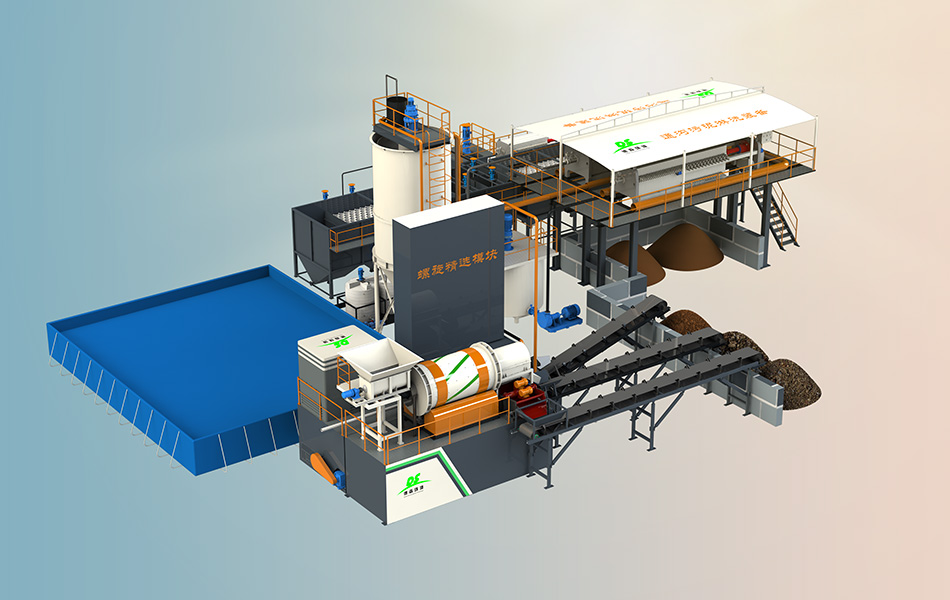
A complete saline soil washing line, whether fixed, modular or mobile, follows a proven multi-stage sequence. The following stages form the core of the process in Desen's soil washing and remediation plants.
1. Prescreening and Scrubbing
Feed soil is screened to remove oversize material and debris, then loaded into a rotary scrubbing unit where particles are rubbed against each other. Attrition scrubbing breaks down aggregates and releases salt-bearing fine particles from larger grains so they can be washed away in the next stage.
2. Soaking and Desalination
The scrubbed slurry moves into a soaking module where fresh or recycled water, sometimes with a chemical or biological solvent, promotes the transfer of soluble salts from the soil to the liquid phase. This is the heart of the desalination step: dissolved sodium, chloride, sulfate and other ions leave the solid matrix and enter solution.
3. Classification and Refining
In the multistage classifying and refining modules, the slurry is separated by particle size. Fine salt-laden particles are concentrated and removed, while the cleaner sand fraction is recovered with lower moisture. The result is a meaningful reduction in the total volume of material requiring further treatment or disposal.
4. Filtration and Dewatering
A plate-and-frame filter press dewaters the fine slurry into a low-moisture cake, producing clarified filtrate and minimizing the water carried with the solids. Full automation allows 24-hour continuous operation with low power consumption.
5. Water Treatment and Recycling
Process water from the washing and filtration stages reports to a dedicated water treatment module. Overflow from the thickener and filtrate from the filter press flow to a collection tank, then to inclined-tube sedimentation and a multi-stage reaction system with mixing, aeration and dosing before final discharge. In modular plants, water recycling rates above 90% are achievable, which is critical in a region where water is scarce and costly.
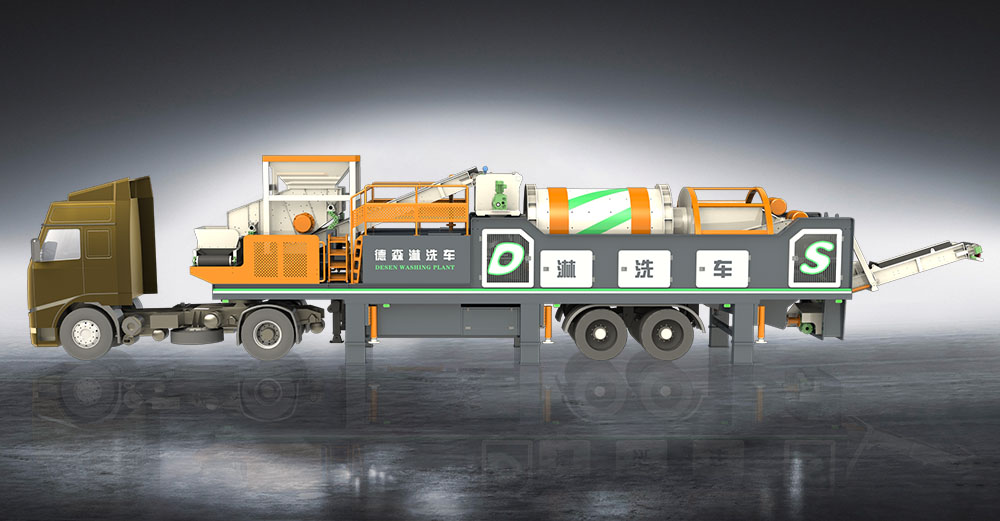
Built for Desert and Coastal Conditions
Equipment used in the Middle East must survive summer temperatures above 45 to 50 degrees Celsius, intense UV, frequent sandstorms and salt-laden marine air with ISO C5-M corrosivity. Desen adapts its washing trains for these conditions with 316L stainless steel and hot-dip galvanized structures, IP65-protected electrical cabinets, high-temperature-rated components, corrosion-resistant slurry pumps and redundant cooling. Mobile and skid-mounted units are delivered pre-assembled so that a plant can be commissioned on site within days, which matters when project timelines are measured in months.
As a national high-technology enterprise with more than 30 years of large-equipment manufacturing experience, Desen has delivered over 1,000 environmental projects and supplied washing equipment to clients in more than 100 countries. The company led the development of China's first team standard for soil washing remediation systems, has iterated its modular skid-mounted washing equipment through ten generations, and has completed China's first 100 t/h contaminated site remediation plant.
Choosing the Right Configuration
- Fixed washing and remediation plants suit long-duration projects with stable feed volumes and permanent site infrastructure, typically ranging from 15 to 100 t/h.
- Modular plants combine speed of deployment with capacity and are preferred where multiple lots or phases must be treated on one site.
- Mobile and skid-mounted units are ideal for dispersed sites, maintenance depots and campaigns across several locations, with compact footprints and rapid relocation.
- Mobile screening and solid-liquid separation units support larger remediation trains by preparing feed and reducing water loading.
Conclusion
Saline contaminated soil in the Middle East is a growing liability for oil companies, developers and regulators alike, but it can be restored efficiently with the right physical process. Soil washing combined with desalination offers speed, soil recovery and water reuse in environments where biological methods struggle. With mature modular and mobile equipment, proven field application and engineering adapted to desert conditions, physical washing and desalination is a practical, field-ready answer to salt-affected land.
For project-specific assessment and equipment sizing, contact Desen Environmental Technology for a technical discussion based on your soil analysis and remediation targets.