How Does Soil Washing Work? A Complete Guide to the Soil Washing Process and Equipment
Learn how soil washing works step by step - pre-screening, drum scrubbing, hydrocyclone classification, dewatering, filter pressing and closed-loop water recycling.
What Is Soil Washing?
Soil washing is a physical and chemical treatment technology used to remove contaminants from excavated soil. Rather than transporting polluted material to an off-site landfill, contractors run the soil through a soil washing plant that separates the clean sand and gravel fraction from the fine particles where most of the contamination concentrates. The technique is widely used for heavy metals, petroleum hydrocarbons, PAHs, BTEX and other organic compounds, and it is regarded as one of the most cost-effective options for treating medium and large volumes of contaminated soil.
Why Contaminants Concentrate in Fine Soil
Contaminants rarely spread evenly through a soil mass. Because clay and silt particles carry a large surface area and an active surface charge, heavy metals and organic pollutants prefer to bind to these fines rather than to clean sand or gravel. Once the soil is disaggregated, mechanical and hydraulic separation can isolate the polluted fine fraction from the greater volume of acceptable material. This is the principle that makes the soil washing process efficient: treat only the contaminated fraction and reuse the rest.
How Does Soil Washing Work? The Step-by-Step Process
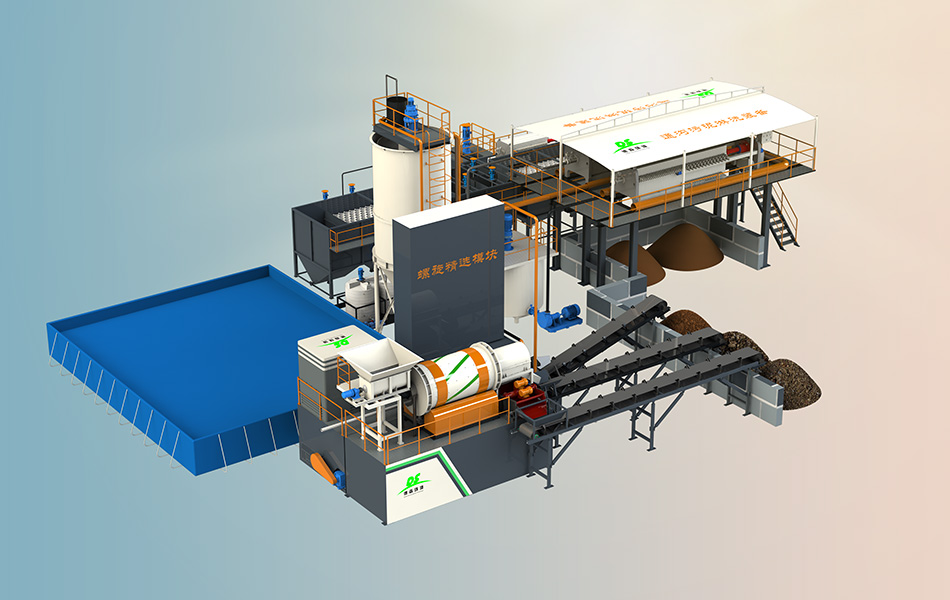
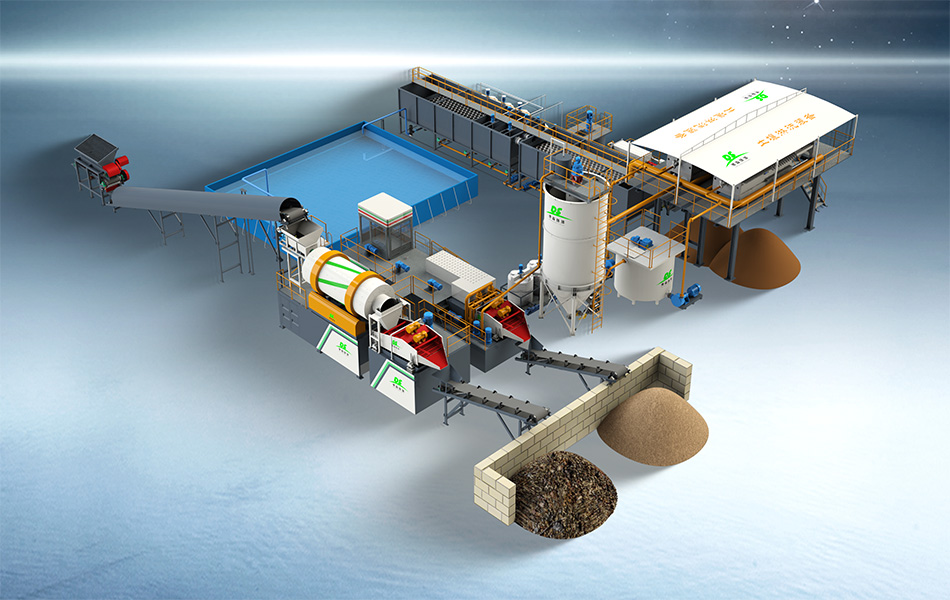
Although every project is adapted to its own contaminant profile, a standard soil washing plant follows a well-defined process train.
Step 1: Pre-Screening and Feed Preparation
Excavated soil is fed into the plant through a vibrating or bar screen that removes oversize material such as rocks, roots, concrete and debris. Large particles are washed and discharged as clean aggregate, while the soil below the cut size moves to the next stage. A well-designed feed section protects downstream equipment and improves the stability of the whole line.
Step 2: Drum Scrubbing and Slurry Preparation
The screened soil enters a drum scrubber or a high-efficiency scrubbing unit where high-energy friction between particles detaches contaminants from the soil surface. The mechanical action breaks down soil agglomerates and transfers pollutants into the water phase or concentrates them on ultra-fine grains. Rubber-lined drums fitted with high-elasticity linings intensify the scrubbing and thoroughly separate clay lumps from sand.
Step 3: Size Classification with Hydrocyclones
The scrubbed slurry is pumped to a hydrocyclone or a multistage classifying unit, which uses centrifugal force to split the flow into a coarse underflow and a fine overflow. A multistage classifier combined with spiral concentrators can sharpen the cut and maximise the recovery of fine sand. Precise control of the cut point determines how much clean material is recovered and how much polluted fines must be disposed of.
Step 4: Dewatering of the Clean Fraction
Coarse sand recovered from the classification stage is passed to a spiral classifier or a dewatering screen. The dewatered sand is re-tested and, where it meets the remediation criteria, returned to the site as backfill or reused as aggregate. This step is central to the economics of the process because it converts contaminated soil back into a usable resource.
Step 5: Thickening and Filter Press Separation
The fine fraction and the process water are pumped into a deep-cone thickener, which produces a clear overflow and a concentrated underflow. The underflow is then fed to a plate and frame filter press, which squeezes it into a dry filter cake with low residual moisture. The cake is collected and transported for approved off-site treatment or disposal, dramatically reducing the volume of waste.
Step 6: Water Treatment and Closed-Loop Recycling
Water is the working fluid of a soil washing plant, and a responsible design recycles almost all of it. Overflow water from the thickener and filtrate from the filter press are collected, dosed with reagents in reaction tanks that combine stirring and aeration, settled in inclined-plate clarifiers and returned to the washing circuit. High-efficiency plants recycle more than 90 percent of process water, cutting fresh-water demand and eliminating uncontrolled discharge.
What Equipment Is Used in a Soil Washing Plant?
Modern soil washing systems are available in several configurations to match project scale and site constraints.
Fixed washing and remediation plants for large, long-term projects with a stable feed.
Modular and skid-mounted systems that can be expanded as the project grows.
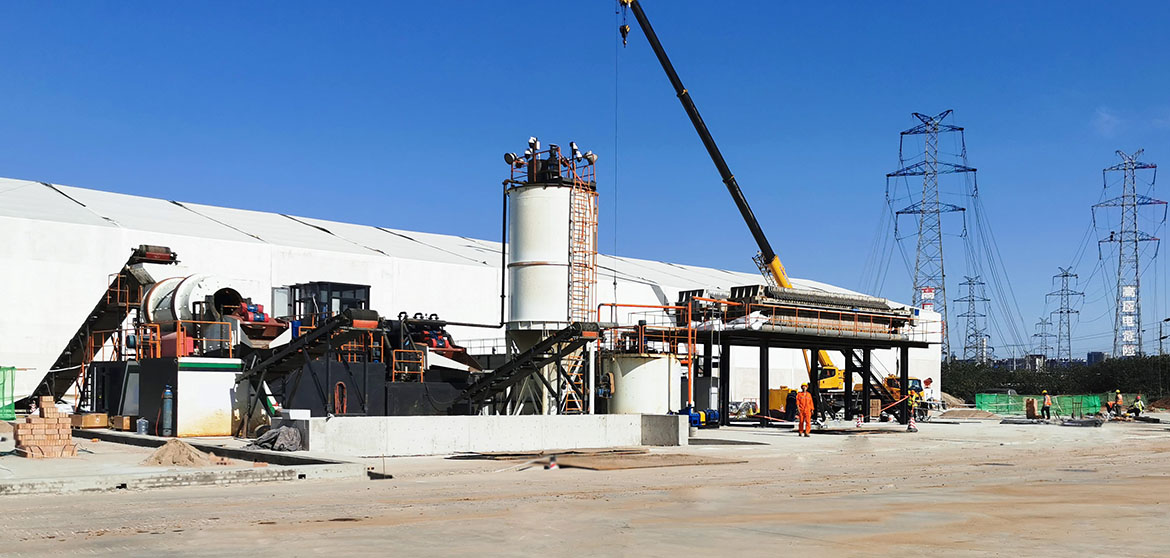
Mobile soil washing equipment integrated on trailer or tracked carriers for rapid deployment and multi-site rotation.
Mobile screening plants for field pre-treatment and oversize removal.
Mobile solid-liquid separation and water treatment plants that close the loop on site.
A typical mobile remediation unit can process 15 to 30 tonnes per hour, arrive on site and begin operating within one to three days, and be run by three people per shift. Modular systems scale from a single machine to multiple parallel lines for throughputs well above 100 tonnes per hour.
When Is Soil Washing the Right Choice?
Soil washing works best when the contamination is concentrated in the fine fraction of a predominantly sandy or silty soil. Typical applications include:
Industrial and petrochemical sites contaminated with heavy metals, petroleum hydrocarbons, PAHs or BTEX.
Steel, smelting and coking plant brownfields where metals dominate the risk profile.
Mobile remediation for emergency response, scattered hotspots and urban sites with limited space.
Oil-contaminated soil and oil sludge from terminals, pipelines and tank farms.
Technology selection should always be confirmed by treatability testing and particle size analysis before full-scale deployment, because soil texture is the single most important factor in the feasibility of any soil washing project.
Real-World Performance
Commercial installations demonstrate the value of the process at scale. Equipment providers with extensive project histories report treating sites across a wide throughput range, from 8 tonnes per hour for small urban plots to more than 100 tonnes per hour for large national remediation programmes. A single project in Ningxia, China, processed roughly 180,000 cubic metres of petroleum-hydrocarbon-contaminated sandy soil using a combination of soil washing and biological treatment, while a Middle East project treated approximately 300,000 cubic metres of oil-impacted sand. These examples show that soil washing is not a laboratory curiosity; it is an industrial-scale remediation method with a long operational record.
Working with an Experienced Equipment Partner
The success of a soil washing programme depends as much on equipment design as on chemistry. An experienced manufacturer brings value through process engineering, modular design, remote monitoring and after-sales service. Look for a partner that offers complete process trains, including scrubbing, classification, dewatering and water treatment, and that can verify performance against real project data rather than theoretical figures.
Engineer the Process Train as One System
Every stage of the soil washing process depends on the one before it. Matching the scrubber to the soil texture, the hydrocyclone to the slurry density and the filter press to the sludge volume requires an integrated view of the whole line. A supplier that engineers the full process train delivers higher recovery rates, lower reagent consumption and shorter commissioning times.
Conclusion
Soil washing is a proven, resource-efficient technology for contaminated soil remediation. By concentrating pollutants in a small fine fraction and recycling most of the process water, it improves the economics of site clean-up. Understanding the step-by-step soil washing process, selecting equipment matched to the soil texture and working with an experienced process partner are the key steps to a successful project.