Mine Tailings Washing and Classification: A Practical Recovery Roadmap
Learn how mine tailings washing and classification recovers sand, cuts storage volume and extends dam life, with field results from Desen Environment.
Mine Tailings Washing and Classification: A Practical Recovery Roadmap
Mine tailings are often described as waste, but anyone who has stood next to a settling pond knows the label is misleading. Fine sands, residual metals and usable aggregate sit locked inside material that operators pay to store. Mine tailings washing and classification changes that equation: instead of paying for disposal, you recover saleable products and shrink the footprint of what remains. This article explains how the process works, what equipment it takes, and what results Desen Environment has seen on real projects.
How Tailings Washing and Classification Works
The starting point is a simple observation: tailings are not uniform. They contain coarse oversize, recoverable fine sand, silt and clay, plus a small fraction of valuable minerals that the primary mill could not extract. Tailings washing separates these fractions so each one can be handled according to its actual value.
A typical line starts with a vibrating screen to strip oversize material, then moves into a washing stage where an attrition scrubber breaks up agglomerated fines and liberates particle surfaces. From there, a hydrocyclone cluster classifies the slurry by particle size, and a dewatering screen or filter press dries the recovered sand into a stackable product. Water from the process is clarified and recycled back to the front of the plant, which matters in arid mining regions where every cubic metre counts.
Why Classification Drives the Economics
Mine tailings washing pays for itself only when the output has a market. That is why classification is the heart of the system rather than an afterthought.
- Construction-grade sand: clean, well-graded fines can be sold as aggregate for concrete and road base.
- Recovered fines: targeted washing can lift residual metal values into a concentrate stream for reprocessing.
- Reduced tailings volume: removing sand for sale cuts the slurry that must be pumped to the dam, extending its life.
- Lower closure liability: smaller storage areas mean less long-term monitoring and rehabilitation cost.
In practice, Desen Environment has found that the ratio of saleable sand to waste clay drives most project decisions. When that ratio is favourable, the payback period for a tailings washing plant drops sharply.
Equipment Selection for Different Tailings Types
No single line suits every mine. Iron ore tailings, for example, are relatively coarse and respond well to screens and cyclones with high throughput. Phosphate and clay-heavy tailings need stronger attrition scrubbing and more efficient dewatering. Modular and skid-mounted configurations have become popular because they let operators start with one stream, verify product quality, then scale up without rebuilding the plant.
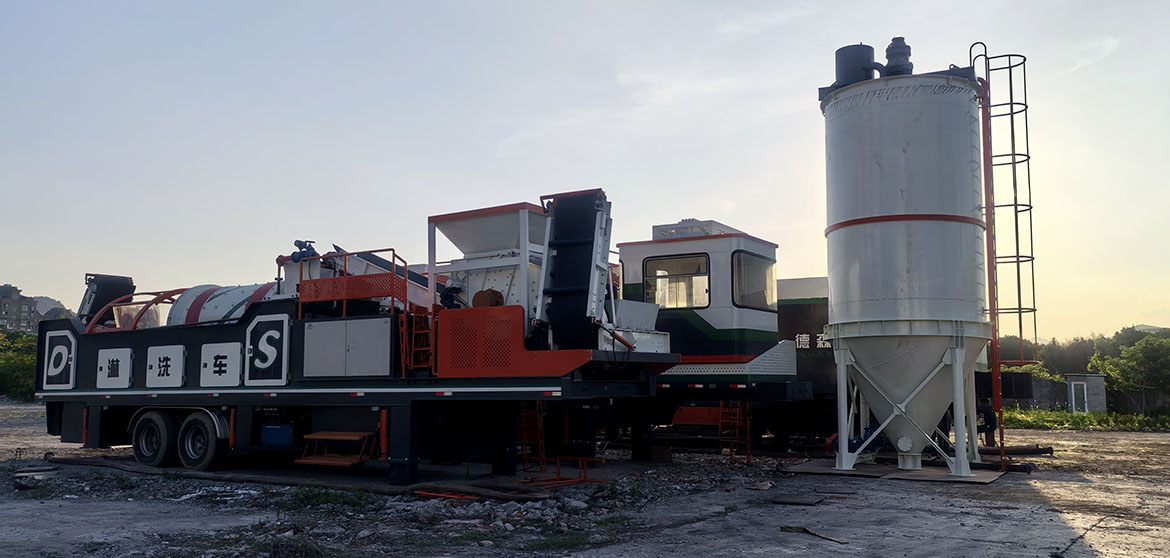
Desen Environment, based in Zhengzhou (郑州德森环境), builds both fixed and mobile tailings washing and classification systems. The mobile option is particularly useful at short-life mines or satellite pits, where permanent civil works are hard to justify.
Case Study: Sand Recovery from a Chinese Iron Tailings Dam
One recent Desen Environment project involved an iron ore operation in central China. The tailings dam was filling faster than planned, and the operator faced rising storage costs. A mobile washing and classification plant was deployed, recovering approximately 60 percent of the feed as clean construction sand while the clay-rich fraction continued to the dam at a much reduced volume.
The operator sold the sand to local ready-mix producers, and the revenue offset most of the plant operating cost. Equally important, the remaining tailings slurry became easier to manage, and the projected life of the storage facility stretched by several years. The full case detail is available at materialwashing.com for operators evaluating the same route.
FAQ
Can mine tailings washing handle fine clay-rich material?
Yes, but the process needs sufficient attrition scrubbing and hydrocyclone stages to break down and remove the clay fraction. Desen Environment tailors the line to the particle size distribution of each site.
How much water does a tailings washing plant consume?
Modern plants recycle most of their process water through clarifiers and thickeners, so net consumption is typically a fraction of the gross flow. In water-scarce regions, this recycling is a key design requirement.
Is a mobile tailings washing plant as effective as a fixed one?
For most ore types, yes. Mobile and skid-mounted units use the same screens, scrubbers and cyclones as fixed plants; the difference is throughput scale and foundation work, not separation performance.
What products can be recovered from tailings?
The most common outputs are construction sand, fine aggregate for road base, residual metal concentrates and dewatered fines suitable for backfill. The exact mix depends on ore mineralogy and market demand.