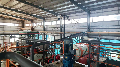
Oil Contaminated Soil Washing in the UAE: 300,000 m3 at 25-30 TPH
A soil remediation project in the UAE treating about 300,000 m3 of sandy, petroleum-hydrocarbon contaminated soil at 25-30 tonnes per hour, using washing remediation followed by bio-remediation.
Project at a glance
| Location | United Arab Emirates (UAE) |
| Contaminant | Petroleum hydrocarbons (landing oil) |
| Average hydrocarbon content | 5% – 8% |
| Soil texture | Sandy |
| Soil volume | About 300,000 m³ |
| Plant capacity | 25 – 30 tonnes per hour |
| Treatment process | Washing remediation + bio-remediation |
| Status | In progress (started December 2024) |
Why a 5–8% hydrocarbon site is not a routine job
Most oil-contaminated soil that reaches a washing plant carries hydrocarbons in the low thousands of mg/kg. This site averages 5% to 8% — between 50,000 and 80,000 mg/kg. That is roughly an order of magnitude heavier, and it changes the design brief in three ways.
First, the oil is not a thin film on the grain surfaces. It occupies pore space, which means the soil behaves more like a tar-saturated matrix than a free-flowing granular material. Feed handling, screening and slurry preparation all have to be sized for that.
Second, the level of contamination makes a single-process route uneconomic. Washing alone would carry too much hydrocarbon into the effluent loop; biological treatment alone would be far too slow at this concentration.
Third, sandy soil is an advantage. Sand releases oil more readily than clay, and it classifies cleanly — the property the whole treatment route depends on.
The treatment route: washing first, bio-remediation second
The project uses a two-stage process, and the logic of the split matters more than the equipment list.
Stage one — washing remediation. The soil is washed as a slurry. Hydrocarbons are driven off the grain surfaces into the liquid phase, then separated from the process water. The important effect is not just cleaning the sand; it is concentrating the contamination. Washing splits the feed into a coarse, largely clean sand fraction and a much smaller fine fraction that holds most of the remaining hydrocarbon mass.
Stage two — bio-remediation. Only that concentrated fine fraction goes to biological treatment. This is the part most site owners miss: bio-remediation is slow, so you want to apply it to the smallest possible volume. Washing first means the biology is polishing a fraction of the original soil, not the whole 300,000 m³.
That sequencing is what makes a site this large and this heavily contaminated treatable within a realistic programme.
How to read the capacity figure
25 to 30 tonnes per hour is a working figure, not a marketing one. It sets the civil works, the water balance and the stockpile strategy. When you are looking at a site in the hundreds of thousands of cubic metres, the decision that actually determines your cost is not the headline capacity — it is how many tonnes you can keep out of the haulage fleet. Every tonne treated on site is a tonne that never has to be loaded, permitted, driven and landfilled.
Project status
The plant was commissioned in December 2024 and is in operation. We will publish throughput and post-treatment verification data once the programme is complete — we do not report remediation results before the laboratory does.
Planning a similar site?
If you are working on an oil-contaminated site, the two numbers that decide the right configuration are the hydrocarbon concentration and the soil texture. Send us a soil analysis and a rough volume, and we will tell you whether washing alone is enough, or whether you need a combined route like this one.