Mining Tailings Washing and Classification: A Complete Treatment Solution
How mining tailings washing and classification turns waste into sand product: process, advantages, field cases and FAQs from Desen Environment.
Mining Tailings Washing and Classification: A Complete Treatment Solution
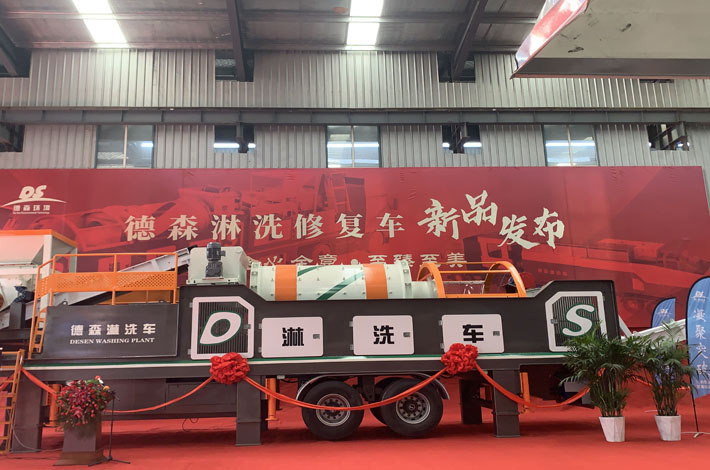
Mining tailings are often treated as a waste problem, but they carry an economic story that few operators stop to read. The fine fractions that once cost money to store and manage can be converted into saleable sand, recovered metals and a much smaller disposal footprint. The shift starts with the right process: washing the tailings, classifying the particle streams and letting each fraction find its own market.
How Tailings Washing and Classification Works
Raw tailings from a beneficiation circuit rarely arrive as a uniform material. They are a mix of coarse sand, silts, clays and residual valuable minerals, all locked together by water and process chemistry. A mining tailings washing plant breaks that mix apart using a sequence of attrition scrubbing, screening and hydrocyclone classification.
Attrition scrubbing removes the coating that keeps fines glued to sand grains. Screens then split the feed by size, while hydrocyclones separate the lighter clay and silt from the denser sand. The result is a set of clean streams: a washed sand product that meets construction specifications, a fine fraction that dewaters quickly for dry stacking, and a slurry that can be treated separately or returned to the process. Each stream carries its own value and its own handling cost.
Why Operators Choose This Route
Turning tailings into product
The clearest advantage is economic. Clean washed sand from tailings can be sold into local aggregate markets, turning a disposal liability into a revenue line. Recovery of residual metals from the heavier fraction adds a second stream of value, and the reduced volume of fine waste cuts both storage and closure costs.
Environmental and permitting benefits
- Dewatered coarse fractions reduce the size of the tailings dam footprint.
- Less mobile fines mean lower dust and leachate risk at the storage site.
- Recycled process water lowers fresh-water consumption and operating cost.
- A cleaner discharge profile makes permit renewal and community engagement easier.
Flexible capacity for changing feed
Ore grades change, and so does the particle distribution arriving at the plant. A modular washing and classification train handles that drift without a redesign: adjust the screen panel, change a cyclone apex, or add a scrubbing stage. The same plant keeps producing a spec-compliant product even when the feed does not look like yesterday's sample.
Case Notes from the Field
Desen Environment has delivered washing and classification lines for mineral processing and mine-site clients, applying the same engineering discipline used in soil remediation to the tailings yard. Zhengzhou Desen Environmental Technology Co., Ltd. designs each line around the actual particle-size curve and the target product spec, rather than bolting together a standard skid and hoping it fits. Project references and process layouts are documented on materialwashing.com, where operators can review typical flowsheets before commissioning an engineering study.
FAQ: Mining Tailings Washing and Classification
Can washing really make tailings sand saleable? In most cases, yes. Attrition and classification remove the fines that disqualify sand for construction use. The final spec depends on the feed, but a well-designed plant consistently upgrades tailings to a marketable product.
How much water does the process use? Modern plants recirculate most of the process water. Fresh-water demand is typically limited to make-up volume, which keeps operating cost and environmental impact low.
Is the equipment suitable for remote mine sites? Yes. Skid-mounted modules ship in standard containers and assemble quickly on site, which is why mobile configurations are popular in mining regions.
How long does it take to commission a plant? For a modular train, commissioning usually takes a few weeks once the modules arrive, depending on site preparation and utilities.
Can the plant recover valuable metals as well? The classification stage concentrates heavy and magnetic fractions, which can be sent to further recovery. It will not replace the main beneficiation circuit, but it captures value that would otherwise be lost to the tailings dam.