Mobile Soil Washing Equipment on Heavy Metal Sites: Applications and Field Results
How mobile soil washing equipment handles heavy metal contaminated sites: applications, field results and selection guidance from Desen Environment.
Mobile Soil Washing Equipment on Heavy Metal Sites: Applications and Field Results
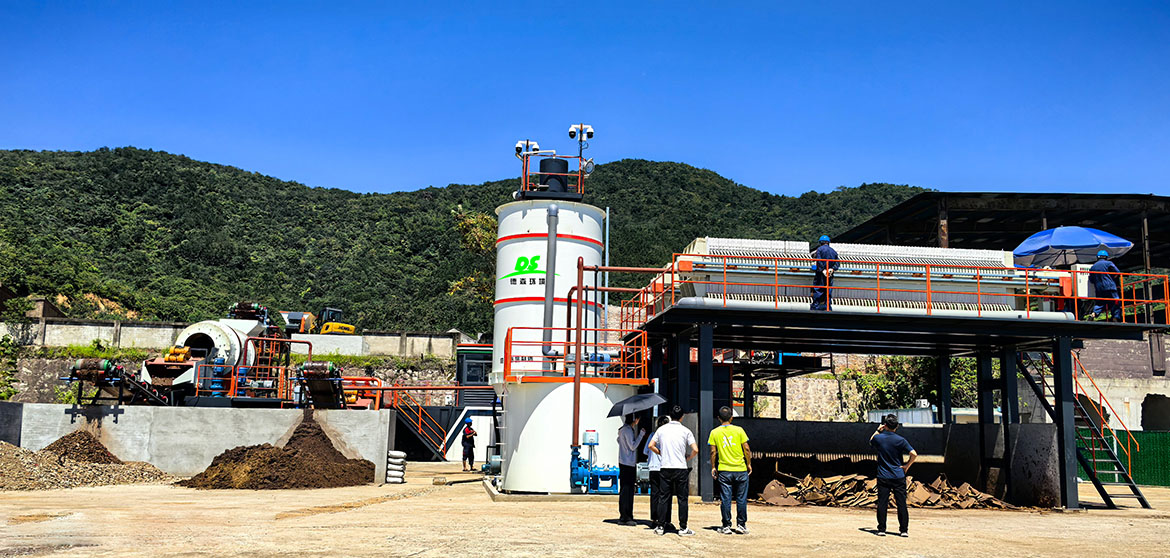
Heavy metal contamination rarely arrives as a neat problem. A former plating shop can carry lead, zinc and chromium across three different soil types within a few hundred meters, and that patchwork is exactly why mobile soil washing equipment has moved from a backup option to a first-choice strategy for contractors who need results on a schedule. When the site is complex and the deadline is fixed, a mobile washing plant often becomes the only way to hit both. For owners who have been burned by schedule slips, that reliability is the real value of mobile soil washing equipment.
How Mobile Soil Washing Equipment Handles Heavy Metals
The core principle is simple: separate the contaminated fines from the clean coarse fraction, then treat only what remains. In practice, mobile soil washing equipment runs soil through several linked stages. A vibrating screen removes oversized debris, an attrition scrubber breaks up agglomerates so metal-bearing silt is released from the particle surfaces, and a hydrocyclone or classification unit splits the slurry by particle size. The metal-rich fines move to dewatering and further treatment, while the washed sand and gravel can often be returned to the excavation.
What changes with mobile soil washing equipment is the way those stages are packaged. Instead of a fixed building, the units arrive on trailers or skids, get connected to water and power, and start producing within days. For a site holding thirty thousand cubic meters of impacted material, that speed changes the economics of the whole project.
Applications Where the Technology Earns Its Keep
Three application patterns keep coming up in field work with mobile soil washing equipment:
- Plating and metalworking sites where contamination sits in shallow soil and spreads unevenly across the property.
- Former industrial yards being redeveloped for housing or commercial use, where cleanup deadlines are written into the land transaction.
- Remote or temporary sites where building a permanent plant would cost more than the remediation itself.
In each of these cases, the deciding factor is rarely the chemistry. It is the logistics, and that is precisely where mobile soil washing equipment shines.
Field Results That Matter
One project in Central China gives a useful picture of what mobile soil washing equipment can deliver in the field. A former battery recycling facility had left cadmium and lead concentrations roughly four times above the local screening values across 18,000 cubic meters of soil. Desen Environment deployed a mobile washing line rated at 30 tons per hour. Over eleven weeks, the plant processed the full volume. Post-treatment sampling showed the coarse fraction consistently below the target thresholds, and around 70 percent of the material stayed on site as clean backfill. The concentrated fines were stabilized and disposed of off site.
Numbers like those matter, but so does the calendar. For many clients, the pace of mobile soil washing equipment is what makes remediation financially viable. The client had a fixed handover date, and the mobile configuration meant the plant was on site and producing inside ten days from contract signature. A fixed plant would have taken two to three months just to build.
Choosing the Right Mobile Setup
Not every mobile washing plant fits every job, and choosing mobile soil washing equipment without site data is a gamble. Contractors should look at three numbers first: required throughput, fines content of the feed, and particle size distribution. A unit that handles sandy soil beautifully can struggle with clay-bound contamination, where longer attrition residence time and more aggressive scrubbing are essential. Zhengzhou Desen Environmental Technology offers configurations from compact single-trailer units to modular multi-stage lines, so the plant can be matched to the material rather than the other way around.
FAQ
How fast can mobile soil washing equipment be mobilized?
Most trailer-mounted systems are operational within 7 to 14 days of arrival on site, depending on access and water supply setup.
Which heavy metals can the process remove?
The process targets metals that attach to silt and clay, including lead, cadmium, zinc, chromium, copper and nickel. Soluble metals may require chemical enhancement of the wash water.
Is the cleaned soil reusable?
Yes. In many projects the washed coarse fraction meets residential or commercial screening values and is reused as backfill, which cuts both disposal cost and imported fill expense.
Talk Through Your Site
Every contaminated site carries its own mix of constraints, and the right answer is rarely a generic one. If you are evaluating mobile soil washing equipment, the materialwashing.com team can review your lab data and site layout, then recommend a mobile configuration that fits both the contamination and the calendar. Desen Environment has shipped washing systems to projects across Asia, the Middle East and Africa, and the engineering team stays involved from the first test wash to the final report.