Petroleum Hydrocarbon Soil Remediation
Petroleum hydrocarbon soil remediation with mobile washing plants: how the process works, its key advantages, real case data and practical FAQs.
Petroleum Hydrocarbon Soil Remediation: Field-Proven Solutions That Actually Work
Petroleum hydrocarbon contaminated soil is one of the most persistent headaches in industrial site redevelopment. Tank farms, refineries, pipelines and old workshops all leave behind a stubborn mix of light and heavy fractions that refuse to disappear on their own. Over the past decade, mechanical soil washing has quietly become the default choice for petroleum hydrocarbon soil remediation, and for good reason: it is fast, measurable, and far more economical than thermal treatment when contamination sits above the water table. This article walks through how the technology works, where it shines, and what real projects tell us about running it well.
Technical Principles: How Soil Washing Breaks the Oil-Soil Bond
Soil washing for petroleum hydrocarbon contaminated soil is not about dissolving oil in water. It is a physical-chemical separation process built on three repeating cycles:
- Attrition scrubbing — high-shear mixing in a washing drum or attrition cell mechanically strips oil films from sand and gravel surfaces;
- Surfactant-assisted desorption — a carefully dosed washing solution (often food-grade surfactants or biosurfactants) lifts residual hydrocarbons off fine particles without generating secondary waste;
- Solid-liquid separation — hydrocyclones, screens and filter presses split the stream into clean aggregate, contaminated fines and process water, each routed to its own treatment loop.
The magic lies in the mass balance. Most petroleum contamination on a site concentrates in the silt and clay fraction, which typically accounts for only 10-30% of the total soil volume. Remove that fraction and you can treat 70-90% of the excavated soil on site, leaving only the concentrate for further treatment or disposal. That single fact drives the economics of every soil remediation project we see.
Technical Advantages: Why Field Teams Prefer Washing
Compared with excavation-and-offsite-disposal or in-situ thermal desorption, mobile soil washing equipment offers advantages that matter on real schedules, and they make petroleum hydrocarbon soil remediation both faster and cheaper to deliver:
- On-site processing cuts transport and landfill costs dramatically; clean soil can be backfilled on the same plot.
- Short mobilisation time — a skid-mounted or modular plant can be commissioned within days, not months.
- Controllable endpoint — treatment targets for petroleum hydrocarbon contaminated soil are set per lot, and samples confirm compliance before backfill.
- Lower carbon footprint — no haulage fleets and no energy-hungry heating stages, which also keeps operating costs under control.
None of this means washing is a silver bullet. Heavy fractions such as weathered bitumen respond better to thermal or biological polishing, which is why a good contractor pairs washing with a treatment train instead of forcing one unit to do everything.
Case Analysis: What Projects Actually Show
In a decommissioned tank farm we equipped near the Yangtze River delta, the client faced roughly 45,000 tonnes of diesel-contaminated sandy loam with total petroleum hydrocarbons (TPH) averaging 4,800 mg/kg. The washing plant ran two shifts, processed 120 tonnes per hour, and brought the sand fraction down to below 500 mg/kg in six weeks. The fines slurry, about 18% of the total volume, was dewatered and sent for thermal treatment — a far smaller bill than hauling the whole site off. The client later reused 80% of the treated soil as backfill and subgrade material, a textbook outcome for petroleum hydrocarbon soil remediation done right.
Another instructive case: an old lubricant warehouse with PCB-free but heavily weathered oils. Surfactant dosage had to be doubled and scrubbing time extended, which confirms that bench-scale tests are not optional — they decide whether the soil remediation job runs at 60 or 130 tonnes per hour.
FAQ: Common Questions from Site Owners
Is soil washing suitable for all petroleum-contaminated sites?
Not all. Petroleum hydrocarbon soil remediation via washing performs best on sandy and loamy soils with contamination concentrated in fines. Clay-heavy or highly weathered sites may need pre-treatment or a polishing step.
How long does a typical washing project take?
For 30,000-60,000 tonnes, most soil remediation projects complete in four to ten weeks, depending on throughput and site layout.
Can treated soil be reused on site?
Yes, when laboratory results meet the agreed remediation target. Many projects backfill clean sand directly, saving both money and landfill space.
What does Desen Environment provide?
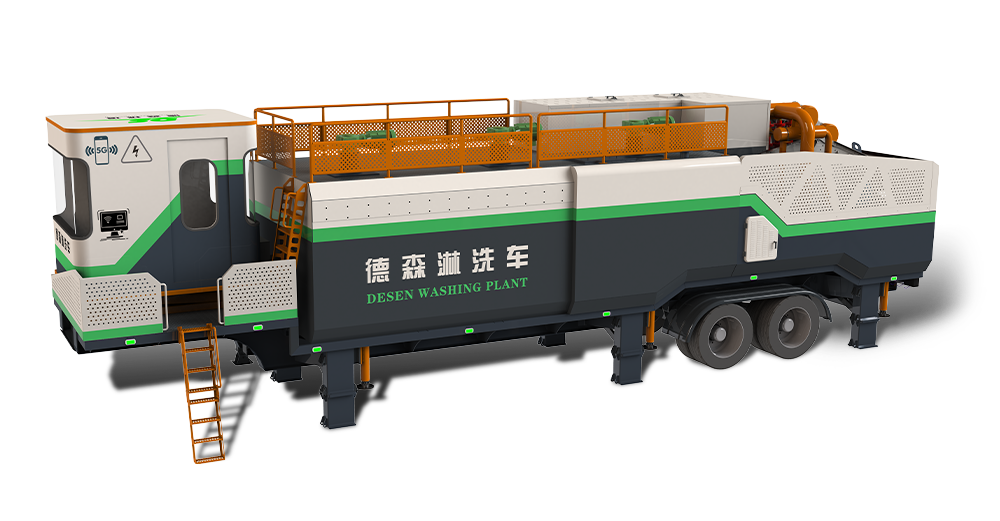
Zhengzhou Desen Environmental Technology Co., Ltd. (Desen Environment) supplies complete mobile and modular washing plants, process design, and on-site commissioning support for petroleum hydrocarbon contaminated soil. Our engineering team can run treatability tests and tailor a flow sheet for your specific contamination profile. For more details, visit materialwashing.com or contact us through the site.