Heavy Metal Soil Washing Case Studies
Heavy metal soil washing case studies: mobile plants remove lead, arsenic and zinc from contaminated soil, with project data and practical FAQs.
Heavy Metal Soil Washing Case Studies: Lessons from Real Remediation Sites
Heavy metal contaminated soil does not degrade, evaporate or wash away on its own. Lead, cadmium, arsenic, chromium and nickel stay put for decades, which is why metal-laden brownfields keep appearing on every urban redevelopment shortlist. Soil washing has emerged as one of the most dependable physical separation routes for these sites, and the case studies below show what it actually takes to hit a clean-up target in the field. We look at the technology behind it, the advantages that matter on a budget, and the project numbers that planners should study before signing anything.
Technical Principles: How Soil Washing Removes Heavy Metals
Heavy metal soil washing relies on the fact that metals bind preferentially to fine particles. Most of the contamination ends up in silt and clay fractions because those particles carry more surface area and organic matter per gram. The washing process exploits this through four core steps:
- Screening and classification — oversize materials are separated first so that downstream units only treat the soil fractions that actually hold contamination;
- Attrition scrubbing — intense mechanical shearing detaches metal-bearing coatings from sand and gravel surfaces;
- Chemical-assisted extraction — where needed, acidic or chelating agents mobilise stubborn metals from the fine fraction;
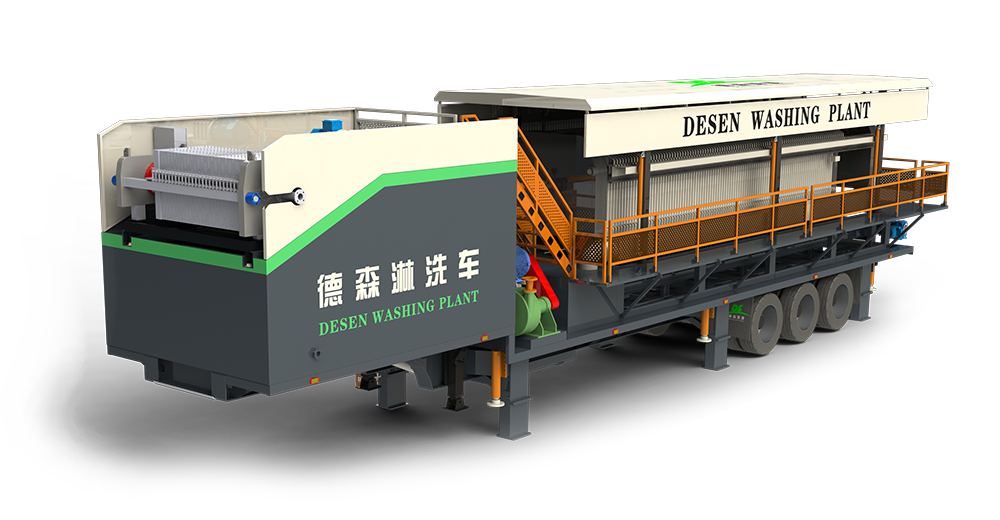
- Dewatering and water recycling — filter presses and clarifiers produce a dry, concentrated cake and return process water to the front of the plant.
Clean sand can often be returned to the excavation, while the smaller metal-rich concentrate goes for stabilisation or off-site disposal. That split is the whole point: it shrinks the volume needing expensive treatment to a fraction of the original.
Technical Advantages: What the Numbers Say
Across the projects Desen Environment has supplied, the practical advantages of soil washing for heavy metal contaminated soil are consistent:
- Volume reduction of 70-90% — only the contaminated fines need special handling, which cuts disposal cost dramatically;
- On-site treatment — mobile and modular plants eliminate long-haul trucking and reduce project risk;
- Fast commissioning — a skid-mounted washing line can be operational within days, keeping schedule pressure low;
- Documented compliance — every batch is sampled, giving regulators and site owners verifiable results rather than estimates.
These are not theoretical benefits. They translate directly into shorter schedules, lower carbon footprints and budgets that stay within reach of small municipalities and private developers alike.
Case Analysis: Real Projects, Real Numbers
Case 1: Lead and zinc contaminated soil at a former smelter
A former non-ferrous smelter site in central China carried lead concentrations above 3,200 mg/kg across roughly 38,000 tonnes of sandy loam. A modular soil washing plant supplied by Zhengzhou Desen Environmental Technology Co., Ltd. ran for seven weeks at 100 tonnes per hour. The washed sand fraction dropped to below 400 mg/kg, meeting the residential screening level, and 82% of the treated soil was reused as backfill. The concentrated fines, around 15% of the input volume, were stabilised with cementitious reagents and disposed of off site.
Case 2: Arsenic-contaminated farmland near a mining zone
In a second project, arsenic levels of 280 mg/kg in agricultural topsoil had made local produce unsellable. Attrition scrubbing with a low-dose iron-based amendment brought the fine fraction under control, and the plant recycled 95% of its process water. The owner gained usable soil for non-food landscaping within two months. The lesson: matching the reagent chemistry to the local soil mineralogy decides whether washing reaches target in one pass or needs a second.
FAQ: Heavy Metal Soil Washing Questions We Hear Most
Which metals can soil washing remove?
Lead, zinc, copper, cadmium, nickel and chromium respond well when they are bound to fine particles. Site-specific treatability tests are the only reliable way to confirm performance for a given soil.
Is the treated soil safe to reuse?
When laboratory analysis confirms the agreed target values, the clean fraction can be reused for backfill, landscaping or construction subgrade. Compliance data is documented per batch.
How long does a project take?
For 30,000-50,000 tonnes, typical projects complete in six to twelve weeks, depending on throughput, soil type and the clean-up level required.
How does Desen Environment support these projects?
Desen Environment provides complete soil washing systems, process design and on-site commissioning, with treatability testing performed before equipment selection. Our team supports clients worldwide; visit materialwashing.com to request a proposal or discuss your site data.
上一篇:Petroleum Hydrocarbon Soil Remediation
下一篇:没有了!