Tailings Washing and Classification for Mine Waste Recovery
Classify and wash mine tailings to recover clean sand for construction and backfill. Desen Environment modular lines cut waste volume and recycle water.
Tailings Washing and Classification for Mine Waste Recovery
Most mining operations spend years building their tailings impoundment and decades wondering what to do with it. Tailings are not uniform waste. They are a mix of fine sands, silts, clay minerals and residual process chemicals, with a particle size distribution that varies from one lift to the next. Buried in that mass there is usually recoverable sand, and in some cases residual metal value. Tailings washing and classification is the process of splitting the stream into those fractions so that each one goes where it earns the most: clean sand back to construction, fines to managed storage, and water back to the plant.
The Technical Principle: Size Separation First, Chemistry Second
The starting point for tailings washing is a simple observation: coarse particles settle faster and carry less surface contamination than fines. A tailings washing circuit exploits that difference mechanically. Feed from the impoundment, or directly from the mill, passes over a vibrating screen that removes oversize rock and tramp material. The undersize slurry enters a scrubber or high-energy mixing tank where clay coatings are loosened and particle surfaces are cleaned. From there, a bank of hydrocyclones classifies the slurry at a selected cut point, typically 75 to 150 microns. The underflow, a clean, dense sand fraction, is dewatered on screens or spiral classifiers and stockpiled. The overflow, containing silt, clay and the residual reagent load, goes to thickening and filtration.
Where residual metal value exists, a short leaching or flotation stage can be inserted after classification. Because the fines carry most of the metal, treating only that concentrated stream shrinks reagent consumption dramatically compared with treating the entire tailings mass.
Technical Advantages: Why Washing Beats Capping and Storage
- Sand recovery from old tailings often reaches 60 to 75 percent of the dry mass, depending on the original grind size.
- Recovered sand can be sold as construction aggregate or used for mine backfill, reducing both waste volume and the purchase of virgin material.
- The fine fraction, now much smaller, can be stored in a reduced footprint or co-disposed with overburden, simplifying closure.
- Water recovered from the circuit returns to the mill or the washing plant, cutting fresh water demand in water-stressed regions.
- A modular plant can process 20 to 100 tonnes per hour and relocate as the working face moves.
Case Study: Retreatment of a Sand-Rich Tailings Deposit
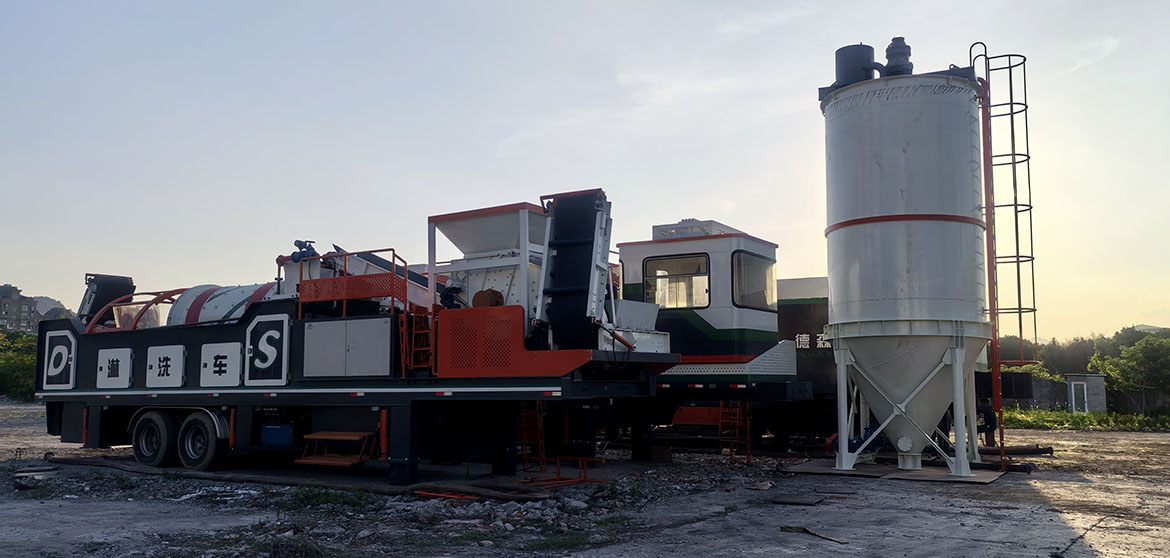
At a mining site in northern China, Desen Environment deployed a modular washing and classification line on a tailings deposit that had been accumulating for over a decade. The feed was roughly 65 percent sand, much of it fine enough for masonry sand applications once cleaned. The line screened the feed, scrubbed the clay coatings off the grains and classified the slurry with a two-stage hydrocyclone bank. Over a six-month campaign, more than 120,000 tonnes of sand were recovered and sold as local construction fill, while the clay-rich fines were re-deposited in a fraction of the original area. Water from the classification circuit was clarified and returned to the plant, holding make-up demand under 15 percent.
The operator's report was about value, not compliance: the recovered sand paid for the equipment, and the impoundment got smaller and easier to close in the same stroke.
FAQ
Can tailings washing handle fine-grained or clay-heavy material?
Yes, but expect the sand recovery rate to fall as the fines fraction rises. Clay-heavy tails need more scrubbing energy and a finer cyclone cut, and the economics should be tested with a pilot run on representative material before committing to full scale.
Is there a risk of re-suspending heavy metals in the process water?
The water circuit is designed to contain the load. Process water is clarified, treated and recycled in a closed loop, and the concentrated fines are managed in the same controlled way as the original tailings.
How is the recovered sand quality assessed?
The sand is sampled against the intended end use: gradation, silt content and, where relevant, leachate parameters. Desen's engineers set the cyclone cut point and rinse intensity to match the target specification.
What is the typical payback on a tailings washing plant?
On sand-rich deposits, recovered product value plus reduced closure cost often repays the plant within one to two campaigns, but the number depends on local sand prices, haulage distances and disposal fees.
Mine waste is not a single material, and treating it as one is where most money leaks away. Tailings washing and classification gives operators a way to separate value from liability with equipment that moves to the material. If you are looking at an old impoundment with a question mark on it, send the particle size data to Desen Environment at materialwashing.com, and we will tell you what the sand fraction is worth.