Mining Tailings Washing & Classification
Tailings washing and classification plants turn mine tailings into clean sand, aggregates and filter cake, with field data from Desen Environment.
Mining Tailings Washing & Classification
Every mine has a pile of material nobody wants to talk about. Tailings, the crushed rock and slurry left behind after the valuable minerals are extracted, accumulate by the million tonnes at the edge of processing plants. They sit there taking up space, leaching fines into drainage and costing money to maintain. The part that gets overlooked is that the tailings stream is not uniformly worthless. A meaningful share of it is sand and gravel that simply missed the cut, and with the right washing and classification line that fraction turns back into product.
Technical Principles: What Happens Inside a Tailings Washing Plant
Tailings washing starts with classification, not cleaning. The slurry from the mill is screened and then split in a hydrocyclone bank, where heavier sand reports to the underflow and the fine slimes overflow to thickening. The sand fraction still carries a film of clay and mineral slime on its surface, so it moves into an attrition scrubber, where particles grind against each other and shed that coating.
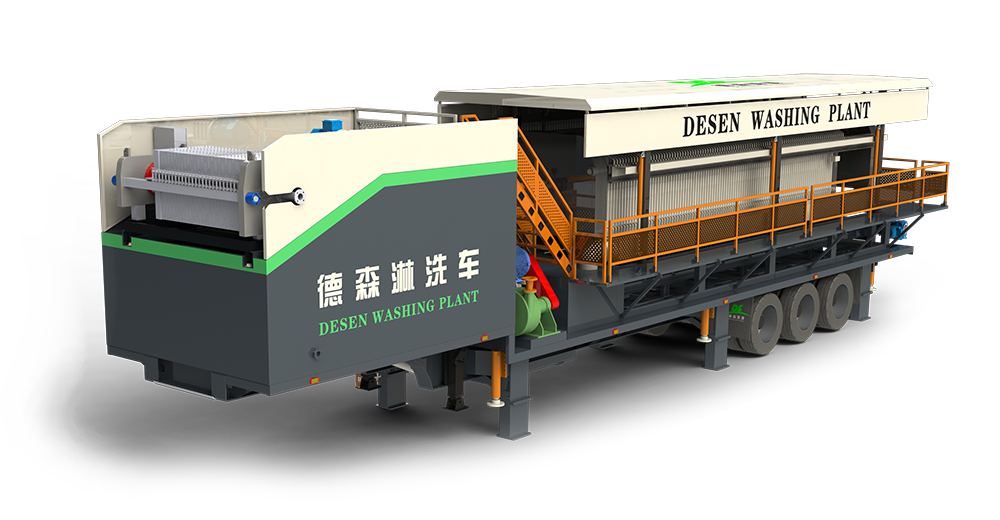
From there the washed sand goes to a dewatering screen, while the slimes and wash water report to a thickener and filter press. Water is clarified and returned to the front of the plant. The result is a closed loop that produces dry, stackable sand, a compact filter cake and almost no fresh water demand.
Technical Advantages
- Recovered products. Clean sand can be sold for concrete aggregate, backfill or block making instead of sitting in a dam.
- Smaller tailings footprint. Removing the sand fraction can cut the volume sent to storage by 30 to 50 percent, extending dam life without new construction.
- Water recovery. A well-run tailings washing plant recycles 90 percent or more of its process water, which matters where make-up water is scarce.
- Modular and relocatable. Skid-mounted units scale with the operation and move between pits or campaigns.
Case Study: Reclaiming Sand from a Tungsten Tailing Stream
At a tungsten processing plant in southern China, the tailings stream averaged 45 percent recoverable sand by dry weight, but the material had been pumped to the dam for years. Desen Environment installed a modular tailings washing and classification line rated at 50 tonnes per hour. Within the first season the plant recovered clean sand that met local concrete aggregate specifications, reduced the volume going to the tailings dam by close to a third, and held water recovery above 90 percent. The sand sales covered the operating cost of the line, turning a liability into a modest profit centre.
FAQ
How much sand can be recovered from a typical tailings stream?
It depends on the ore and the grinding circuit, but recoverable sand of 30 to 50 percent by dry weight is common. A laboratory screen analysis of the slurry tells you the realistic ceiling before you commit to equipment.
Can the plant handle very fine slimes?
Yes. The slimes side runs through a thickener and filter press, producing a dry cake that can be co-disposed with the remaining tailings or used for backfill.
What about process water?
Clarified water returns to the front of the tailings washing plant, so make-up demand stays small. In arid regions this is often the deciding factor.
Is the equipment suitable for existing operations?
Yes. The modular skid-mounted layout connects to existing slurry lines, and Desen Environment can size the line to match your current tailings tonnage.
Tailings are not a waste stream; they are an under-processed resource. Zhengzhou Desen Environmental Technology has applied this thinking on mining projects across China and beyond, delivering tailings washing equipment that pays its own way. If your operation is pumping saleable sand into storage, ask the Desen Environment team at materialwashing.com for a classification test and a payback calculation.
上一篇:Mobile Screening for Construction Waste
下一篇:没有了!