Hot Water Soil Washing Equipment for Oil Contaminated Soil: A Selection Guide
Hot water soil washing equipment treats oil contaminated soil fast and cost-effectively. Selection guide and project data from Desen Environment.
Hot Water Soil Washing Equipment for Oil Contaminated Soil: A Selection Guide
Oil does not soak into soil the way water does. It clings, spreads along grain surfaces, and over time turns into the weathered, sticky mess that makes remediation contractors quote cautiously. Hot water soil washing attacks exactly that problem: heat drops the viscosity of the oil, a surfactant lifts the film off the particles, and mechanical scrubbing finishes the job. The result is a fast, cost-effective route for fuel oil, diesel and light crude contamination, without the energy bill of thermal desorption. This guide explains how the process works, where it makes sense, and what to check before buying hot water soil washing equipment.
Technical Principle: Why Heat Changes the Game
Cold water can rinse sand, but it struggles with anything that has weathered into the pore structure. Raise the wash water to 60 to 90 degrees Celsius and the picture changes. Heat thins the oil, so it stops behaving like a tar and starts behaving like a liquid that surfactants can reach. The washing train itself looks familiar: screening, attrition scrubbing, classification, dewatering and closed-loop water treatment. The difference sits in the heating system, the reagent dosing and the residence time in the scrubber.
For heavy fractions that have bonded to silt and clay, the combination of hot water and surfactant does what cold washing cannot. The oil film detaches from the grain surface, the fines are classified out, and the clean sand fraction exits as reusable material. The oily concentrate moves to dewatering, and the wash water is clarified and recycled, typically at rates above 90 percent.
Technical Advantages: Where Hot Water Washing Earns Its Keep
Compare the options and the middle ground becomes obvious. Thermal desorption removes almost anything but burns through energy and capital. Bioremediation is cheap but slow, and heavy concentrations stall it. Hot water soil washing equipment sits between them: faster than biology, far cheaper to run than a 300-degree kiln, and proven on real projects.
- Energy use stays modest. Heating water to 60-90 degrees costs a fraction of vapourising soil at 300-550 degrees.
- Volume reduction is immediate. The contaminated fines shrink to a small concentrate while 60 to 80 percent of the feed becomes reusable sand.
- Endpoints are controllable. Every batch is sampled, so the contract target is verified before backfill rather than hoped for.
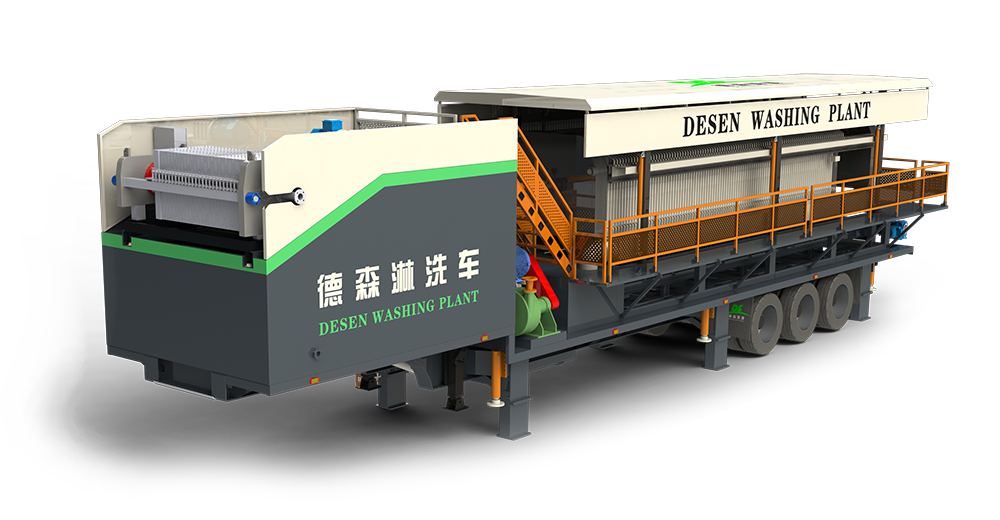
- Deployment is quick. Skid-mounted and trailer units arrive ready to run, which suits short excavation windows.
None of this means hot water washing is universal. Heavily weathered bitumen and very strict targets may still need a polishing step, and that is a normal part of the treatment train, not a failure of the equipment.
Equipment Selection: What Actually Decides the Price and Performance
Buyers tend to focus on throughput first, and that is a mistake. The questions that decide whether a hot water soil washing plant works are simpler: what fraction of the feed is clay, how weathered is the oil, and how hot does the water need to run for this specific soil? Desen Environment runs a bench-scale test on site samples before sizing anything, because the same machine that clears diesel from sand at 30 t/h may drop to half that on sticky clay.
Configuration matters too. A fixed plant suits a permanent treatment centre, while a modular or mobile line suits a one-season campaign. Zhengzhou Desen Environmental Technology Co., Ltd. supplies both, with the same scrubbing, classification and water-treatment stages packaged differently. Process data and equipment specifications are published on materialwashing.com.
Case Analysis: Diesel-Contaminated Clay in a Tight Window
On a refinery project in the Middle East, Desen Environment faced roughly 28,000 tonnes of diesel-contaminated clay with a six-month deadline. The solution combined hot water washing for the bulk volume with thermal desorption for the fine tailings. The washing line processed about 30 tonnes per hour, and the clean fraction, roughly 72 percent of the total, was returned to the site as backfill. Independent sampling confirmed TPH below 500 mg/kg, the contract target. The lesson was not about the hardware; it was about matching the heat and reagent to the soil before the plant ever arrived.
FAQ: Hot Water Soil Washing Questions We Hear Most
Is hot water soil washing the same as thermal desorption? No. Thermal desorption vapourises hydrocarbons at 300 to 550 degrees; hot water washing loosens them at 60 to 90 degrees. The energy cost per tonne is far lower.
Which oils respond best? Diesel, fuel oil, gasoline-range compounds and light crude wash well. Heavily weathered tars and asphaltenes usually need a polishing step afterwards.
Does the plant need a big water supply? No. The closed-loop circuit recycles most of the process water, which is a real advantage on remote or arid sites.
How do I know the right temperature and reagent for my soil? Send samples for a bench-scale test. Desen Environment runs these before any proposal, and the result tells you whether one pass will reach the target or whether a polishing step is needed.