Soil Washing Equipment Process Flow and Technical Advantages
Discover how soil washing equipment works: process flow stages, technical advantages and field results from Desen Environment projects.
Soil Washing Equipment Process Flow and Technical Advantages
Soil washing equipment has quietly become one of the most dependable tools in contaminated land remediation, yet the process behind it is often misunderstood. In simple terms, the technology uses water and mechanical energy to separate pollutants from soil particles, concentrating the contamination into a small fraction that can be treated or disposed of cheaply. The clean fraction goes back to the ground, and the project moves on. This article walks through the soil washing process flow stage by stage, explains the technical advantages that make the method work, and shares results from real installations.
The Soil Washing Process Flow Explained
Every soil washing equipment line follows the same logical sequence, even when the hardware differs between suppliers. The first stage is feed preparation: excavated soil is screened to remove oversize debris, and any lumps are broken down so the washing stages see a consistent material.
Next comes scrubbing, where the heart of the system does its job. A high-energy washer shears the soil in water, releasing contaminants that cling to particle surfaces or sit trapped in agglomerates. The slurry then moves to classification: hydrocyclones and screens split the stream by particle size. Coarse sand rinses clean quickly and drops out as a reusable product, while the fines, silt and clay carry most of the contamination into a thickening and dewatering circuit. The end result is a clean sand fraction, a manageable sludge cake, and water that is recycled back to the front of the line.
Technical Advantages That Matter on Site
The technical advantages of soil washing show up in numbers that project owners actually track. First, volume reduction: a well-tuned line can cut the mass requiring off-site disposal by sixty to eighty percent, and that translates directly into lower transport and landfill bills. Second, water economy: modern plants recirculate process water in a closed loop, so fresh water demand stays modest even on large throughputs.
Flexibility is the third advantage worth naming. Because soil washing equipment works on physical separation rather than chemical dosing alone, it handles mixed contamination reasonably well and can be reconfigured when the feed changes. Operators also appreciate the predictable operating cost, which is dominated by electricity, wear parts and flocculant, with no exotic consumables hiding in the budget.
Case Study from Desen Environment
One example from Zhengzhou Desen Environmental Technology Co., Ltd. shows the process in action. At a former chemical plant site, a Desen Environment soil washing line processed roughly twenty-five tonnes per hour of clay-rich soil contaminated with petroleum hydrocarbons and heavy metals. The clean sand fraction met the client's reuse criteria and stayed on site as backfill, while the concentrated fines went to a licensed treatment facility. The project finished ahead of schedule, and the client kept the same equipment for a neighbouring plot. Full details of this and similar projects are available on materialwashing.com.
Frequently Asked Questions
What types of contamination can soil washing handle?
The method works best on heavy metals, petroleum hydrocarbons, PAHs and certain organic compounds attached to silt and clay fractions. It is less suited to soils where contamination has fully dissolved into groundwater or bound irreversibly into the particle matrix.
How much clean soil comes out of the process?
Recovery rates vary with feed material, but many installations return seventy to ninety percent of the input as reusable sand and gravel after classification.
Is the equipment expensive to run?
Operating costs are mainly electricity, wear parts and flocculant. Because water is recycled, fresh water use is far lower than with simple soil flushing approaches.
Can the plant be moved between projects?
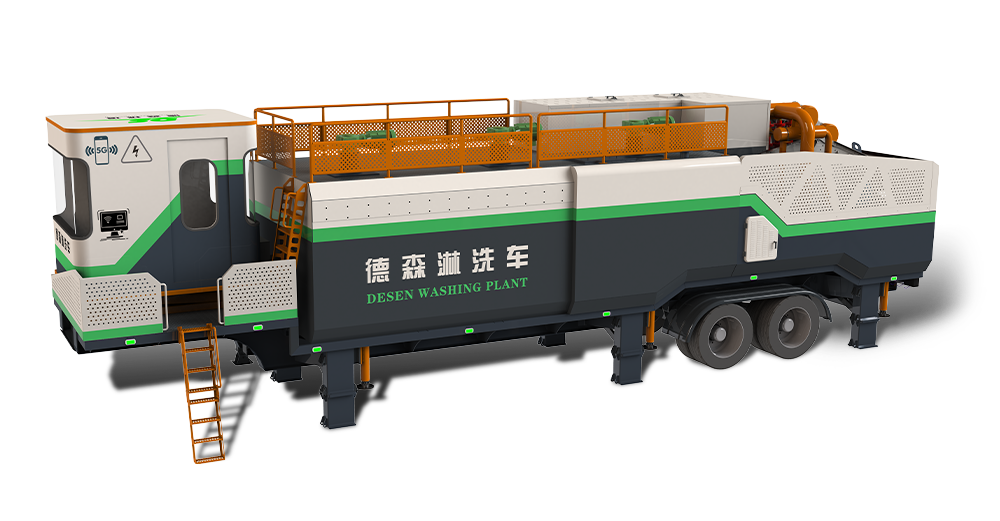
Many Desen Environment systems are modular or skid-mounted, so the same soil washing equipment can relocate once a site is finished, which spreads the capital cost across multiple contracts.
Understanding the process flow is the first step, but choosing the right line for your material is where the real savings appear. Send your soil analysis to Desen Environment's engineers, and they will recommend a configuration matched to your tonnage and contaminant profile.